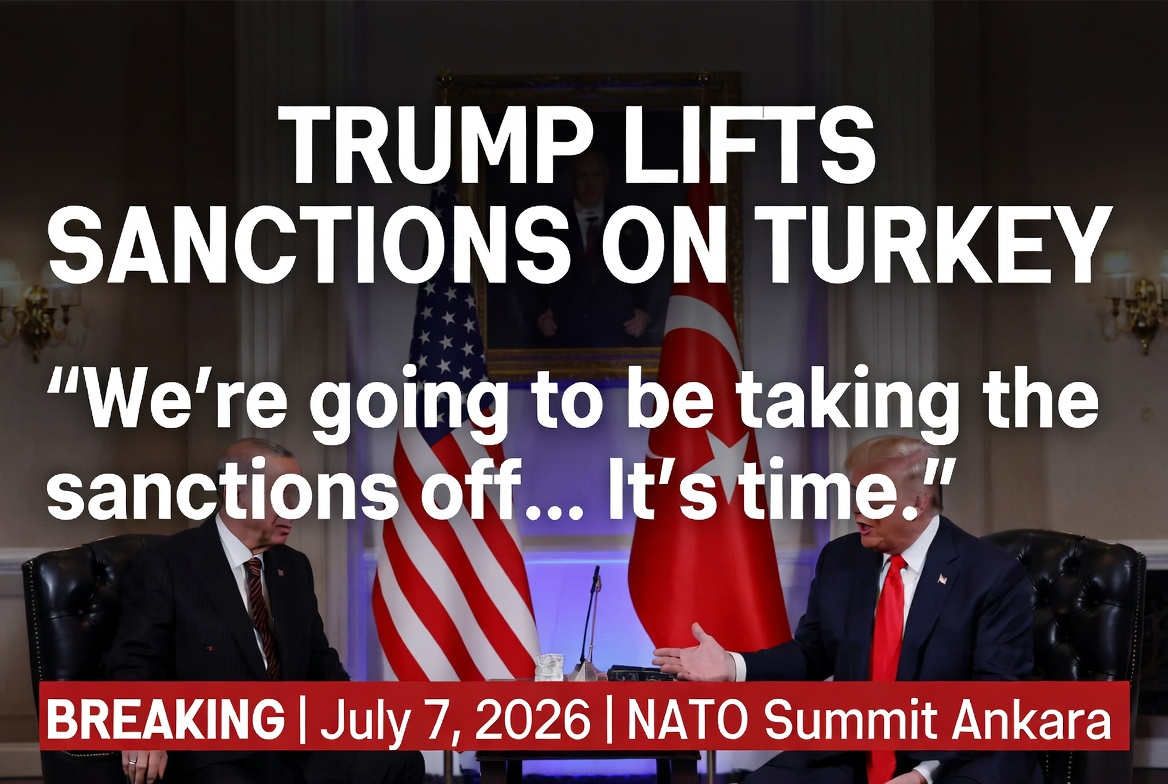
ANKARA, TURKEY July 7, 2026 – President Donald Trump announced Tuesday that the United States will lift sanctions on Turkey imposed under the Countering America’s Adversaries Through Sanctions Act (CAATSA), declaring during a bilateral meeting with Turkish President Recep Tayyip Erdoğan, “We’re going to be taking the sanctions off… It’s time. We don’t want to sanction friends.”
The announcement came during Trump’s visit to Ankara for the NATO summit, hosted by Turkey. A video clip of the moment, shared by the White House rapid response account, shows Trump speaking alongside Erdoğan and his wife, Emine Erdoğan, in a formal setting with U.S. and Turkish flags visible.
The sanctions were imposed in December 2020 under CAATSA Section 231 after Turkey purchased Russia’s S-400 air and missile defense system in 2019, despite repeated U.S. warnings. The move was seen as a significant transaction with Russia’s defense sector, providing Moscow with funds and potential intelligence access.
As a direct consequence, the U.S. removed Turkey from the multinational F-35 Joint Strike Fighter program in 2019. Turkish personnel were ordered to leave U.S. training facilities, and Turkey was barred from receiving the advanced stealth fighters it had ordered and partially paid for. The sanctions specifically targeted Turkey’s Presidency of Defense Industries (SSB) and its officials.
Trump’s remarks also opened the door to reconsidering F-35 sales to Turkey, a long-standing goal for Erdoğan. While lifting the CAATSA sanctions would remove a major legal and diplomatic obstacle, significant hurdles remain — including congressional restrictions and security concerns over the ongoing presence of the S-400 system.
“We don’t want to sanction friends,” Trump emphasized, framing the decision as a pragmatic step to strengthen ties with a key NATO ally.
The announcement occurred as NATO leaders gathered in Ankara for a two-day summit focused on defense spending, burden-sharing, and regional security issues. Turkey, a NATO member since 1952, has often been a point of tension within the alliance due to its purchase of Russian equipment and regional policies.
Analysts note that reintegrating Turkey more closely into Western defense structures could serve U.S. strategic interests by reducing Ankara’s reliance on Russian technology and maintaining leverage within the alliance.
The White House rapid response team posted the video clip shortly after the meeting, highlighting Trump’s direct statement on lifting the sanctions.
Reactions have been mixed. Supporters view the move as realistic statecraft aimed at keeping Turkey aligned with the West rather than drifting toward Russia. Critics argue it rewards a NATO ally that has pursued independent policies, including the S-400 acquisition and other regional actions.
This development marks a notable shift in U.S.-Turkey relations under the current administration and could reshape defense cooperation in the coming months, pending further legal and diplomatic steps.
About The Author