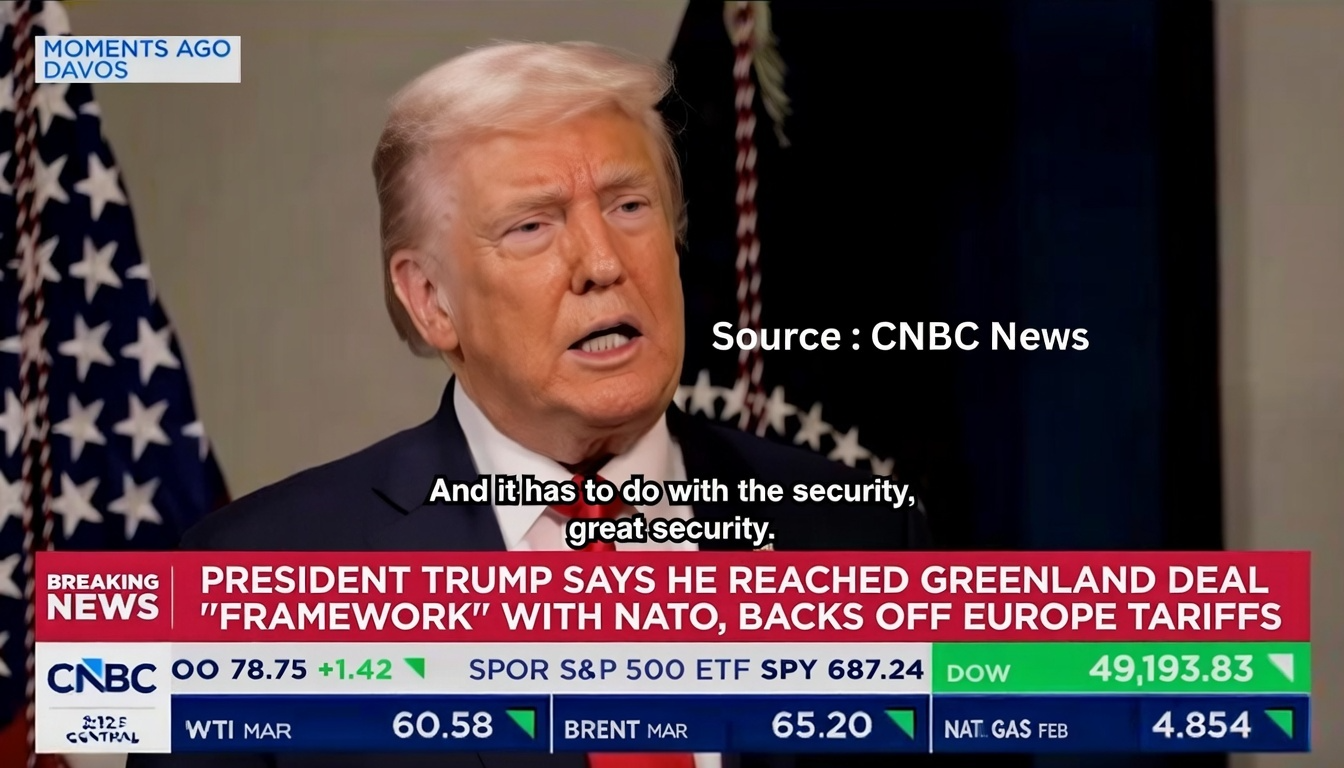
DAVOS, SWITZERLAND January 21, 2026 – President Donald J. Trump declared on Wednesday that he has reached a “framework of a future deal” concerning Greenland following discussions with NATO Secretary General Mark Rutte at the World Economic Forum in Davos. This announcement comes amid heightened tensions over Trump’s push for U.S. control of the Danish territory, which he described as essential for Arctic security and resource access.
In a post on Truth Social, Trump stated, “Based upon a very productive meeting that I have had with the Secretary General of NATO, Mark Rutte, we have formed the framework of a future deal with respect to Greenland and, in fact, the entire Arctic Region.” He added that, as a result, he would not impose the tariffs on European goods scheduled for February 1, which had been threatened against eight NATO allies opposing his Greenland ambitions.
During a CNBC interview from Davos, Trump elaborated, saying, “We have a concept of a deal… a very good deal for the U.S.” He emphasized its long-term nature, calling it “forever” and comparing it favorably to past agreements like the Iran nuclear deal. The framework reportedly includes provisions for missile defense systems, such as a “Golden Dome,” and access to Greenland’s mineral resources, while addressing security concerns in the Arctic against rivals like Russia and China.
Trump ruled out the use of military force to acquire the island, stating in his Davos speech, “I won’t use force,” but reiterated the strategic importance of Greenland for the U.S. and its allies. “It’s the United States alone that can protect this giant, massive land… and make it so that it’s good for Europe and safe for Europe,” he said.
Reactions were mixed. Supporters hailed it as a diplomatic win, with Trump claiming the deal satisfies “everybody.” However, critics, including European officials, expressed skepticism. Danish leaders have repeatedly asserted that Greenland is not for sale, and Greenland’s Prime Minister reiterated this stance, pointing to the island’s self-governance and a 2021 ban on uranium mining. Former NATO ambassador Kurt Volker noted that the “framework” may simply restate existing agreements from 1951.
Analysts warn that the episode has strained transatlantic relations. “The damage has been done,” said one European diplomat, citing fears of ruptured alliances. Markets reacted positively, with a surge in stocks following the tariff reversal.
Details of the framework remain sparse, with Trump indicating they will be released as finalized. Greenland, with its vast ice-covered landscape and strategic position, has long been a point of U.S. interest, hosting American military bases under prior pacts.
This development marks a pivot from Trump’s earlier aggressive rhetoric, including demands for “immediate negotiations” on acquisition. As negotiations proceed, the focus shifts to whether this “concept” evolves into concrete policy or remains a symbolic gesture.
About The Author