Source : BRICS NEWS
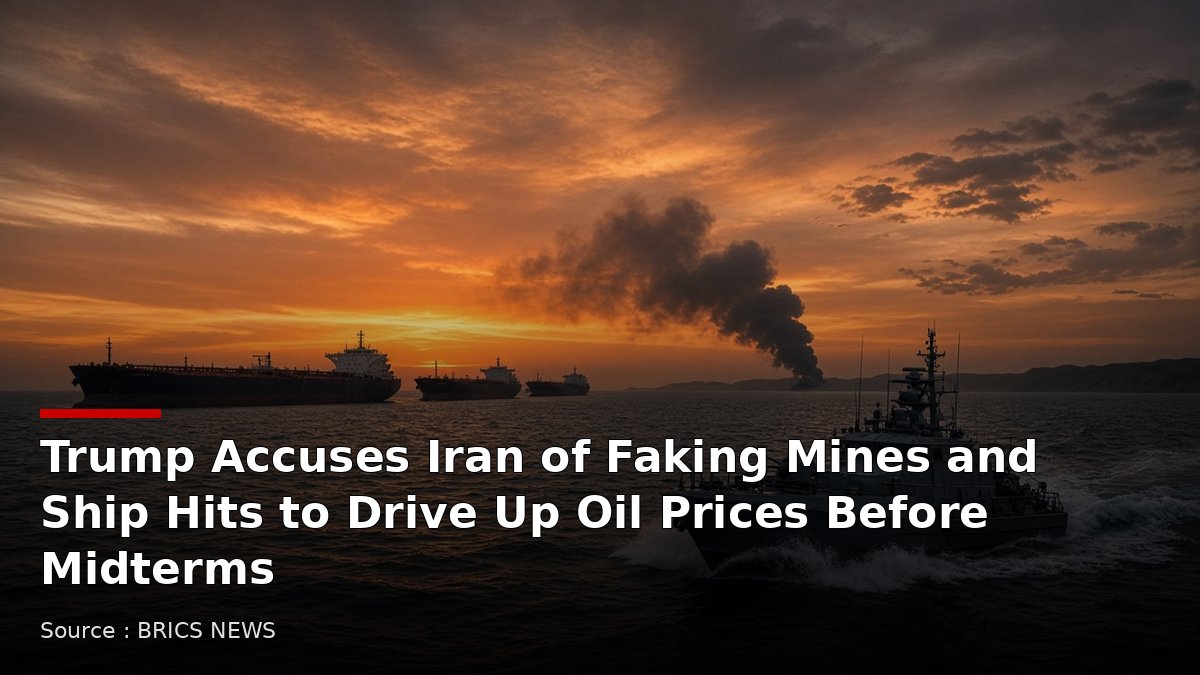
WASHINGTON, October 22, 2026 – US President Donald Trump has accused Iran of fabricating reports of mine strikes and attacks on ships in the Strait of Hormuz in a bid to push up global oil prices before the US midterm elections, BRICS News reported.
BRICS News carried the remarks in a post on X, saying the president claimed Iran was “faking mines and hits to drive up oil prices before the US midterms”.
The president’s claim directly challenges Tehran’s account of events in one of the world’s most important energy chokepoints. The Strait of Hormuz, which links the Gulf to the Gulf of Oman and the Arabian Sea, normally carries around a fifth of global oil consumption, meaning any disruption there quickly feeds into world prices.
Trump made the accusation in a post on his Truth Social platform on October 22. “Iran is doing everything they can to drive up the price of Oil prior to the U.S. Midterm Election. They are even making up fake hits, mines, and everything else, because more Oil is coming through the Hormuz Strait now than it did even prior to the beginning of the Conflict,” he wrote. In the same post, Trump called the Islamic Republic an “Evil Regime” and repeated that “IRAN CAN NEVER HAVE A NUCLEAR WEAPON”.
The president’s comments followed a report on Iranian state television, carried by Reuters, that seven vessels had been hit in the Strait of Hormuz. Quoting the Islamic Revolutionary Guard Corps (IRGC), the report said four vessels were struck while carrying out ship-to-ship transfers, while another three hit mines.
According to the IRGC claims, the vessels were on the southern route through the strait along the Omani coast. The Revolutionary Guard also warned that it may target US bases in the region. Independent confirmation of the incidents was not immediately available, and Tehran has not publicly responded to Trump’s accusation that they were fabricated.
The incidents come almost eight months into the conflict, which began on February 28. In a separate escalation, CBS News reported that a Houthi attack on King Fahd International Airport in Dammam, Saudi Arabia, killed at least two people. Iran has also continued to ship cargoes through the strait, exporting about 4.1 million barrels of liquefied petroleum gas since the US blockade began, Reuters reported, according to Iran International.
Oil markets reacted sharply. Brent crude rose by about 3 to 4 per cent on October 22 to around US$112–113 a barrel, its highest level since May 18, according to CBS News, while US crude climbed to US$99.80.
Energy prices have become a key political issue in the United States ahead of the November 3 midterm elections, with Trump insisting that more oil is now passing through the Strait of Hormuz than before the conflict began. Analysts say the reported attacks and the threat to US bases could keep markets on edge in the weeks before the vote.
Ship-to-ship transfers, in which cargo is moved between vessels at sea, are commonly used to consolidate oil shipments, and have been a feature of tanker traffic in the region during the conflict. Neither the United States nor the governments of the vessels’ flag states had publicly confirmed the IRGC’s account at the time of writing.
About The Author