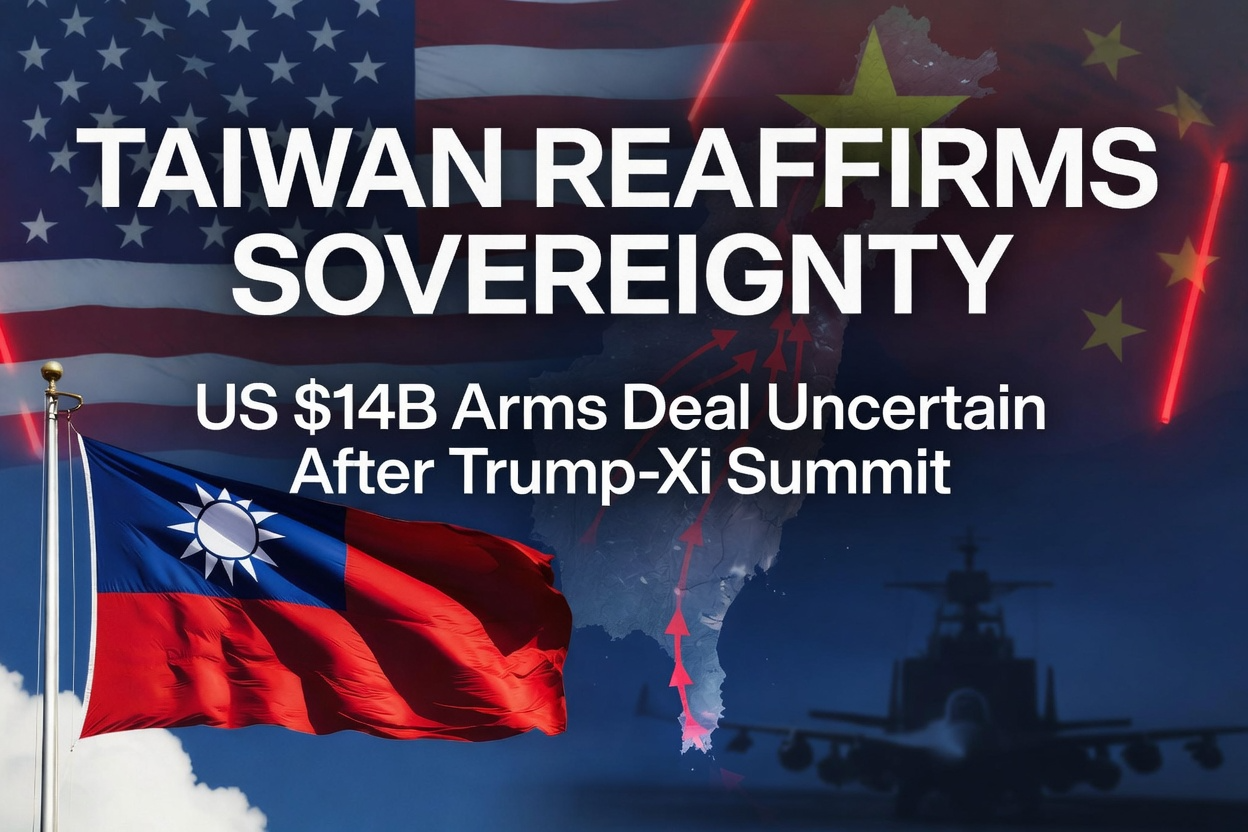
TAIPEI, TAIWAN May 16, 2026 — Taiwan’s government on Saturday declared itself a “sovereign and independent democratic nation” not subordinate to China, pushing back against Beijing’s claims while stressing the importance of continued U.S. arms sales for regional stability. The statement comes after U.S. President Donald Trump expressed indecision on a $14 billion weapons package to Taipei following his summit with Chinese President Xi Jinping in Beijing.
In a press briefing at the Presidential Office, a Taiwanese official highlighted the longstanding U.S.-Taiwan security partnership under the Taiwan Relations Act. “We want to emphasise that the Republic of China is [a sovereign nation],” she stated, underscoring that U.S. arms sales serve as a “joint deterrent against regional threats” and contribute to peace and stability in the Taiwan Strait and Indo-Pacific.
The official added that such cooperation is “not only as explicitly stated in the Taiwan Relations Act, but also [key] to working with global democratic partners.”
Trump, speaking aboard Air Force One after two days of talks with Xi, said he had not yet decided on the arms sale — one of the largest proposed packages — and would make a determination soon. He indicated the decision could depend on China’s actions and expressed a desire for both sides to “cool down” rhetoric, while noting the high costs of potential conflict far from U.S. shores.
China maintains that Taiwan is part of its territory and has opposed U.S. arms sales, while pledging deeper security cooperation with Washington. Taiwan rejects Beijing’s sovereignty claims.
Taiwan’s Foreign Ministry reiterated that U.S. policy toward the island remains unchanged and appreciated Trump’s past support for cross-strait peace. It emphasized that arms sales are a cornerstone of deterrence under U.S. law.
The $14 billion package, approved by lawmakers earlier, has been in limbo as the Trump administration weighs its next steps amid broader U.S.-China engagement. Bipartisan voices in Congress have urged approval to bolster Taiwan’s self-defense capabilities.
The developments underscore ongoing tensions in the Taiwan Strait, where military posturing and geopolitical maneuvering continue to shape regional dynamics.
About The Author