
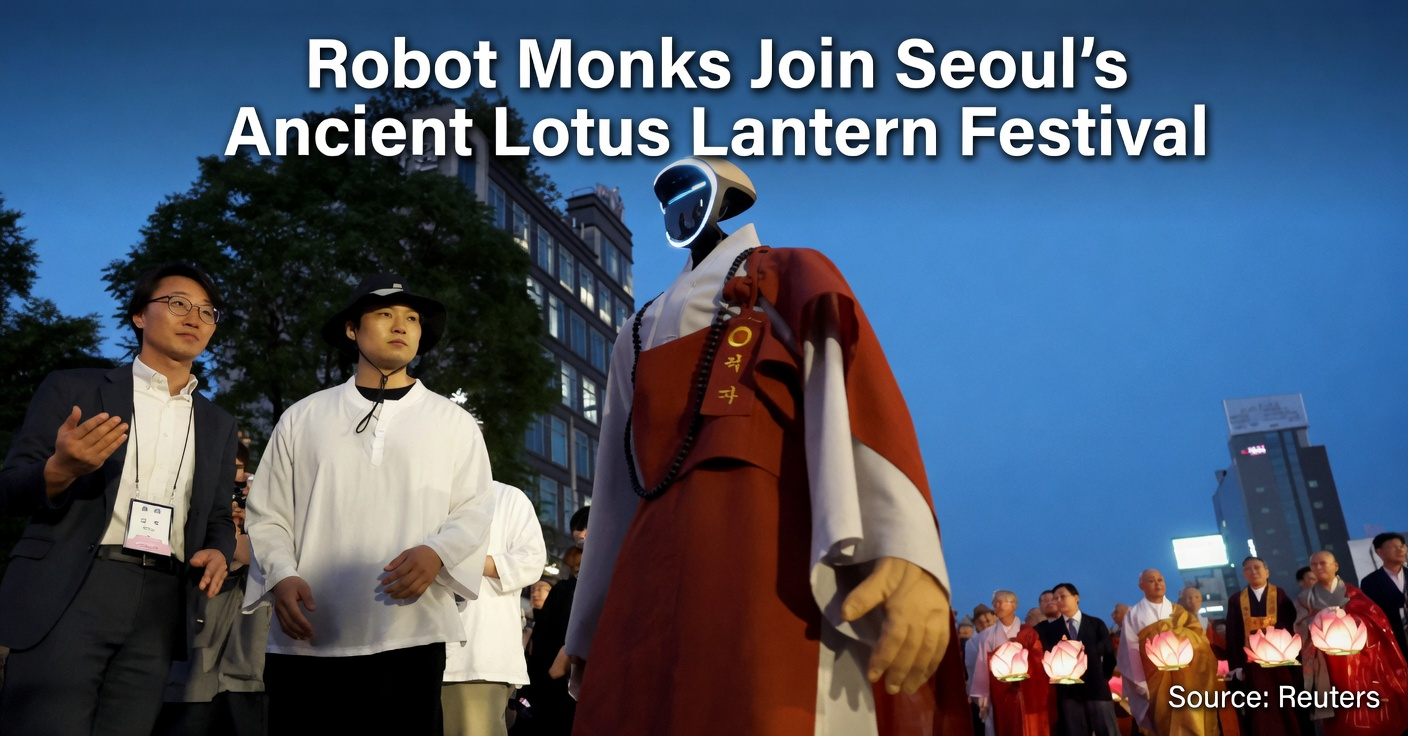
SEOUL, SOUTH KOREA May 16, 2026 — Humanoid robots dressed as Buddhist monks took part in South Korea’s renowned Lotus Lantern Festival (Yeondeunghoe) on Saturday, marching through the streets of Jongno district alongside thousands of participants celebrating Buddha’s birthday.
The four robots — Gabi, Seokga (or Seokja), Mohee, and Nisa — wore traditional monastic robes and carried glowing lotus lanterns as they joined the 1,300-year-old procession. Crowds lined the streets, many holding nearly 100,000 handmade lanterns, creating a vibrant display of light and color.
Gabi, a 130 cm (51-inch) tall humanoid robot based on China’s Unitree G1 platform, led the way as South Korea’s first honorary robot monk. It received its Dharma name and took modified Buddhist precepts during a special ceremony at Jogyesa Temple on May 6. Instead of traditional incense burning, organizers placed a festival sticker on its arm to protect its electronics.
The robot’s “birth” date is listed as March 3, 2026 — the day it was built — and its vows include promises to respect life, listen to humans, save energy (avoid overcharging), and refrain from deception.
Festival organizers from the Jogye Order, South Korea’s largest Buddhist sect, described the inclusion of robots as a way to embrace modern technology while keeping ancient traditions alive. “Buddhism is about embracing and accepting everything,” said Venerable Jin-Yong, the festival’s executive director. “So why not include robots in our parade?”
The event drew mixed reactions online, with some praising the innovative fusion of faith and tech, while others questioned whether machines could truly participate in spiritual practices.
The Lotus Lantern Festival continues the celebrations leading up to Buddha’s Birthday on May 24, with more events planned at Jogyesa Temple. Gabi and the other robots are expected to make additional appearances during the festivities.
This year’s parade highlights South Korea’s unique position as a global leader in both robotics and Buddhist heritage, offering a striking visual of the country’s efforts to bridge the ancient and the futuristic.
About The Author