
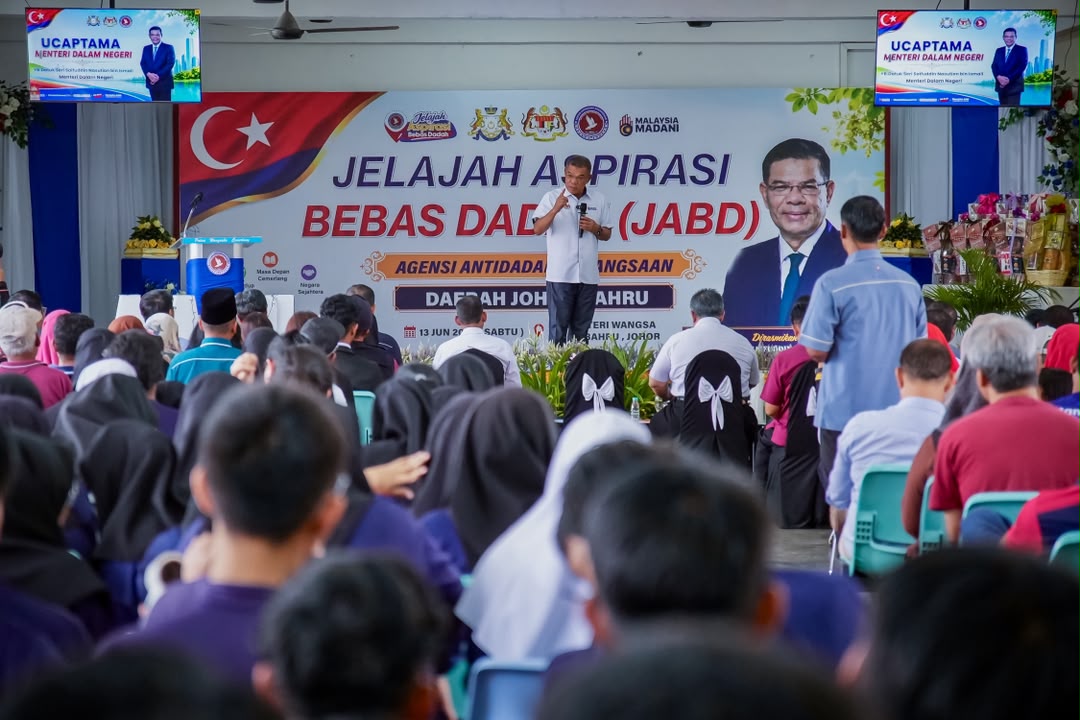
JOHOR June 13, 2026 – The Malaysian government is intensifying its anti-drug efforts through the Jelajah Aspirasi Bebas Dadah (Drug-Free Aspirations Tour), an outreach programme aimed at prevention and raising public awareness, said Home Minister Datuk Seri Saifuddin Nasution Ismail.
The programme, organised by the National Anti-Drugs Agency (AADK), brings together school students, local community leaders, strategic partners, NGOs, and the Education Department to combat drug abuse at the grassroots level.
Speaking at the event, the minister highlighted that the initiative falls under AADK’s core functions of prevention, enforcement, as well as treatment and rehabilitation, with a strong emphasis on the prevention segment.
“Our goal is to widely disseminate information on the current drug abuse situation in the country,” Saifuddin said. “In Johor, the four districts with the highest rates are Mersing, Pontian, Kota Tinggi, and Segamat.”
He noted that national statistics show 192,000 individuals involved in drug abuse out of Malaysia’s 34.2 million population, equating to a rate of 560 per 100,000 people. The figure is derived from combined data from the Ministry of Health, private rehabilitation centres, AADK’s PUSPEN facilities, and the Narcotics Division.
Johor records 499 cases per 100,000 people, which is below the national average. However, Mersing stands out as particularly concerning with approximately 1,200 cases per 100,000 residents.
The minister stressed the government’s commitment, revealing that AADK receives an annual allocation of RM500 million and has about 5,000 personnel. The agency operates 30 PUSPEN (Cure and Care) centres nationwide, currently housing nearly 5,000 court-ordered clients. Additionally, around 50,000 individuals receive community-based rehabilitation support.
Saifuddin also highlighted recent amendments to the Drug Addicts Act, which encourage voluntary rehabilitation. Individuals who seek help voluntarily are not recorded as having a criminal history as drug addicts, aiming to reduce stigma and motivate more people to come forward for treatment.
“Private rehabilitation centres — now 47 across the country — are also regulated by AADK, allowing us to study and potentially adopt effective modules from them,” he added.
The minister emphasised that the government cannot tackle the drug problem alone and called for active participation from all segments of society.
“Programmes like this are part of our continuous calendar of activities. We have conducted similar outreach in Pahang, Kedah, Selangor, and the Federal Territories. Today, it is Johor’s turn,” he said.
The Jelajah Aspirasi Bebas Dadah is positioned as an ongoing, nationwide drive to strengthen prevention efforts and foster greater community involvement in creating a drug-free Malaysia.
About The Author