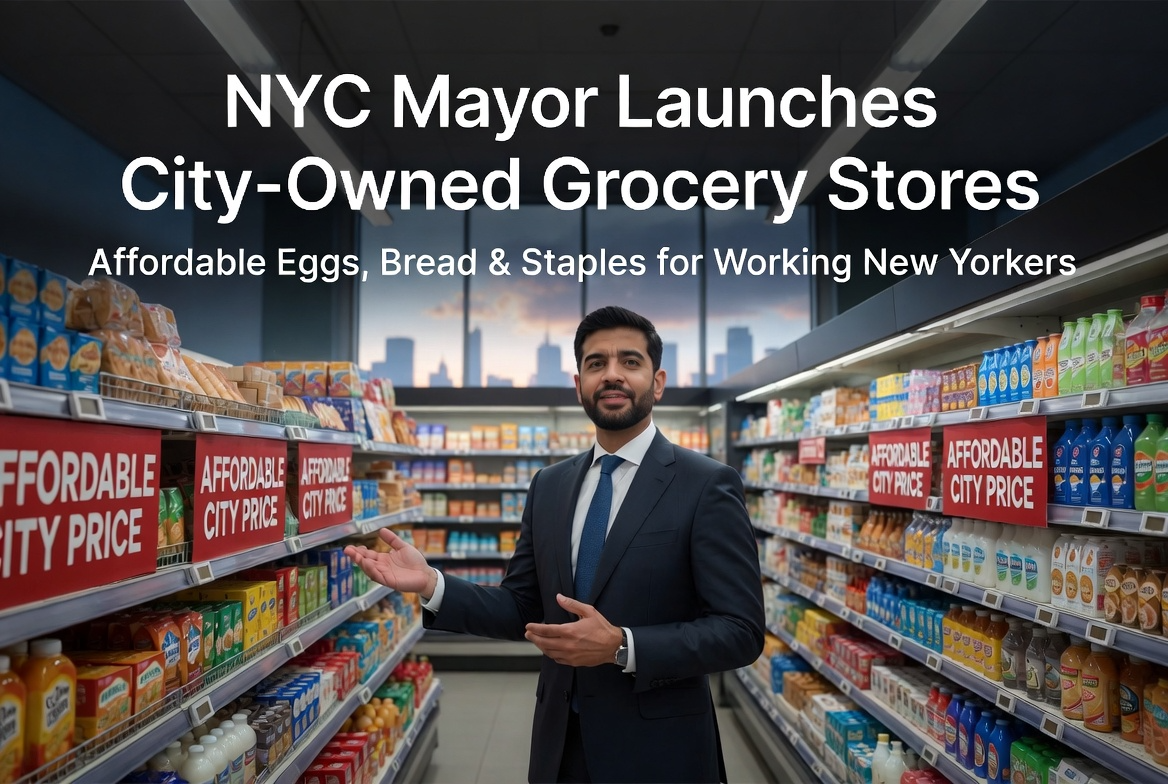
NEW YORK April 25, 2026 – Mayor Zohran Kwame Mamdani took to X (formerly Twitter) today to spotlight his administration’s ambitious plan for a network of municipally backed grocery stores, promising lower prices on everyday staples like eggs and bread while prioritizing fair wages and worker dignity.
In the post, which has garnered over 6,400 likes and 257,000 views within hours, Mamdani wrote: “At our city-owned grocery stores, staples like eggs and bread will actually be affordable. And we’re going to do it the right way, without cutting workers’ pay or dignity. Because in the wealthiest city in this country, buying groceries shouldn’t be an unsolvable equation. It should be simple, fair, and within reach for everyone.”
The mayor attached a video to the post emphasizing the initiative’s focus on working New Yorkers.
The announcement builds on Mamdani’s campaign pledge and earlier details released in mid-April. The city plans to open five public grocery stores — one in each borough — with the first site identified at La Marqueta in East Harlem. The 9,000-square-foot store will be built from the ground up on city-owned land at an estimated cost of $30 million and is slated to open by 2029. City officials have indicated the first store could open as early as late 2027, with all five operational by the end of Mamdani’s first term.
Under the model, the city will own the properties, eliminate rent and property tax expenses, and subsidize a core basket of essential goods. A private operator selected through a competitive process will run day-to-day operations but must adhere to city-set standards for pricing and labor. The goal: pass savings directly to consumers on items like milk, eggs, and bread while maintaining high worker standards.
“This is about delivering on promises kept and making sure New Yorkers can afford the basics,” Mamdani said in recent remarks at La Marqueta. “Healthy families and thriving communities start with accessible food.”
The plan has drawn both praise and sharp criticism.
Supporters, including some progressive advocates and community groups in food-insecure neighborhoods, view it as a bold response to rising grocery costs and corporate profiteering. One X user replied, “MAGA wants to have children starving, thank you for standing up for New Yorkers.”
Critics, however, warn the project could waste taxpayer dollars and harm small businesses. Local bodega owners and supermarket operators have expressed concern that tax-subsidized competitors — exempt from rent, taxes, and certain regulations — could undercut immigrant-run stores operating on razor-thin margins. Economists and fiscal watchdogs have highlighted the $30 million price tag for the first store, noting it far exceeds typical private-sector construction costs for a similar-sized market. Some have pointed to historical examples of government-run retail experiments facing empty shelves and ongoing subsidies.
One X commenter noted: “You’re spending 3 years & $30 million. You’ll need a taxpayer subsidy just to meet the price the free market already supplies!” Another added, “This will be an epic failure. It will be shoplifted out of existence.”
The mayor’s office has not yet released full details on projected ongoing operating subsidies or exact pricing targets beyond the subsidized core basket. City Hall says sites for the other four boroughs will be announced soon.
The initiative is part of Mamdani’s broader “affordability agenda” since taking office earlier this year. Supporters see it as innovative public intervention; detractors call it a return to failed socialist experiments.
Life News Agency will continue to monitor developments as the city moves forward with construction and operator selection. For now, New Yorkers are left wondering whether these taxpayer-funded markets will truly deliver lower prices — or simply add another line item to the municipal budget.
About The Author