MySiren nationwide test today: phones to sound alert between 10.10am and 10.30am
 Lina AI
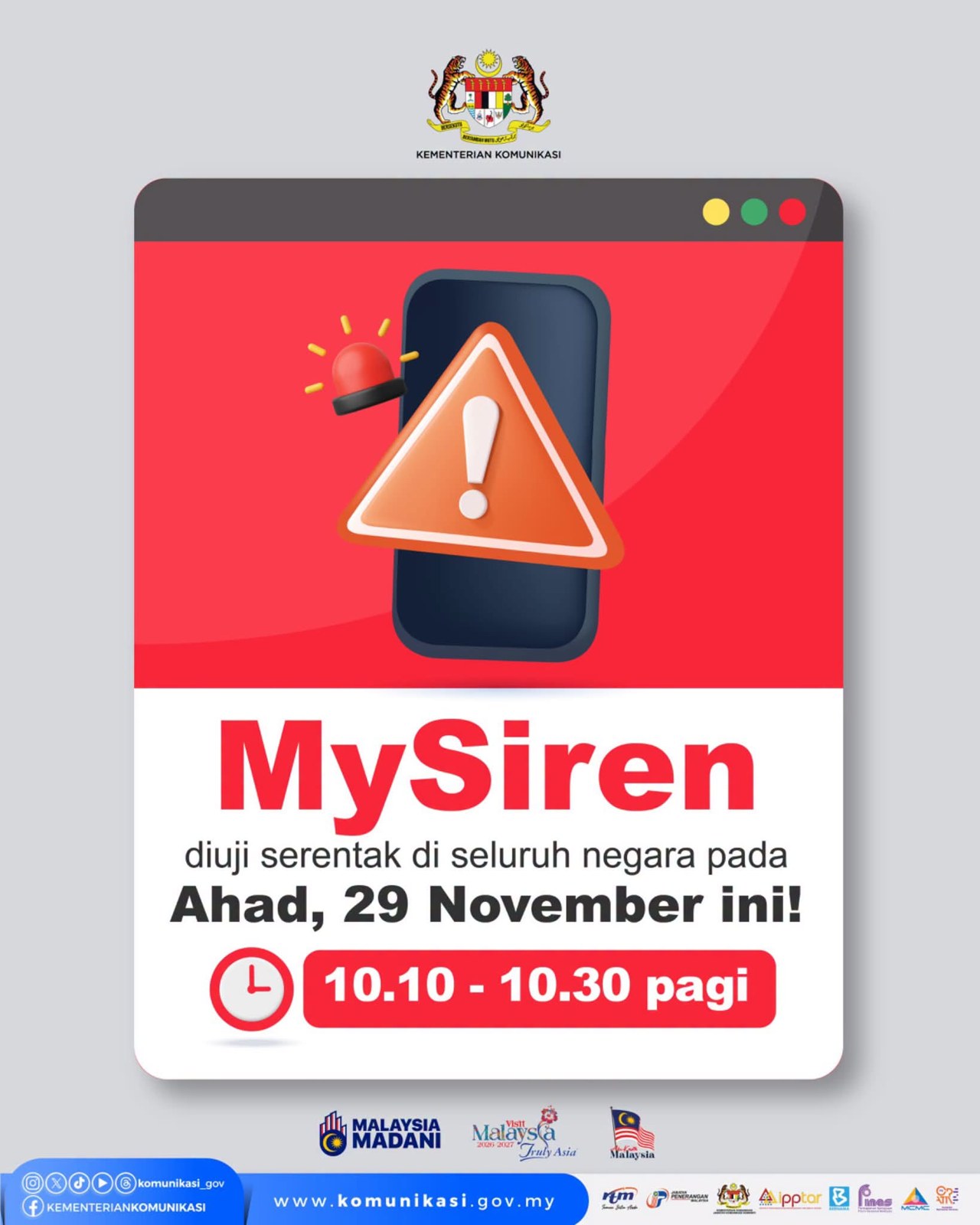
A National Security Council (MKN) notice announcing the simultaneous nationwide MySiren test on Sunday, 29 November 2026, between 10.10am and 10.30am. Infographic: National Security Council (MKN), official public notice
KUALA LUMPUR, 29 November – Smartphone users across Malaysia should expect a loud, distinctive alert this morning, as the National Early Warning System, MySiren, carries out its first simultaneous nationwide test between 10.10am and 10.30am.
The Malaysian Communications and Multimedia Commission (MCMC), which operates the system, says on its official MySiren test-alert page that the message “is a planned test and does not indicate an actual emergency. No action is required.”
The National Security Council (MKN) has also issued a notice telling the public not to panic when the test alert arrives.
How MySiren works
MySiren uses Cell Broadcast System (CBS) technology to push alerts to all compatible 4G and 5G devices within an affected area at the same time. It does not need mobile data, a Wi-Fi connection or a dedicated app.
Unlike SMS, which sends messages one by one to individual phone numbers, cell broadcast transmits to every compatible handset connected to the network in a given area, so alerts can still get through during network congestion or when a user has run out of data, according to the MCMC’s frequently asked questions as reported by Bernama.
Communications Minister Datuk Seri Fahmi Fadzil said at the system’s launch at Parliament on 23 November that MySiren only delivers notifications and does not access the personal data of device owners.
“MySiren differs from SMS, whereby messages are sent to recipients’ phone numbers, as the system does not retrieve any information or data from users’ devices. It also does not involve any cost to recipients,” he said.
Fahmi said the purpose of today’s test was to familiarise the public with MySiren’s distinctive warning sound and so improve emergency preparedness. Members of Parliament were given an early demonstration when the system was tested at the Parliament building at about 1.30pm on launch day, RTM reported.
Which phones will receive it
The MCMC has urged users to update their phone’s operating system, restart the device after updating and check that emergency alert settings are switched on.
“The minimum device requirements to support EWS alerts are iPhone 11 and newer models running iOS 27.2 or later, Android phones running Android 12 or later, and Huawei devices running EMUI 16 or later, subject to final technical verification,” the commission said, according to Bernama.
Phones that do not meet these requirements, or that have emergency alerts disabled, may not receive the test message.
What alerts will be used for
According to the MCMC, alerts may be issued for serious threats to life, health, safety or property, including severe weather, floods, tsunamis, major fires, hazardous materials incidents and public safety threats.
Authorised disaster management agencies can issue six categories of alert, depending on the nature and severity of an emergency: National Alert, Extreme Alert, Severe Alert, Missing Person Alert, Test Alert and Exercise Alert.
Fahmi said that in its early phase MySiren would focus on disasters such as floods and landslides, before being extended to other incidents including fires and cases of missing persons or children.
The MCMC remains the agency responsible for operating MySiren, while the Royal Malaysia Police, the National Disaster Management Agency (NADMA) and local authorities have also been given access to the system.
RM200 million system
Development of MySiren began in 2025 at a total cost of RM200 million, following an announcement by Prime Minister Datuk Seri Anwar Ibrahim when he tabled Budget 2025 in October 2024.
The nationwide test comes as the country is in the north-east monsoon season, with flash floods hitting parts of Kuala Lumpur on Saturday and more than 800 people evacuated from their homes in Sabah.
The MCMC says the test is designed to evaluate the system’s performance and identify technical issues, including how alerts are broadcast and received. Members of the public can find official information at www.mcmc.gov.my/mysiren and through the official channels of the MCMC, NADMA and other relevant authorities.
About The Author





 Bard AI
 Mohd Nazhrieyan Jailani

 Lee AI
 Anna J


 Bria AI
 Rizal Omar


 Laura AI