Source : @BernamaBiz
KUALA LUMPUR, November 7, 2026 – The Investment, Trade and Industry Ministry (MITI) has imposed provisional anti-dumping duties of between 4.41 per cent and 35.06 per cent on imports of certain flat-rolled steel products from China, Taiwan and Vietnam, with effect from Saturday, Bernama reported.
The ministry said the provisional duties, which will apply for up to 120 days, are needed to stop further injury to the domestic industry. The move follows a preliminary determination that found enough evidence to justify continuing the investigation.
Products covered
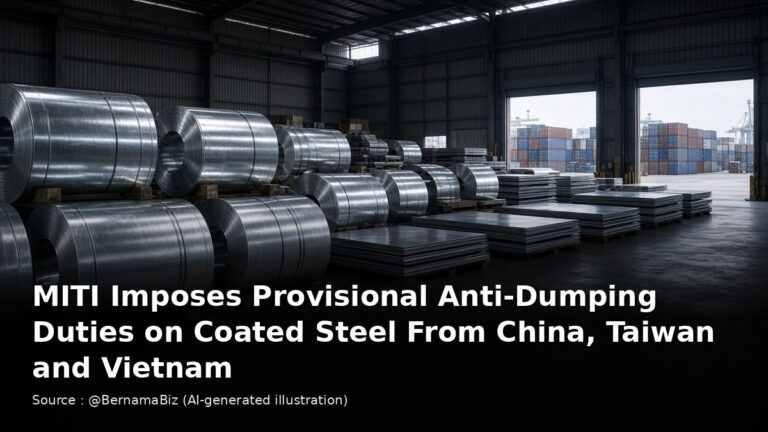
The investigation covers imports of flat-rolled products of other alloy steel and non-alloy steel that are plated or coated with aluminium and zinc, originating in or exported from the three economies.
Steel coated with an aluminium-zinc alloy is widely used in roofing, wall cladding, building panels and a range of construction and manufacturing applications, making it an important product for Malaysia’s construction sector.
Petition by NS BlueScope Malaysia
According to MITI’s statement, the anti-dumping investigation was launched on July 17, 2026, under the Countervailing and Anti-Dumping Duties Act 1993 (Act 504) and the Countervailing and Anti-Dumping Duties Regulations 1994.
It was started following a petition by NS BlueScope Malaysia Sdn Bhd on behalf of the domestic industry.
The petitioner claimed that the products were being brought into Malaysia at prices lower than their selling prices in their home markets, and that this had caused material injury to the local industry, MITI said.
Duties secured through guarantees
The ministry said the preliminary determination was completed under Section 23 of Act 504.
The government decided to impose provisional measures in the form of anti-dumping duties secured through guarantees equal to the dumping margins. This means importers must provide security covering the duty amounts while the investigation continues, rather than the duties being treated as final at this stage.
A final determination is expected no later than March 6, 2027, the statement said.
How anti-dumping rules work
Dumping occurs when goods are exported to another country at a price below their normal value, usually the price charged in the exporter’s home market. Under World Trade Organization rules, importing countries can impose anti-dumping duties to offset the effect when such imports cause or threaten material injury to their own industries.
Malaysia’s Act 504 sets out the process for these investigations, which typically involves a petition from the domestic industry, a preliminary determination and then a final determination. Provisional measures such as those announced on Saturday are intended to protect local producers while the full investigation is completed.
What it means for industry
For local steel makers, the provisional duties offer some relief from lower-priced imports while MITI completes its investigation. For importers and downstream users, such as construction firms and manufacturers that rely on coated steel, the measures could raise costs for the affected products from the three sources during the provisional period.
The steel sector in Southeast Asia has faced pressure in recent years from a surge in low-cost imports, and several governments in the region have turned to trade remedies to protect domestic producers.
The outcome of the final determination, due by early March next year, will decide whether the duties are confirmed, adjusted or lifted. Interested parties are generally given the chance to make submissions before a final decision is reached.
Source : Bernama
About The Author