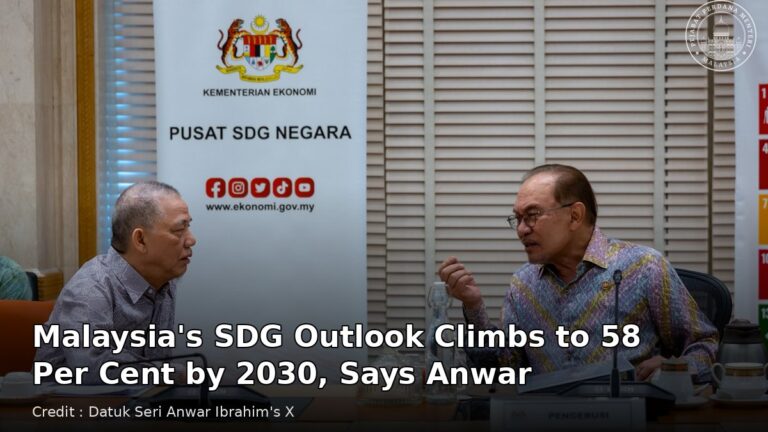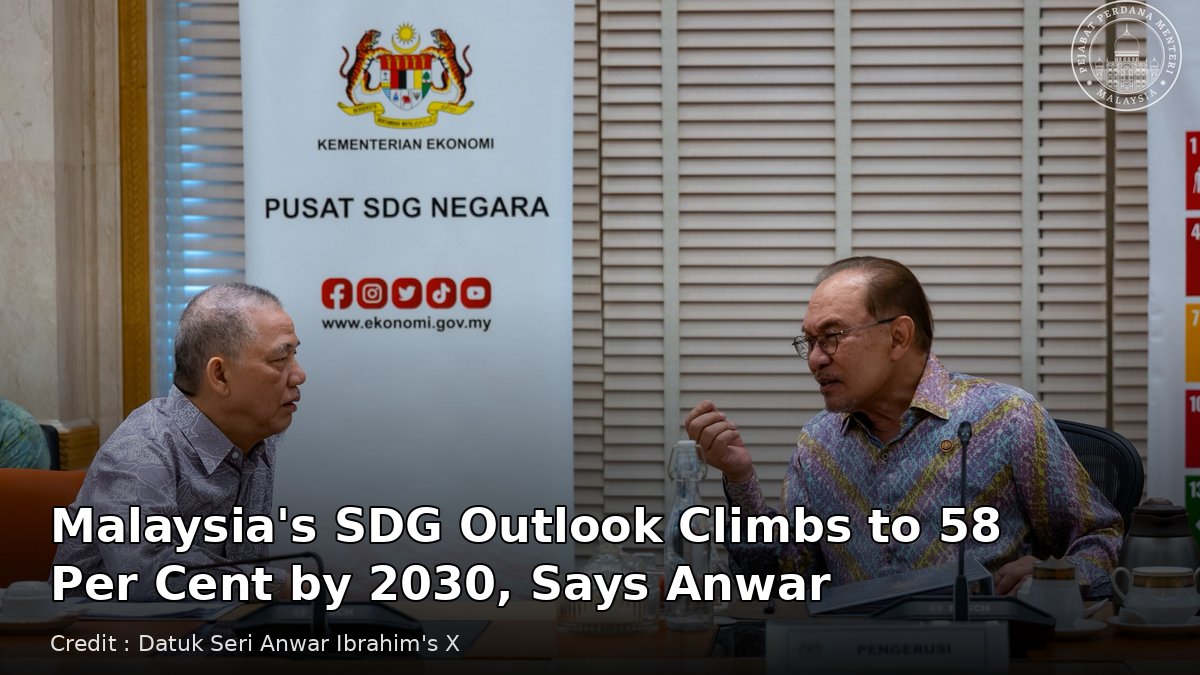
Credit : Datuk Seri Anwar Ibrahim's X
KUALA LUMPUR, October 22, 2026 – Malaysia is now projected to achieve 58 per cent of its Sustainable Development Goals (SDG) targets by 2030, up from the 49 per cent projection reported a year ago, Prime Minister Datuk Seri Anwar Ibrahim said today.
Anwar said the improved outlook was presented at the 2026 National SDG Council Meeting, which he chaired this morning to review the progress of SDG implementation across the country.
“This morning I chaired the 2026 National SDG Council Meeting, which reviewed the progress of the implementation of the Sustainable Development Goals (SDG) in Malaysia. Alhamdulillah, the country’s projected achievement has risen to 58 per cent by 2030, compared with 49 per cent last year,” he said in a post shared on X.
The post was accompanied by photographs of the meeting, showing the Prime Minister at the head of the council table alongside ministers and senior officials, with National SDG Centre (Pusat SDG Negara) and Ministry of Economy banners displayed in the meeting room.
https://x.com/anwaribrahim/status/2113137657870205294
The nine-percentage-point rise marks a notable jump from the figure announced at the 2025 council meeting on November 5 last year. At that meeting, Anwar said Malaysia’s projected achievement rate of 49 per cent by 2030 was far above the global average of around 18 per cent, according to reports by Bernama and The Star at the time.
Even then, the Prime Minister cautioned that much work remained, particularly under the nation’s 10 SDG Priority Areas. He pointed to issues ranging from child malnutrition, mental health and the management of students with special needs to employment opportunities for persons with disabilities, and stressed that progress required cooperation across the federal and state governments, the private sector and civil society so that no one is left behind.
The National SDG Council, led by the Prime Minister, is the main decision-making body for Malaysia’s SDG governance, setting the national direction, agenda and milestones. According to Malaysia’s 2025 Voluntary National Review (VNR) to the United Nations, the council is supported by an SDG Steering Committee chaired by the Minister of Economy, and a Technical Committee chaired by the Secretary-General of the Ministry of Economy, which draws up the country’s SDG roadmaps and monitors progress through seven working committees involving ministries, UN agencies, the private sector, civil society organisations and academia.
In that 2025 VNR, presented at the UN High-Level Political Forum, Malaysia estimated that 43 per cent of its targets were on track for 2030, compared with a global average of 17 per cent. The report noted that the SDGs have been systematically built into national planning since the Eleventh Malaysia Plan (2016–2020) and the Twelfth Malaysia Plan (2021–2025).
The United Nations has also acknowledged Malaysia’s comparatively strong progress. Speaking at the 5th Malaysia Sustainability Leadership Summit 2026, UN Resident Coordinator for Malaysia, Singapore and Brunei Darussalam Nikolas Myint said 58 per cent of the country’s targets were on track, while 29 per cent remained off track and 13 per cent lacked sufficient data to assess, as reported by Newswav. He urged governments, businesses and communities to move “from commitments to delivery” and “from pilots to scale”.
Globally, the picture remains far weaker. The Sustainable Development Report 2025 found that none of the 17 goals is currently on course to be achieved worldwide by 2030, with only 17 per cent of targets on track, although East and South Asia has recorded the fastest progress of any region since 2015.
The MADANI Government has said its SDG agenda moves in tandem with the 13th Malaysia Plan, with the aim of inclusive, sustainable and prosperous development for the country’s younger generation. With little more than three years left before the 2030 deadline, today’s upgraded projection suggests Malaysia is gaining ground, though the gaps highlighted under the priority areas are likely to remain the focus of the council’s work.
About The Author