Malaysia targets top-10 AI readiness by 2030 as MDEC readies AI playbooks for small businesses
 Lee AI
 Rizal Omar
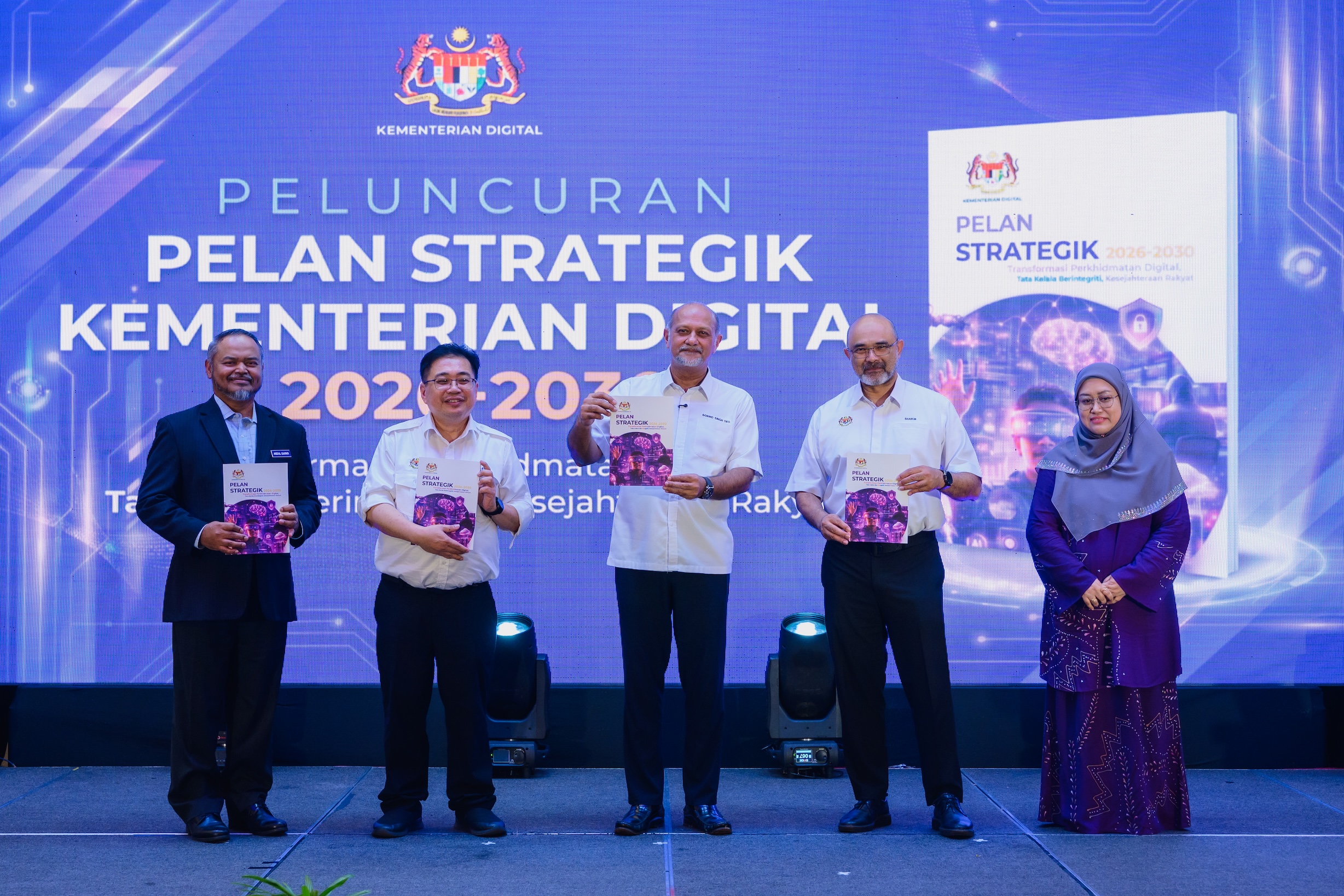
Digital Minister Gobind Singh Deo (centre) launches the Digital Ministry Strategic Plan 2026-2030 on 27 November 2026. Image: Gobind Singh Deo/X
PUTRAJAYA, 28 November — Malaysia has set out a five-year roadmap to become what it calls an “AI Nation” by 2030, with the Digital Ministry aiming to place the country among the world’s 10 most AI-ready nations, while the Malaysia Digital Economy Corporation (MDEC) says it will write sector-by-sector rulebooks to help small businesses use artificial intelligence without leaking sensitive data.
Five targets, five pillars
The Digital Ministry Strategic Plan (PSKD) 2026-2030, launched on Friday by Digital Minister Gobind Singh Deo, sets five headline targets, Bernama reported. Beyond the top-10 ranking for AI readiness, the ministry wants the digital economy to account for 30 per cent of gross domestic product (GDP).
The other three targets are rankings and satisfaction scores: a place among the top 20 countries on the United Nations E-Government Development Index, a place in the top 25 of the International Institute for Management Development’s (IMD) digital and AI ranking, and at least 85 per cent user satisfaction with government digital services.
In plain terms, the UN index measures how well governments deliver services online, while the IMD ranking compares how ready economies are to adopt and exploit digital technologies. Both are widely watched by investors comparing countries in the region.
Gobind said the PSKD was “not merely a policy planning document” but a concrete commitment to ensuring every digitalisation initiative translates into faster, safer public services that directly benefit Malaysians, according to the ministry’s statement.
The plan rests on five pillars: Digital Government, Digital Economy, Digital Society, Digital Ecosystem Trust and Digital Governance. Each will be broken down into action plans with named initiatives, key performance indicators, targets, lead and implementing agencies and timelines, and the ministry said monitoring and evaluation would be tightened so problems are spotted and fixed along the way.
The ministry said the plan was drawn up in line with the 13th Malaysia Plan and the Malaysia Digital Action Plan 2030, and that it would emphasise digital infrastructure readiness, talent, innovation, investment and governance frameworks so new technologies are used “optimally, safely and responsibly”.
AI playbooks for small firms
Hours later, MDEC chairman Ganesh Kumar Bangah said the agency would prepare industry-specific guidelines on AI use for micro, small and medium enterprises (MSMEs), the businesses that make up most of Malaysia’s economy.
Speaking on Bernama TV’s Ruang Bicara programme on Friday night, he said the guidelines would show companies how to prompt AI tools for their particular needs and help them decide what information is appropriate to share.
“For responsible use of the technology, the guidelines will help MSMEs identify what can and cannot be used when using AI applications,” he said.
Ganesh said more than one-third of Malaysians had already started using AI, and that the next step was productivity, including building AI agents that can carry out repetitive tasks. He drew the line between the two simply: “The difference between a prompt and an AI agent is that with a prompt, we have to tell the AI to give us advice and guidance. With an agent, it can take action on its own. Once we start building more agents, that is where our productivity will rise.”
Cheaper computing on the way
Ganesh named subscription costs and know-how as the two main barriers for small firms. On cost, he pointed to the National Compute Exchange, due to launch next year, which is meant to connect local companies with spare computing capacity in Malaysia’s data centres.
“The hope is that costs for these MSME companies will come down with NCX in place,” he said, adding that cheaper access to computing power could help smaller firms compete with larger rivals and expand into Southeast Asian markets.
Computing capacity, often called “compute”, is the processing power needed to run and train AI models. It is usually rented from cloud providers by the hour, and the bills can be a real hurdle for a small business. An exchange that pools demand could, in principle, win better rates from data centre operators, of which Malaysia has attracted a large number in recent years, particularly in Johor.
Ganesh also said MDEC was looking at aligning technical and vocational education and training (TVET) with robotics, and that its Jelajah Malaysia Digital roadshow had visited 12 locations, mostly rural, to introduce communities to AI and digital software. He described AI literacy as a key skill if Malaysia is to reach its 2030 goal. “Wider AI adoption among local companies and the public could raise productivity, supporting wage increases and national economic growth,” he said.
What to watch
The big test is in the detail still to come: the action plans and performance indicators under each PSKD pillar, the timing and pricing of the National Compute Exchange, and which industries get the first MDEC AI playbooks. Watch, too, for how the 30 per cent of GDP digital economy target is measured, and whether Malaysia’s next placings on the UN and IMD indices show movement towards the 2030 goals.
Sources: Bernama, The Star.
About The Author



 Anna J




 Bard AI
 Mohd Nazhrieyan Jailani



 Bria AI


 Laura AI