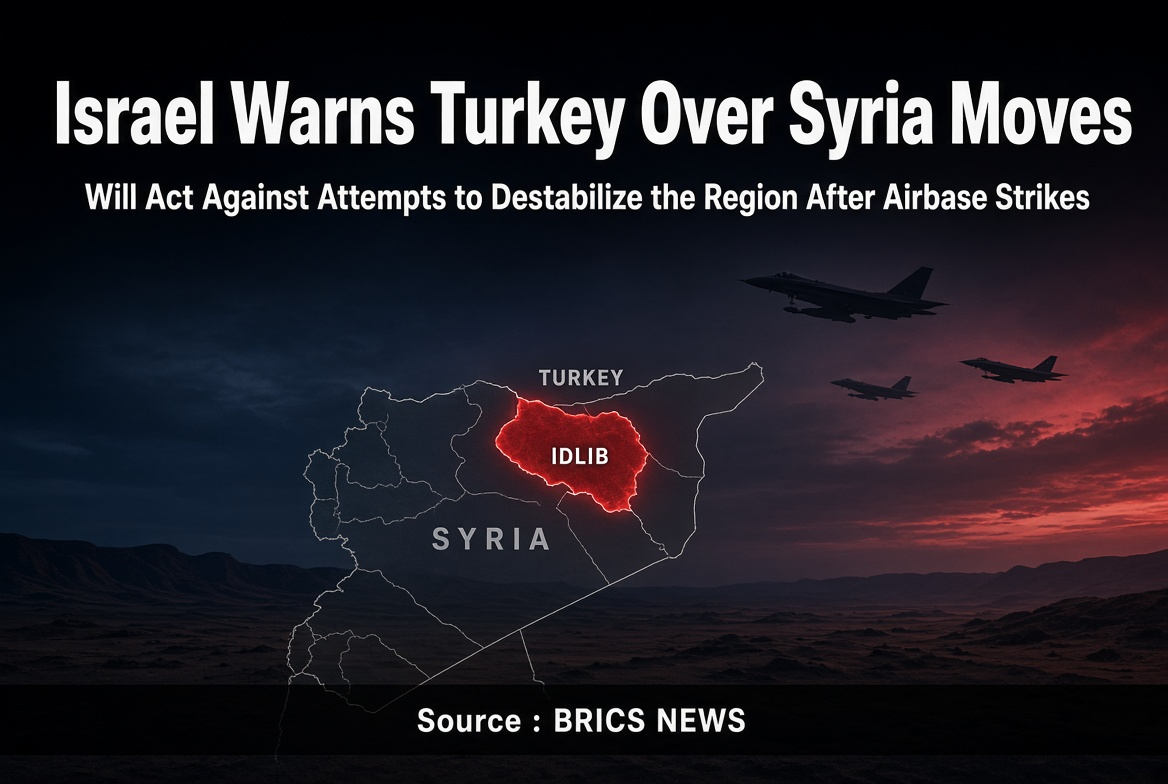
ANKARA August 21, 2026 — Israel has issued a sharp warning that it will take action against what it describes as Turkey’s attempts to “destabilize the region,” following Israeli airstrikes on a Syrian airbase earlier this week that Jerusalem said were intended to block a potential Turkish troop deployment.
The statement, highlighted in recent reports, comes days after Israeli forces struck the Abu al-Duhur (also spelled Abu Duhur or Abu al Duhur) airbase in Syria’s northwestern Idlib province, near Aleppo and roughly 45–70 kilometers from the Turkish border, on the night of August 17–18, 2026. Syrian state media and officials reported that Israeli warplanes carried out at least eight airstrikes targeting runways and hangars or storage facilities. The attacks caused material damage to the recently reconstructed runways but resulted in no casualties.
Israel’s Prime Minister’s Office confirmed the operation, stating that Syria was “on the verge of breaching” an agreed security status quo by permitting Turkish troops to deploy at the airbase near Aleppo. “Israel repeatedly warned Syria that such a deployment would pose a threat to Israel’s security. Syria chose to ignore these warnings. Israel will not tolerate threats to its security, and would welcome a return to the status quo,” the office said.
Prime Minister Benjamin Netanyahu later reinforced the message, saying Israel had clearly signaled to Turkey against any military activity or buildup moving southward in Syria. “The message was conveyed, but apparently they didn’t hear it, so we made sure they understood it more clearly,” Netanyahu stated, adding that Israel would not tolerate a Turkish military entrenchment that threatens its security. Israeli Ambassador to the United States Yechiel Leiter described the alleged Turkish plans as having crossed a “red line.”
On Thursday, Israeli Defense Minister Israel Katz escalated the rhetoric in a post on X, cautioning Turkish President Recep Tayyip Erdoğan against “dragging Turkey into dangerous adventures in Syria” and “testing Israel’s determination to defend itself.” Katz emphasized that “Israel will not allow any entity to threaten its security.”
Turkey and Syria have rejected Israel’s claims. Syrian Foreign Minister Asaad al-Shaibani told Axios that Damascus had no intention of establishing a Turkish military base or permanent presence at Abu al-Duhur, nor of deploying Turkish forces there. He said Turkish military officers had visited the site as part of ongoing cooperation on training and expertise exchange, and that rehabilitation work was solely for the Syrian Air Force. Al-Shaibani described the Israeli strike as lacking any legitimate justification and a violation of Syrian sovereignty.
Turkey’s Defense Ministry denied that any Turkish military delegation was present at the base before or during the attack and condemned the Israeli strikes as “reckless.” Ankara called for Israel to halt such actions and comply with international law, while affirming its continued support for Syria’s efforts to rebuild its military capabilities under the principle of “one state, one army.” Turkish officials have described Israel’s allegations as untenable.
The incident has heightened regional tensions in post-Assad Syria, where Turkey maintains influence in the north and has been involved in military cooperation with the new Syrian authorities. Israel has conducted repeated strikes in Syria to counter perceived threats near its borders and maintain a security buffer. U.S. Ambassador to Turkey and special envoy for Syria Tom Barrack called the Israeli airstrikes an “unnecessary escalation” that risked confrontation, noting that Turkish forces were unaware of the incoming aircraft and could have scrambled jets in response. Washington is working to establish a deconfliction mechanism among Israel, Turkey, and Syria.
No further military actions have been reported as of August 22, but the war of words between Jerusalem and Ankara underscores the fragile balance in Syria, where competing interests of regional powers continue to test the limits of post-war arrangements. Both sides have expressed openness to dialogue in principle, though mutual accusations of destabilization persist.
About The Author