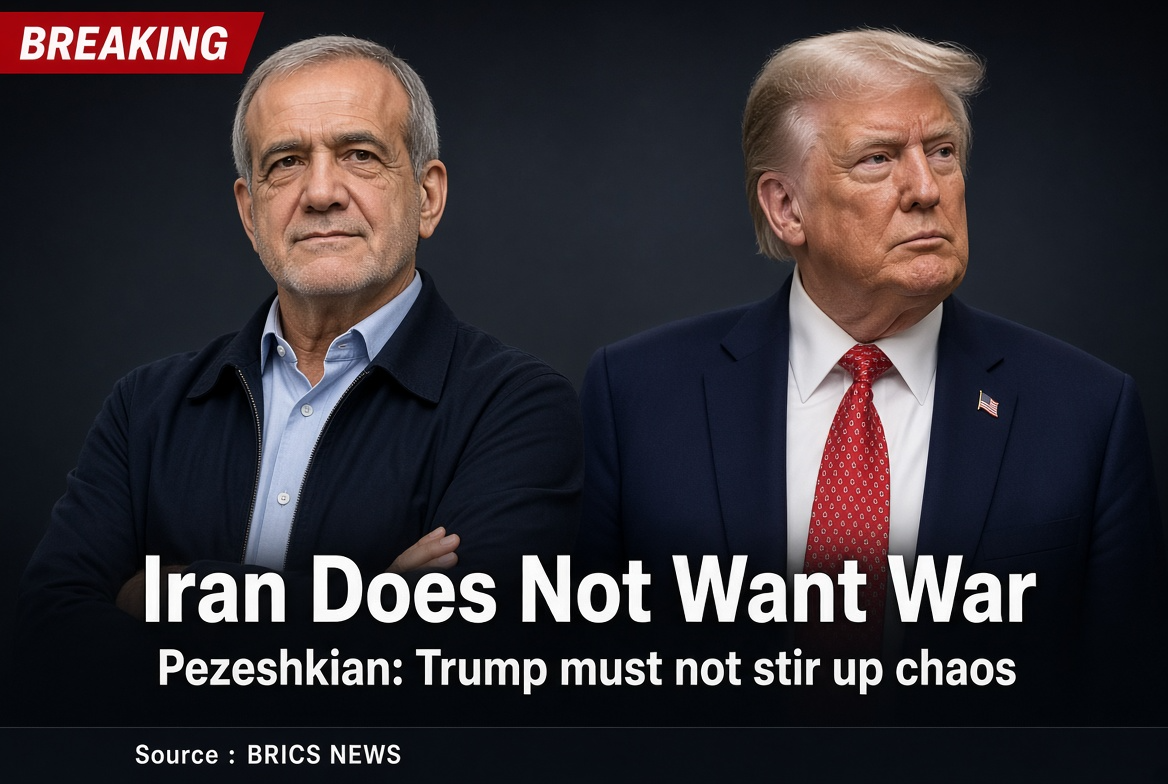
TEHRAN Aug 29, 2026 — Iranian President Masoud Pezeshkian said Iran “does not want war” and that it is in the interest of Iran, the region, and the world that U.S. President Donald Trump refrain from creating further instability, according to remarks circulated Saturday by BRICS News.
The account quoted Pezeshkian as saying: “We do not want war.” It added: “It is in the interest of Iran, the region, and the world that Trump does not stir up chaos.” The post featured official-style portraits of the two leaders.
The comments align with remarks Pezeshkian made Thursday during a meeting in Tehran with Qatari Prime Minister and Foreign Minister Sheikh Mohammed bin Abdulrahman Al Thani. According to Iranian official statements and Xinhua, he said Iran “has not, does not, and will not seek war, but it will not submit to bullying either.” He added that other parties must recognize Iran’s rights under international law.
Pezeshkian said the conflict was imposed by the United States and Israel and that its continuation harms Iran, West Asia, and the world. He argued it is logical to resume implementation of the June memorandum of understanding with Washington and resolve remaining issues through dialogue rather than force. “The interests of some are in continuing the war, but the Islamic Republic of Iran believes that peace and security will benefit Iran, the region, and the world,” he said.
The war began in late February 2026 after U.S. and Israeli strikes on Iranian targets, including nuclear-related sites. A 14-point memorandum of understanding signed in mid-June established a fragile ceasefire and a 60-day window for talks on navigation through the Strait of Hormuz, Iran’s nuclear program, and sanctions. That deadline passed in mid-August without a comprehensive deal. Both sides have accused the other of violations, and Washington has shifted toward intensified economic pressure, including threats of sweeping new sanctions described by Trump officials as an “economic D-Day.”
Qatar, which helped mediate the June understanding, is again trying to revive diplomacy. Sheikh Mohammed’s visit to Tehran came as Trump said the United States was not currently talking to Iran and was in no hurry to resume negotiations. Tehran has insisted it will not reopen the Strait of Hormuz on Washington’s terms and has rejected what it calls bullying, while Pezeshkian has repeatedly argued that Iran should end the current “neither war nor peace” stalemate from a position of “power and dignity.”
Iran joined BRICS in 2024. Public calls for de-escalation from Tehran fit the grouping’s broader emphasis on multipolar diplomacy and reduced Western-led military campaigns in the Middle East, though hard-line voices inside Iran have criticized engagement with the United States.
Talks remain stalled. The United States continues economic and naval pressure; Iran maintains it will not capitulate and wants the June memorandum implemented. Whether Pezeshkian’s latest appeal produces movement depends on whether Washington treats it as an opening or as rhetoric amid unresolved disputes over Hormuz, sanctions, and Iran’s nuclear program.
About The Author