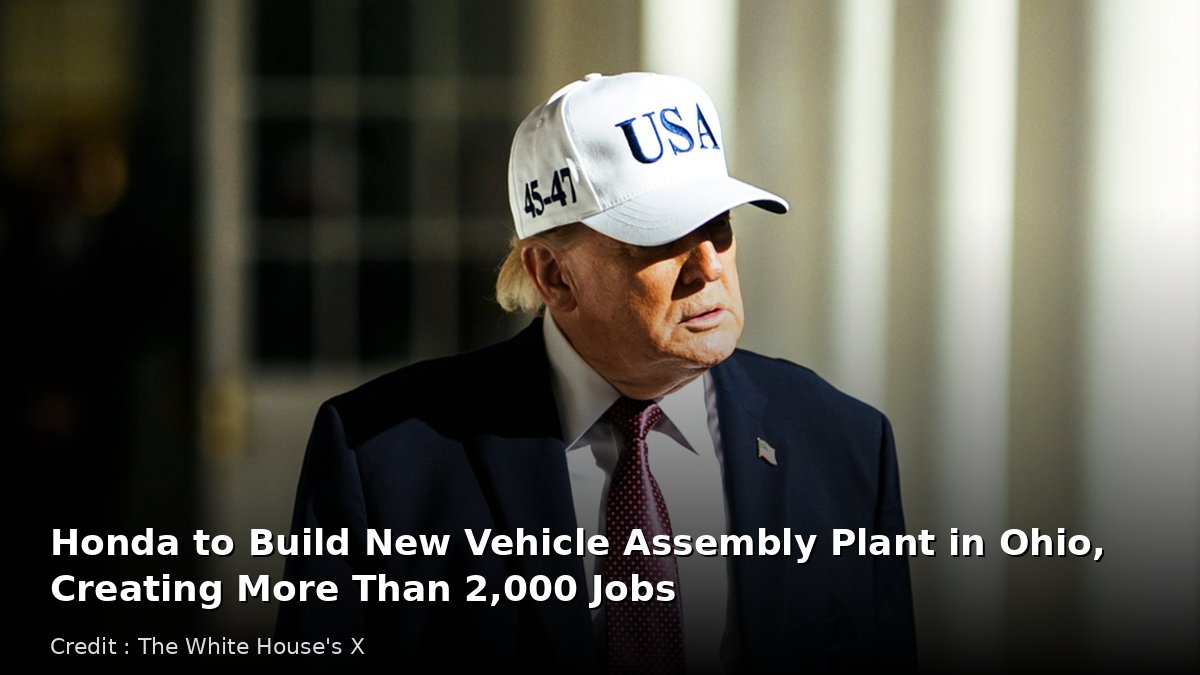
Credit : The White House's X
MARYSVILLE, OHIO November 9, 2026 — Honda will invest US$3 billion to build a new vehicle assembly plant in central Ohio, the Japanese automaker said, a project it said would create more than 2,000 jobs and raise its annual US car-making capacity to about 1.3 million vehicles.
The plant will sit on land between Honda’s existing East Liberty and Marysville factories and is expected to begin production in 2029, pending final government approvals. Honda said the factory would be able to build 240,000 vehicles a year and could produce hybrid, petrol-powered and battery-electric models. It would be the company’s fourth car plant in Ohio and its ninth auto-related production site in the United States.
“As Honda approaches 50 years of building products close to our customers in America, we are making one of the most significant commitments in our history to position Honda for the next 50 years. These investments strengthen America’s role as a cornerstone of Honda’s global future and reflect our confidence in our more than 30,000 Honda associates and the strength of American manufacturing.”
That statement came from Bob Nelson, executive vice president of American Honda Motor Co. The White House on November 10 highlighted the announcement on X as “yet another historic investment for American manufacturing,” saying President Donald Trump was “prioritizing MADE IN AMERICA” and that such moves were generating “more jobs, investments, and wealth for American businesses and families.” Honda’s own release presented the factory as a commercial decision to meet rising demand for hybrid vehicles in North America.
The new Ohio plant is part of a wider set of investments at Honda operations in Ohio, Alabama and Georgia intended to expand production of hybrid-electric vehicles, engines and hybrid systems. Honda said those projects, together with the new factory, would lift North American vehicle capacity to about 1.9 million a year. In May 2026 the company announced plans to introduce 15 new Honda and Acura hybrid models globally by 2030, with North America expected to be the main market for many of them. Designers and engineers at Honda’s development operations in California and Ohio are already working on multiple new models, the company said.
Honda said it chose Ohio because of the skilled workforce, the concentration of its US suppliers, and nearby research and manufacturing operations, including Honda Development & Manufacturing of America, the North American Automotive Development Center and the Transportation Research Center, as well as the L-H Battery Company joint venture, which it said could produce battery cells for hybrid and all-electric vehicles. Ohio Governor Mike DeWine joined Honda officials for the announcement in Marysville.
The company is also retooling the Anna Engine Plant in Ohio, which it describes as its largest engine plant in the world, and the Honda Transmission Plant-Ohio, where it said production capacity for hybrid systems would rise by 250 per cent in the coming years. A related hybrid-system project is planned at its transmission plant in Georgia. In Alabama, Honda said it is preparing its auto and engine plant — which marks 25 years of vehicle production this autumn — to expand engine production for a new V6 hybrid engine and to make Line 1 flexible enough to build the Passport, which is now assembled only on Line 2.
CNBC reported that automakers have been trying to localise more production amid Mr Trump’s tariffs and higher logistics costs. Honda did not, in its official release, present the Ohio plant as a direct response to tariffs, and it has not disclosed which models the new factory will build. Production remains subject to final government approvals. The White House post used the announcement to argue that its manufacturing agenda was drawing investment; the underlying decision, and the figures attached to it, come from Honda itself.
About The Author