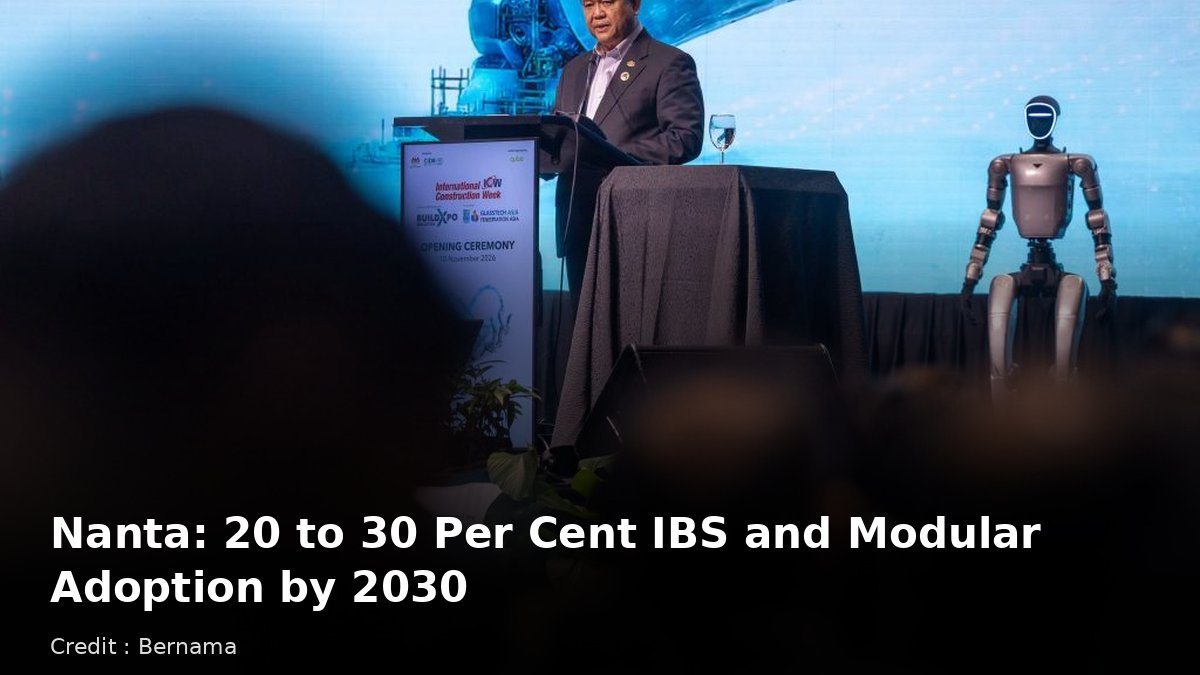
Credit : Bernama
KUALA LUMPUR, November 10, 2026 – The Works Ministry has set a target of 20 to 30 per cent adoption of the Industrialised Building System (IBS), modular construction and Building Information Modelling (BIM) by 2030, Works Minister Datuk Seri Alexander Nanta Linggi said.
Nanta said the target, set out under the Modular Construction Roadmap 2026–2030, was crucial to meeting the demands of public infrastructure development, particularly the construction of schools under the 13th Malaysia Plan. He described the initiative as a major step by the government towards faster, more efficient, sustainable and high-quality construction methods driven by indigenous technology.
“We want Malaysia’s construction industry to be more productive, innovative and globally competitive. Therefore, the ministry is putting a lot of emphasis on technology transfer and collaborations between global players and local companies,” he told reporters after attending International Construction Week (ICW) and BuildXpo Malaysia 2026 at the Malaysia International Trade and Exhibition Centre (MITEC).
The event, officiated by Prime Minister Datuk Seri Anwar Ibrahim, is the 28th edition of ICW and the fourth consecutive year of collaboration between the Construction Industry Development Board (CIDB) Malaysia and event manager Qube Integrated Malaysia in organising BuildXpo as its flagship exhibition. Bernama reported that the gathering brought together around 20,000 participants and more than 200 international exhibitors. Also present were Deputy Works Minister Datuk Seri Ahmad Maslan, CIDB chief executive officer Ahmad Farrin Mokhtar and Qube Malaysia chairman Tan Sri Ahmad Tajuddin Ali. ICW and BuildXpo are being held from November 10 to 12, 2026, hosted by the Works Ministry and CIDB.
Elaborating on the industry’s performance, Nanta said the sector’s current four per cent contribution to gross domestic product did not fully reflect the value chain of the entire ecosystem. “The figure (four per cent) is quite normal globally. However, the construction sector encompasses a wider scope as many building materials are classified under the manufacturing sector, (which is overseen by) another ministry,” he said. “We cannot carry out construction without building materials, so the construction process and manufacturing complement each other.”
He also acknowledged that the domestic construction sector was not immune to the impact of current geopolitical tensions in Europe and the Middle East, especially on logistics chains and fuel supply costs.
Addressing concerns from industry players about a potential disruption in the supply of Indonesian workers following recent negative sentiments, Nanta said the situation remained stable and that the construction sector had so far seen no significant interruption to the entry of Indonesian workers. “At this moment, it is perhaps a little bit too early, and we have not seen much interruption in that. Hopefully, things are quite normal. We will just wait and see exactly what decisions are made by the Indonesian government,” he said, adding that Putrajaya was monitoring Jakarta’s official policies to help ensure an uninterrupted supply of workers.
ICW 2026, held in line with the Malaysia MADANI framework, features BuildXpo Malaysia as its official trade exhibition and is co-located with Glasstech Asia and Fenestration Asia.
Sources: Sarawak Tribune/Bernama, Bernama (ICW dates)
About The Author