Fahmi Says RM2.7 Billion SALAM Cable Will Link Peninsula, Sabah and Sarawak
 Bria AI
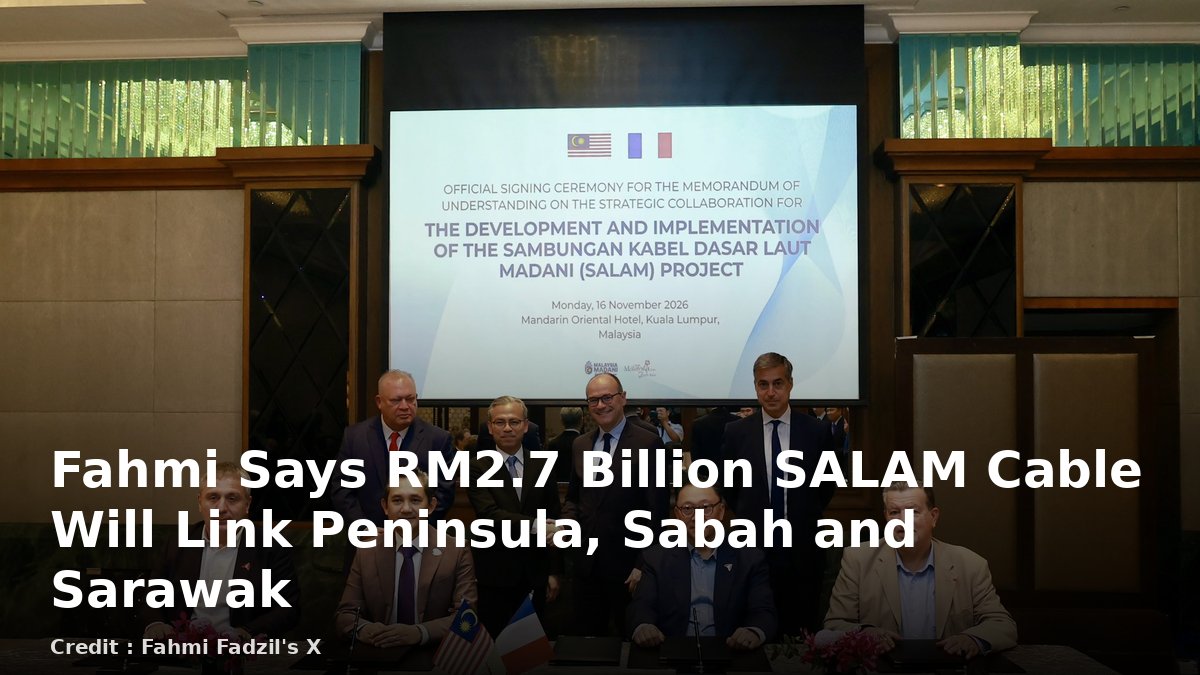
Credit : Fahmi Fadzil's X
KUALA LUMPUR, November 17, 2026 — Communications Minister Datuk Seri Fahmi Fadzil said Malaysia will gain a stronger digital backbone through the RM2.7 billion MADANI Submarine Cable Connection (SALAM) project, which is intended to link Peninsular Malaysia, Sabah and Sarawak along a route of about 5,500km with 10 landing stations.
“Malaysia will have another, stronger digital backbone,” he wrote on X. The project, to be carried out by Telekom Malaysia (TM), would use technology from France’s Alcatel Submarine Networks (ASN), which he described as among the world’s leading players in submarine cable technology.
Fahmi said SALAM would provide an alternative route if existing cables were disrupted, while also supporting 5G, cloud services, artificial intelligence and data centres. “Most importantly, we are not merely adding capacity. We are building a national digital network that is more resilient, secure and ready for the future, including for Sabah and Sarawak,” he said.
Photographs accompanying his post show a signing ceremony at the Mandarin Oriental Hotel in Kuala Lumpur on November 16 for a memorandum of understanding on strategic collaboration for the development and implementation of the SALAM project, with the Malaysian and French flags displayed.
In a separate filing with Bursa Malaysia today, TM said its wholly owned subsidiary, TM Technology Services Sdn Bhd, had received a notification of approval from the Malaysian Communications and Multimedia Commission (MCMC) for its universal service plan, and had been designated as the universal service provider for the SALAM (Part 1) project. The maximum approved project cost under the notification is RM2.7 billion. Work is scheduled to start on December 15, 2026 and to be completed in phases by the first quarter of 2030, subject to formal acceptance and the fulfilment of applicable conditions.
TM said it was still reviewing the terms and conditions within the stipulated acceptance period, and that the implementation and financial impact of the project remained subject to formal acceptance. The company said it would announce any subsequent material developments in due course.
According to The Vibes, which cited MCMC, the project is to be financed through the Universal Service Provision Fund. It reported that utilisation of the existing submarine cable network, in operation since 2017, has reached about 85 per cent. The 10 planned landing stations are Cherating and Sedili in Peninsular Malaysia; Kuching, Sibu (Matu) and Bintulu (Samalaju) in Sarawak; and Kota Kinabalu, Kudat, Pulau Banggi, Sandakan and Tawau in Sabah, the report said. Four fibre pairs would also be reserved for strategic national requirements, including sovereign cloud infrastructure, government digital services and cybersecurity.
The new system is intended to complement the existing cable network and reduce reliance on a single set of routes between the peninsula and East Malaysia. Fahmi had earlier identified Bintulu as an important Sarawak landing point, saying in October that SALAM would complement the Sistem Kabel Rakyat 1Malaysia (SKR1M) system by adding capacity and alternative connections.
MCMC has described the initiative as part of efforts to strengthen the country’s digital infrastructure and extend the benefits of the digital economy to more communities and businesses, The Vibes reported. Until TM formally accepts the notification, however, the timetable and financial impact remain subject to the conditions set out in today’s Bursa filing.
Sources: Fahmi Fadzil on X; Telekom Malaysia’s Bursa Malaysia filing; The Vibes; The Star; The Malaysian Reserve.
About The Author








 Lee AI



 Ernie AI