Credit : Datuk Amar Fadillah Yusof's X
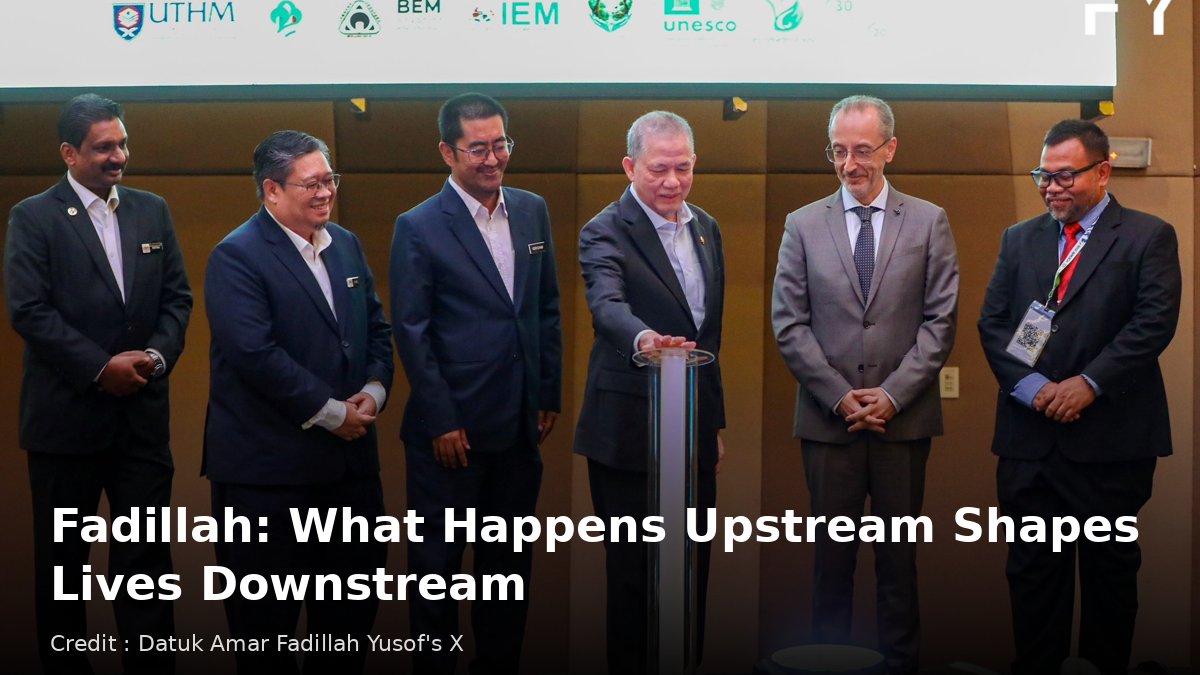
Deputy Prime Minister Datuk Amar Fadillah Yusof has said that the choices made upstream, from how development is planned to how water catchments are protected, can shape the lives of communities living downstream, as he opened Malaysia’s first International Conference on Ecohydrology and Water Resilience (ICEWR 2026) in Putrajaya on November 3, 2026.
In a post shared on X, Fadillah, who is also Energy Transition and Water Transformation Minister, said he was pleased to officiate the inaugural conference, which brings together government representatives, researchers, industry players and civil society from Malaysia and abroad to share their experience in managing water resources and facing the risks of floods and droughts.
“In my speech, I touched on how the decisions we make upstream, from the way we plan development to our efforts to conserve water catchments, can affect the lives of communities downstream,” he wrote. “Water connects us in ways we sometimes only realise when supply is disrupted or when rivers begin to overflow.”
According to Bernama, as reported by The Star, Fadillah told the conference that land clearing, river alterations and catchment development must take into account their impact on communities beyond the boundaries of a project, and that water resilience must remain a strategic national priority in how towns are planned, land is managed and infrastructure investments are made.
In his post, the Deputy Prime Minister said dams and drainage systems play an important role, but so do well-protected catchment areas, wetlands that can hold water and healthy rivers. He pointed to Putrajaya Lake and Wetlands, together with projects at Universiti Tun Hussein Onn Malaysia (UTHM) and Universiti Sains Malaysia (USM), as places where Malaysia can see how nature and engineering can complement each other.
The three sites are UNESCO Ecohydrology Demonstration Sites, according to RTM and Bernama. Besides Putrajaya Lake and Wetlands, they are the Sustainable Stormwater Management Project at UTHM in Johor and the Bio-Ecological Drainage System (BIOECODS) at USM in Penang. RTM reported that Fadillah encouraged the institutions involved to strengthen the sites as platforms for joint research, professional training and international knowledge exchange.
Fadillah said he hoped the discussions at the conference would help bring research findings into planning and widen the use of solutions that have already been shown to work. He added that the experience of local communities deserves to be heard, as people who live close to rivers are often the first to notice changes in them.
The conference was organised by the Department of Irrigation and Drainage (JPS) Malaysia and the Humid Tropics Centre (HTC) Kuala Lumpur with the support of UNESCO, according to the Ministry of Energy Transition and Water Transformation (PETRA). Its theme is “Ecohydrology and Water Resilience: Advancing Nature-Based Solutions for Sustainable Water Systems”, and it is being held at The Everly Putrajaya. Fadillah thanked JPS Malaysia, HTC Kuala Lumpur and all the co-organisers for making the event possible.
“Water is a blessing from Allah, and caring for it is a trust we all share,” he wrote. “May the efforts we begin today allow future generations to enjoy healthier rivers, more secure water supplies and safer lives.”
Source : @PetraJayaMP
About The Author