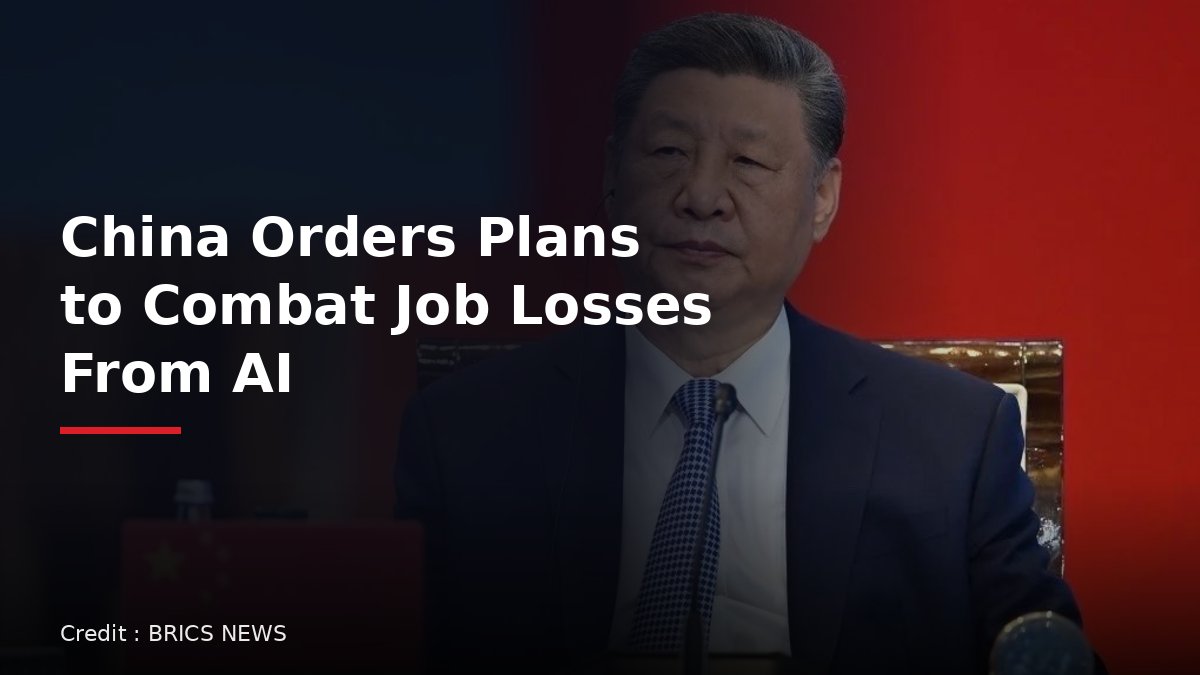
Credit : BRICS NEWS
BEIJING, October 24, 2026 — China has directed government agencies to develop plans to combat widespread job losses from artificial intelligence (AI), BRICS News reported on X, after Beijing issued new national guidelines on employment in the age of AI.
The post, published at about 2.10am Malaysia time on Saturday and marked “JUST IN”, read: “China directs government agencies to develop plans to combat widespread job losses from AI.”
https://x.com/BRICSinfo/status/2113694495623786741
The guidelines were issued by the General Office of China’s State Council and announced on Thursday, October 23, according to the official Xinhua news agency. They aim to harness AI to create jobs, improve the quality of employment and stimulate entrepreneurship, while mitigating job displacement caused by AI applications.
Xinhua said the document sets out 18 tasks in six areas. These are boosting AI’s job-creation potential, making AI adoption more employment-friendly, improving workers’ digital skills, enhancing employment services, strengthening labour and social security protections, and monitoring and addressing employment risks.
The guidelines call for expanding employment opportunities in emerging fields, helping micro, small and medium-sized enterprises stabilise and expand their workforces, fostering new forms of employment and entrepreneurship in the AI sector, and developing new AI-related occupations.
They also urge efforts to tap AI’s job-creation potential in traditional sectors, to reduce the displacement of workers caused by AI, and to set up a mechanism for assessing the employment risks associated with adopting the technology.
In addition, the guidelines emphasise improving the framework for protecting workers’ rights in human-machine collaboration, strengthening social security for people in flexible employment and in new forms of work, and refining income distribution mechanisms to adapt to advances in AI, Xinhua said.
The full Chinese text, published on the central government’s website as State Council General Office document No. 29 of 2026 and dated October 16, goes further on job losses. It calls for the scope, intensity and pace of AI use in labour-intensive industries to be handled “prudently” to minimise the impact on workers, and for AI to be deployed first in jobs facing labour shortages or hazardous conditions. Companies are encouraged to explore an “unemployment buffer period”, notifying affected workers in advance and offering support to retrain or move to new roles when rolling out AI on a large scale.
The document also requires employment risk assessments for AI projects that could cause significant job losses, the inclusion of AI-related job risks in China’s mechanism for preventing large-scale unemployment, and the drawing up of contingency plans. Local governments and ministries are told to implement the measures, with human resources, social security and development departments responsible for coordination. On skills, it urges universities and vocational schools to expand AI-related programmes quickly, and asks local authorities to encourage young graduates, migrant workers and unemployed people to join AI-focused training schemes, while workers displaced by AI should receive targeted job guidance, training and unemployment insurance benefits in full and on time.
The BRICS News post did not give further details, and Xinhua did not publish specific targets or a timeline for agencies to submit their plans.
Source: BRICS News on X, Xinhua and the Chinese government’s official website.
About The Author