Credit : CENTCOM's X
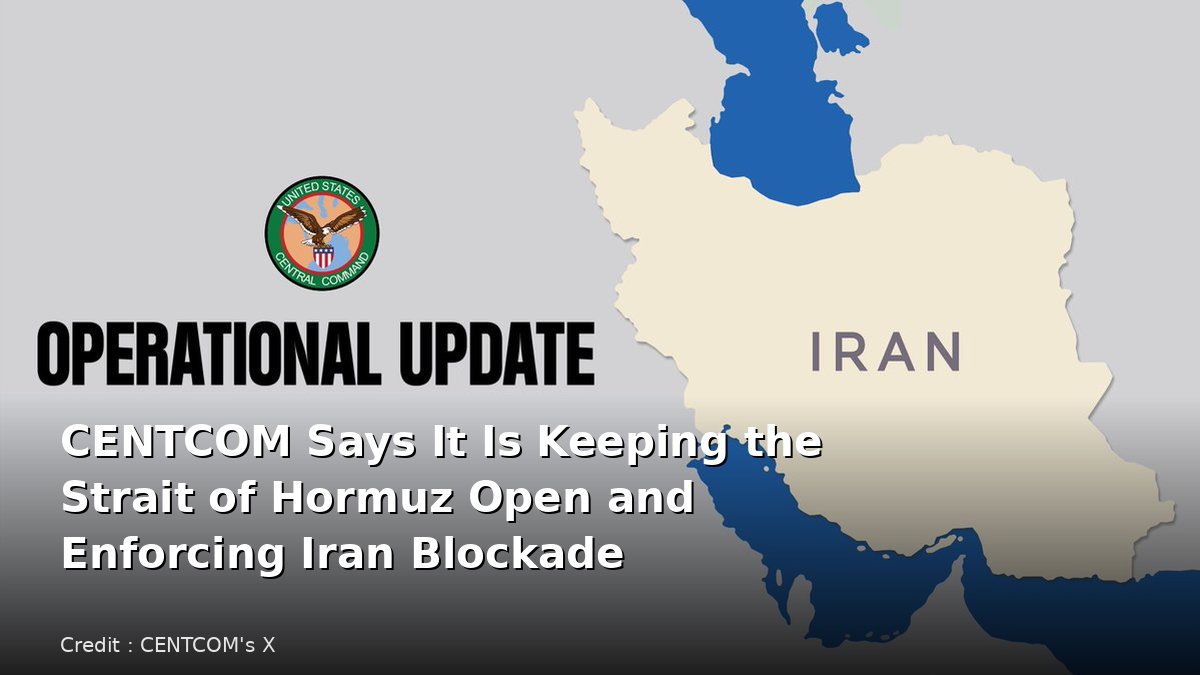
TAMPA, November 11, 2026 – US Central Command said on Wednesday that American forces were continuing to keep the Strait of Hormuz open for commercial shipping, to enforce a naval blockade against Iran, and to work with other US agencies to stop Iran’s Islamic Revolutionary Guard Corps from moving weapons and sanctioned goods by land and across the Caspian Sea.
In a post on X, accompanied by a video, CENTCOM said: “U.S. forces continue to work around the clock keeping the Strait of Hormuz open for commercial shipping, strictly enforcing the ironclad naval blockade against Iran, and working with U.S. interagency partners to prevent the IRGC from using land routes and the Caspian Sea to move advanced weapons systems, dual-use tech, sanctioned materials, and illegal revenue streams.”
The statement is an account of what the command says its forces are doing. It does not give figures for ship inspections, seizures or incidents on Wednesday, and it does not name specific IRGC routes or cargoes. Those operational claims have not been independently detailed in the post.
The Strait of Hormuz, at the mouth of the Persian Gulf, is one of the world’s main oil shipping routes. The United States has maintained a naval blockade of Iran during the war that began in February, a measure Tehran has demanded be lifted as one of its conditions for talks and for fully reopening the waterway. Iranian officials, including security chief Mohsen Rezaei, have said the strait will not be opened on Iran’s terms until Washington meets a list of demands.
CENTCOM, whose headquarters are at MacDill Air Force Base in Tampa, Florida, is the US military command responsible for operations in the Middle East. Its Wednesday post presented the blockade and the escort of commercial traffic as ongoing tasks rather than a new operation announced that day.
Iran has previously said the strait would remain closed, or would not be reopened, until the blockade was lifted and other conditions were met. Shipping and insurance markets have continued to treat the waterway as high risk while the war has gone on. CENTCOM’s statement did not address those Iranian conditions, nor did it report a change in the formal status of the blockade.
Commercial tankers, insurers and energy markets have treated the strait as a high-risk passage for months. A large share of seaborne oil from the Gulf normally transits Hormuz, which is why governments and shipping companies watch any military statement about the waterway closely. CENTCOM’s post did not say that traffic had returned to pre-war levels, only that US forces were working to keep the strait open for commercial shipping while the blockade of Iran remained in force.
The command also said it was trying, with other US government agencies, to stop the IRGC from using overland routes and the Caspian Sea to move advanced weapons, dual-use technology, sanctioned materials and “illegal revenue streams.” It offered no examples in the post. Iranian authorities have not, in that post, been quoted in reply.
Source: U.S. Central Command’s X
About The Author