
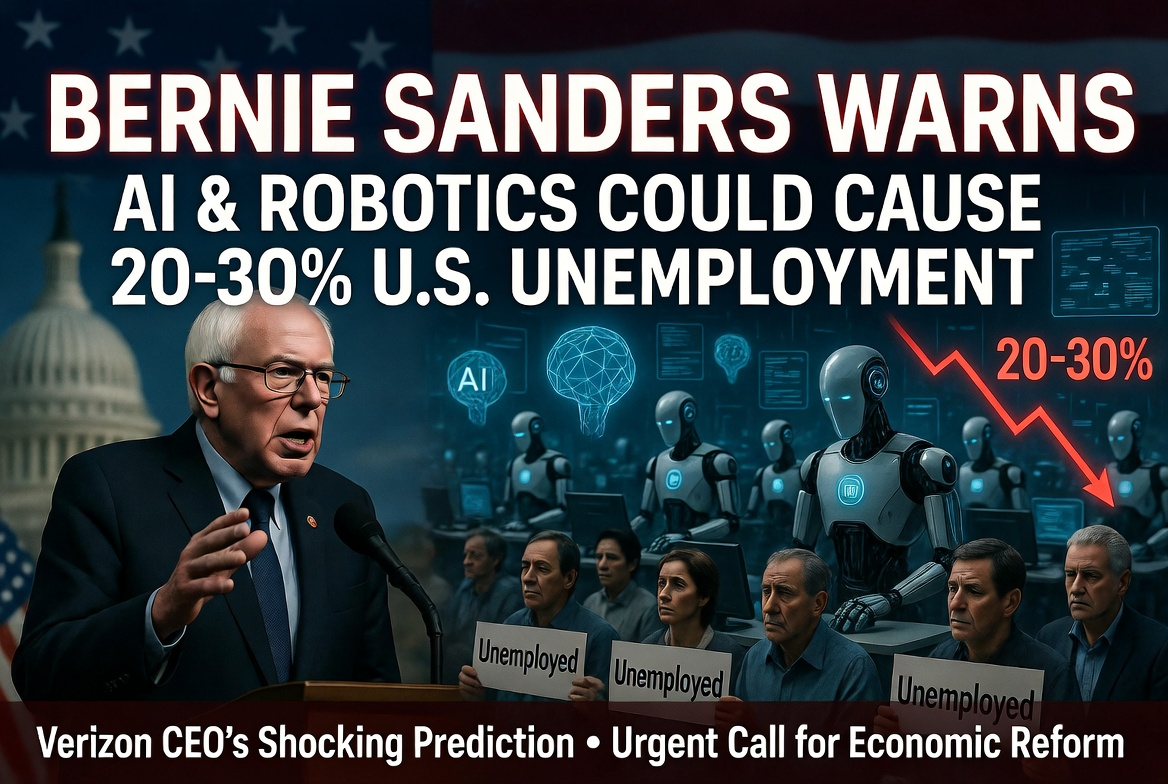
WASHINGTON D.C. April 26, 2026 – U.S. Senator Bernie Sanders (I-Vt.) is urging immediate action to address the potential upheaval from artificial intelligence and robotics, citing a stark warning from Verizon CEO Dan Schulman that the technologies could drive unemployment rates to 20-30% within the next two to five years.
In a post on X (formerly Twitter) Sunday afternoon, Sanders highlighted Schulman’s prediction and declared the need for swift preparation.
“When the CEO of Verizon predicts AI & robotics could lead to 20%-30% unemployment within the next few years, we may want to take notice,” Sanders wrote. “AI is the most transformative technology in human history. We’re not prepared for it economically or socially. That must change. NOW.”
Schulman, who took over as Verizon’s CEO in October 2025, has been outspoken about AI’s disruptive potential. The telecom giant laid off more than 13,000 employees late last year as part of a restructuring effort. While the cuts were not officially tied to AI, Schulman has pushed for corporate transparency about the technology’s impact on jobs. He has also launched a $20 million career-transition and retraining fund to prepare workers for what he calls the “age of AI.”
In recent interviews, including with The Wall Street Journal, Schulman warned that AI could eliminate large segments of both white-collar and manual-labor jobs, with humanoid robots further accelerating the shift. He has called on business leaders to be candid with employees about the coming changes.
The U.S. unemployment rate currently stands at approximately 4.3% as of March 2026, making Schulman’s forecast a dramatic escalation if realized.
Sanders’ comments reflect growing bipartisan concern among policymakers about AI’s societal effects. He has long advocated for stronger worker protections, economic inequality measures, and proactive government intervention in response to technological disruption.
Critics, however, argue that past waves of automation—from the Industrial Revolution to the rise of computers—ultimately created more jobs than they destroyed through new industries and increased productivity. Some view Schulman’s remarks as overly pessimistic, noting that companies like Verizon are simultaneously investing heavily in AI to boost efficiency and innovation.
The senator’s post quickly drew hundreds of replies, with users debating everything from universal basic income proposals and reskilling programs to calls for slowing AI development or embracing it as an engine of abundance.
As AI adoption accelerates across industries, the debate over its workforce impact is intensifying. Sanders’ call for immediate change signals that the conversation is moving from boardrooms to Capitol Hill.
This story is developing. Life News Agency will continue to monitor reactions from policymakers, business leaders, and economists.
About The Author