Anwar Must Intercede With Trump to Reverse US Semiconductor Licence Rule, Says Lim Guan Eng
 Bria AI
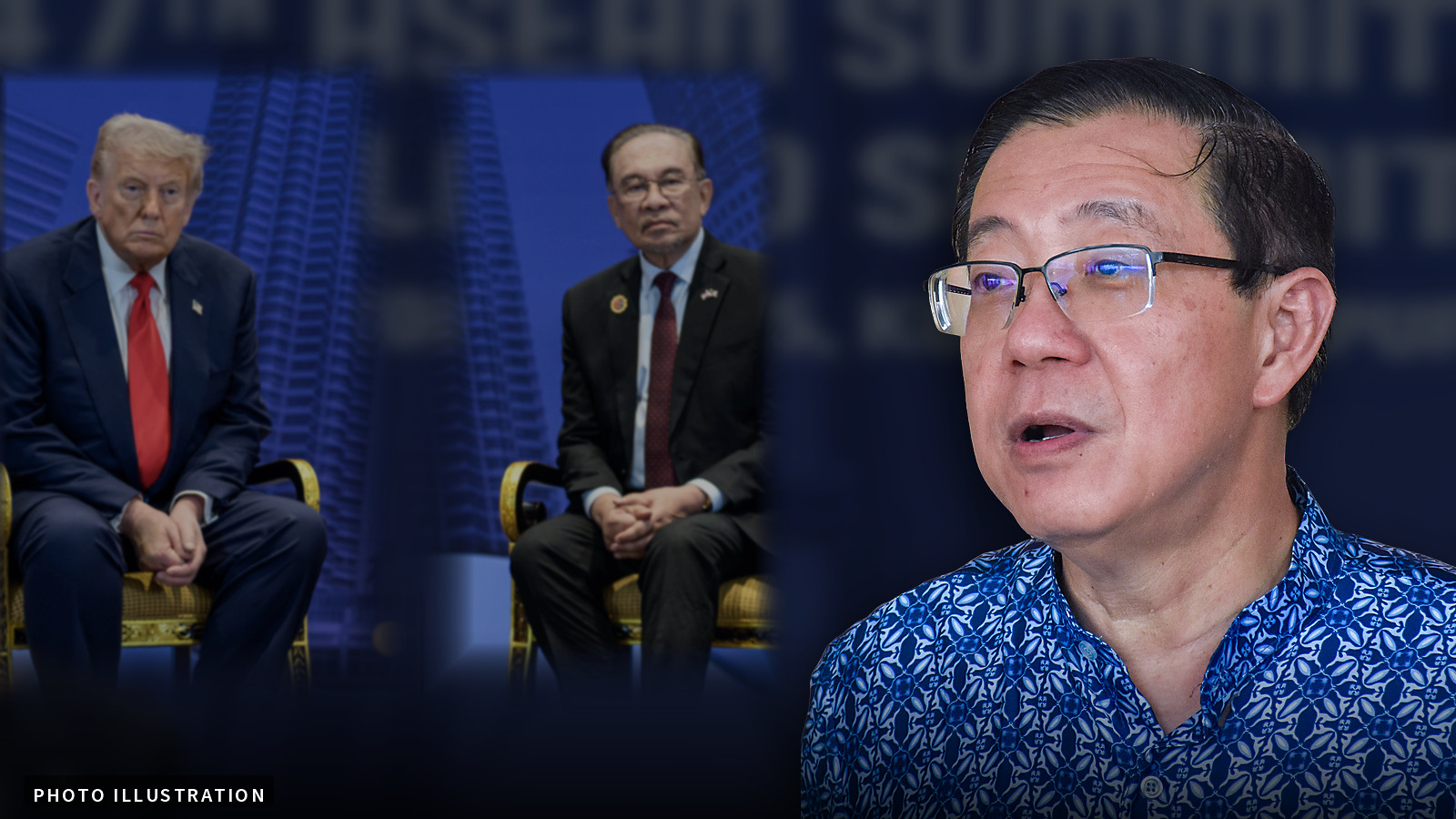
DAP MP for Bagan Lim Guan Eng (foreground) urges Prime Minister Datuk Seri Anwar Ibrahim to raise the US chip licence rule with President Donald Trump (background). Photo illustration: LNA; photos: C.W. Tan (Lim Guan Eng, Wikimedia Commons, CC BY-SA 4.0, adapted) and Official White House Photo by Daniel Torok (public domain).
KUALA LUMPUR, November 24, 2026 — Prime Minister Datuk Seri Anwar Ibrahim must use the reinstatement of Jensen Huang as Nvidia’s president and chief executive to intercede with United States President Donald Trump and reverse Washington’s new licence requirement for the export, re-export or transfer of advanced semiconductors to Malaysia, DAP Member of Parliament for Bagan Lim Guan Eng said today.
In a press statement issued in Kuala Lumpur, Lim said Huang’s return, which he described as showing that Huang was no longer a national security threat to the United States, meant that a similar “all-clear” should be given to Malaysia.
Nvidia’s board announced on 23 November that Huang had been reinstated with immediate effect. The company said the board had received input from senior levels of the United States government and was confident that Huang’s reinstatement posed no national security risk. Reuters reported that the reversal followed intervention by President Trump.
Lim said Huang had resigned on 12 November after, in the lawmaker’s account, he admitted to cheating his wife with an alleged Chinese spy, a claim Lim said had never been proven. He linked that episode to the timing of the new United States licensing rule.
The US Department of Commerce, in an interim final rule effective 19 November, required a licence for the export, re-export or transfer of advanced semiconductors to Malaysia, Singapore, Indonesia, Thailand or Brazil. The department said the measures were intended to prevent certain foreign actors from using advanced, US technology-based computing power to undermine US national security and foreign policy interests.
Lim said the US government had so far failed to offer any evidence that Malaysia was a party to such “sabotage” of US national security interests.
“It is manifestly unjust that Malaysia is subjected to a form of collective punishment, in the absence of any evidence of being involved in undermining US’ national security and foreign policy interests,” the statement said.
He warned that the new ruling would affect the 117 data centre projects currently in Malaysia and would limit the full potential of investment growth related to artificial intelligence and the electronics industry, with Penang the most adversely affected.
Malaysia’s exports could also fall victim to the curbs, he said. Citing figures in the statement, Lim said the country’s exports had surged by 34 per cent to a record RM1.6 trillion in the first nine months of 2026 compared with the corresponding period in 2025, with a trade surplus of RM232 billion. Electrical and electronic products alone, he said, had achieved a record RM601 billion, a 59 per cent increase, comprising nearly 40 per cent of Malaysia’s 2026 total exports to date.
Now that the US government had, in his words, essentially issued an “all-clear” to Huang, “to the extent that Donald Trump openly lobbied the Nvidia Board of Directors for Jensen’s return and reinstatement, there is no reason why a similar all-clear cannot be accorded to Malaysia,” Lim said.
Unless the United States could provide concrete evidence of any misdeeds or wrongdoings by Malaysia that jeopardised US national security or foreign policy interests, he said, Washington should immediately revoke the new licence requirements for advanced semiconductors to Malaysia.
About The Author

 Rizal Omar


 Lee AI
 Ng Kwan Hoong
 Professor Dato’ Dr. Ahmad Ibrahim
 Lina AI