Fadillah Says ASEAN Power Grid Is a Strategic Agenda, Not Just Infrastructure
 Bria AI

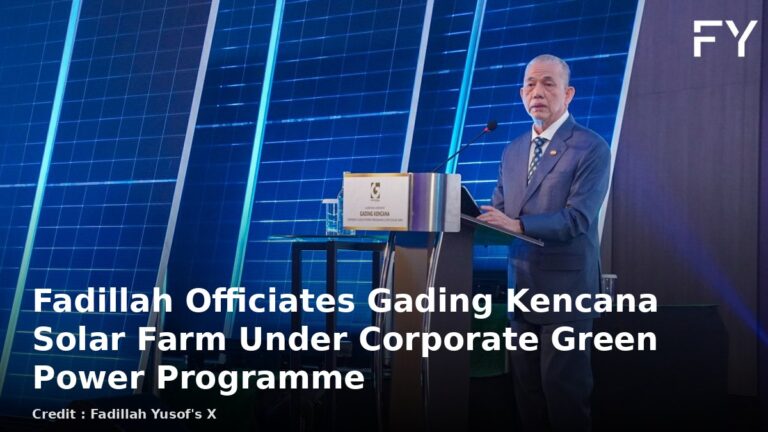
Credit : Fadillah Yusof's X
KUALA LUMPUR, November 16, 2026 — Deputy Prime Minister Datuk Seri Fadillah Yusof has said the future of ASEAN’s energy supply can no longer be built by countries acting alone, and that the ASEAN Power Grid should be treated as a strategic agenda for energy security, economic resilience and regional cooperation, not merely as infrastructure or cross-border electricity trade.
Fadillah, who is also Minister of Energy Transition and Water Transformation, was officiating the ASEAN Power Grid Forum, organised by the Asia-Europe Institute of Universiti Malaya and the Konrad-Adenauer-Stiftung, when he set out the argument in a post on X.
“The strength of a nation is measured not only by what it possesses, but also by what it is able to build together with its neighbours,” he wrote. As demand for electricity rises, particularly from data centres and artificial intelligence, economic growth had to move in step with a sustainable, stable and resilient energy supply, he said.
He said Sarawak, with its hydropower potential and its strategic position on Borneo, had an important role in strengthening regional energy interconnectivity. Being an energy hub, he added, was not merely a privilege but a responsibility to build trust, ensure the reliability of supply and see that the benefits were shared.
Malaysia remained committed to realising the ASEAN Power Grid on the principles of consensus, mutual respect for national sovereignty and ASEAN’s common interests, he said, quoting the Malay proverb “Bersatu teguh, bercerai roboh” — united we stand, divided we fall. “When we connect power grids, we strengthen security. When we build trust, we make interdependence a source of strength, not weakness,” he wrote.
RTM, reporting his keynote at the forum, said Fadillah also pointed to uncertainty in global fuel supplies, including disruption along strategic routes such as the Strait of Hormuz, as a reason for ASEAN members to diversify their energy sources and strengthen the resilience of their systems. He argued that an electricity transmission link binds neighbouring countries more closely, and for a longer period, than oil, according to the report.
Fadillah said Sarawak had the potential to be an important supplier of low-carbon electricity, with hydropower accounting for about 60 per cent of its installed generation capacity, RTM reported. A proposed one-gigawatt Sarawak-Singapore power link had received conditional approval from Singapore’s Energy Market Authority, with commercial operation expected around 2035, subject to the relevant approvals, he said, according to the same report.
He also said any commitment of electricity supply to new investment had to take into account the needs of households, industry and the country’s water resources, so that economic growth did not undermine security of supply. Malaysia would continue to welcome investment from a range of international partners on its own terms, guided by the national interest and without being drawn into great-power rivalry, RTM quoted him as saying.
The remarks come as Malaysia pursues its National Energy Transition Roadmap, including efforts to strengthen the grid, expand energy storage and increase the use of renewable energy. Fadillah has previously argued that regional grid cooperation should proceed under an ASEAN-led approach, a position he restated at the forum.
Sources: Fadillah Yusof on X; RTM.
About The Author







 Lee AI



 Ernie AI