Anwar Calls for Abolition of UN Security Council Veto
 Bria AI
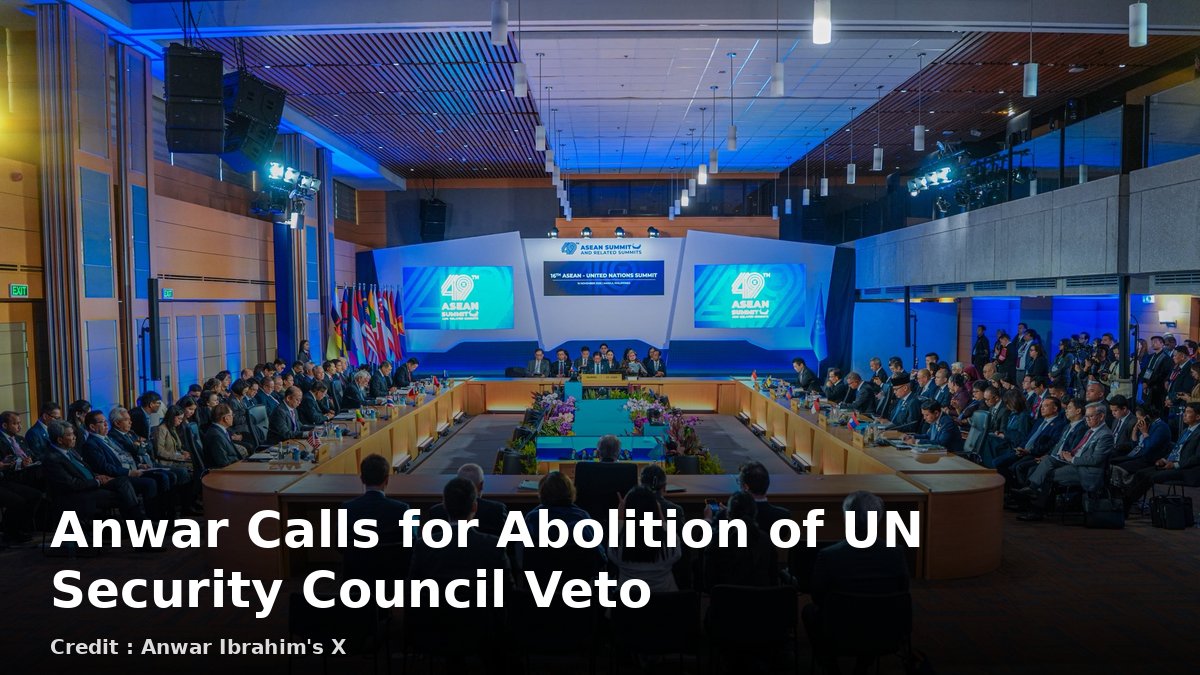
Credit : Anwar Ibrahim's X
MANILA, November 16, 2026 — Prime Minister Datuk Seri Anwar Ibrahim has called for bolder reform of the United Nations, including the abolition of the veto power that he said has long prevented the UN Security Council from acting fairly and effectively.
Anwar was speaking at the 16th ASEAN-United Nations Summit in Manila, held alongside the 49th ASEAN Summit. In a post on X, he said the ASEAN-UN Plan of Action 2026-2030 needed to be translated into tangible results, particularly in the green and digital transitions, climate resilience and sustainable development.
He also urged that UN reform be carried out more boldly, “including the abolition of the veto power that has long bound the UN Security Council from acting fairly and effectively”. ASEAN, he added, must continue to defend the principle of ASEAN Centrality and the supremacy of international law in the face of increasingly challenging geopolitical competition.
Bernama, in a report carried by the New Straits Times, said Anwar argued that the current structure of the Security Council required a comprehensive overhaul so that the UN remained relevant and able to address humanitarian crises and global conflicts without being constrained by the interests of major powers.
On the situation in the Middle East, Anwar said Malaysia strongly condemned what he described as the continued atrocities, forced displacement and starvation inflicted on the Palestinian people. “We demand an immediate and lasting ceasefire, the channelling of humanitarian aid without obstruction, protection for humanitarian workers and full membership for Palestine in the UN,” he wrote.
The remarks were delivered as Anwar led Malaysia’s delegation to the 49th ASEAN Summit and related meetings, which are being held from November 15 to 17 under the Philippines’ chairmanship, themed “Navigating Our Future, Together”. The ASEAN-UN Plan of Action 2026-2030 is the latest framework for cooperation between the regional grouping and the world body, covering areas that include peace and security, digital transformation, climate and disaster action, and progress on the Sustainable Development Goals.
Anwar’s call on the veto goes to a long-running debate at the United Nations, where the five permanent members of the Security Council — China, France, Russia, the United Kingdom and the United States — can each block a resolution. Supporters of the existing system argue that it reflects the political realities of major-power consensus; critics, including a number of developing countries, say it has too often left the Council unable to act. Anwar’s post did not name any permanent member, and there was no immediate official response from the UN or from those governments in the reports available at the time of writing.
The same day, Anwar also attended the ASEAN-Australia Summit, where, according to his later posts and to Bernama, he called for stronger multilateralism, respect for international law and closer cooperation on cybersecurity and the risks of artificial intelligence. He said the ASEAN-Australia Comprehensive Strategic Partnership, now in its fifth year, should be taken to a more concrete and balanced level, including in trade, energy security, climate transition, digital transformation and critical minerals. Those comments were separate from his ASEAN-UN address, but formed part of the same day of summit diplomacy in Manila.
Anwar has repeatedly argued during this summit that ASEAN should hold to a dialogue-led, central role in regional security. That position was also reflected in his earlier remarks in Manila on Myanmar and on relations with major powers, which have been reported separately.
Sources: Anwar Ibrahim on X; Bernama, as carried by the New Straits Times.
About The Author





 Laura AI



 Lee AI

 Ernie AI