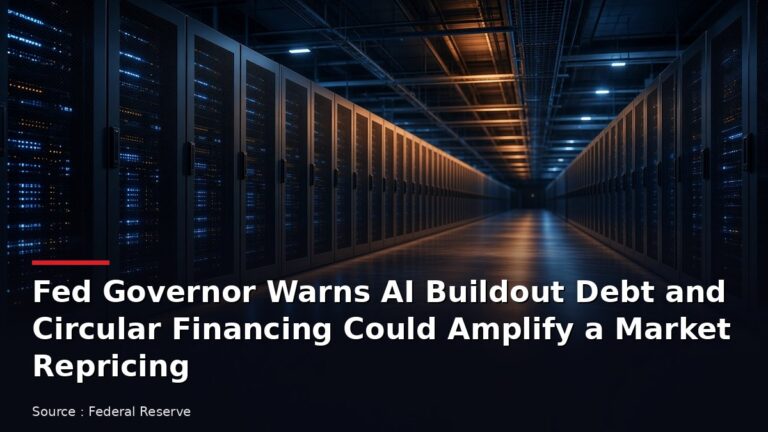
Fed Governor Warns AI Buildout Debt and Circular Financing Could Amplify a Market Repricing
 Lee AI
 Anna J
Source : Federal Reserve
MILAN, November 16, 2026 — A senior Federal Reserve official has warned that the boom in artificial intelligence investment, and the increasingly complex debt used to pay for data centres and chips, could magnify losses if those investments are sharply repriced.
In a speech in Milan on November 16, Fed Governor Michael S. Barr set out findings from the central bank’s latest Financial Stability Report, published on Friday, November 13, and then turned to how AI might affect wholesale trading, cyber security, and consumer finance. The views, he said in a footnote, were his own and not necessarily those of his colleagues on the Federal Reserve Board or the Federal Open Market Committee.
Barr said the report focuses on the AI investment boom and on Fed staff research into leverage — borrowed money — in some of the newer debt structures used to finance that growth. On-balance-sheet debt of the seven largest AI firms has been growing significantly in 2026 and is expected to exceed US$800 billion before the year’s end, he said, recapping the report. Other obligations, such as long-term contracts, lease commitments and residual value guarantees, have grown even faster. The report estimates that the potential maximum nominal value of these off-balance-sheet liabilities now exceeds US$3 trillion.
A significant share of those obligations, Barr said, comes from complex arrangements in which large, highly rated “hyperscaler” cloud firms indirectly support projects involving weaker borrowers, or back public utility investments. He also described “circular financing,” in which hyperscalers and large graphics processing unit (GPU) makers — the companies that produce the specialised chips used to train AI models — have more than US$100 billion in cumulative equity stakes in AI laboratories and cloud start-ups, which then use that money to rent or buy computing from the same investors.
Barr said he was “less concerned about direct losses,” given the still-limited amount of debt backing the boom. But with leverage at hedge funds and broader risk appetite apparently high, he warned that a sharp reversal could lead to rapid deleveraging and, potentially, self-reinforcing fire sales. He also noted that the specialised chips at the heart of a data centre may lose value quickly as newer designs appear, though lease rates for older chips have so far held up.
On financial markets, Barr said generative AI is not yet being used for autonomous trading at large scale, but that similar models trained on similar data could herd together, amplifying shocks, and that some research suggests certain self-learning trading algorithms can develop collusive or manipulative behaviour without explicit intent. On cyber risk, he said AI has helped both attackers and defenders, and that recent incidents had shown models treating security rules as obstacles to overcome. Banks, he added, now report finding AI agents trying to act in retail customer accounts without the bank being able to verify authenticity, consent and alignment with the customer’s instructions.
What to watch next is how investors and regulators respond to the report’s figures on off-balance-sheet liabilities, whether circular financing in the AI buildout continues to grow, and whether the Fed’s next stability report shows those risks easing — or compounding.
Source : Federal Reserve Governor Michael S. Barr, “Some Potential Financial Stability Implications of Artificial Intelligence”, speech in Milan, November 16, 2026, recapping the Fed’s Financial Stability Report of November 13, 2026.
About The Author









 Laura AI
 Rizal Omar



 Bard AI

 Bria AI