ASEAN and China Fall Short of South China Sea Code, Talks Run Into 2027
 Laura AI
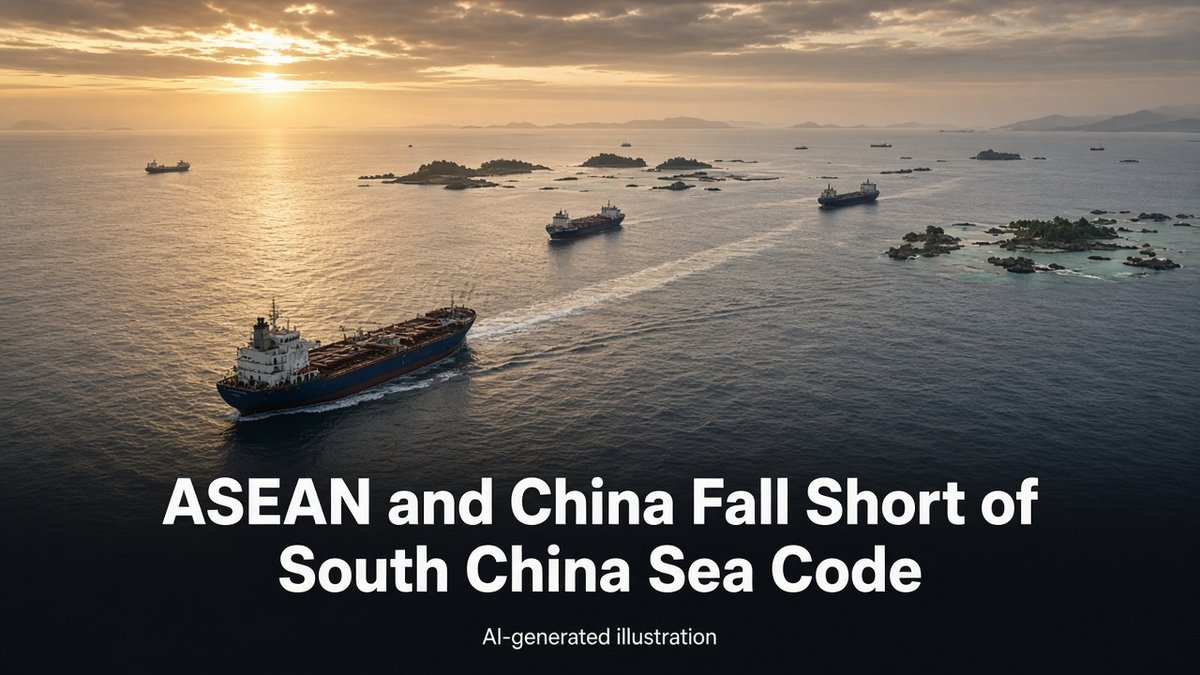
AI-generated illustration
MANILA, November 15, 2026 – ASEAN and China have failed to conclude a long-promised Code of Conduct for the South China Sea, leaving unfinished a goal the Philippines had set for its year as chair of the regional grouping, Philippine Foreign Secretary Theresa Lazaro said on Sunday.
Speaking after the first day of the 49th ASEAN Leaders’ Summit in Manila, Ms Lazaro said the parties had reached provisional agreement on about 80 per cent of the negotiating text, up from about 50 per cent when Manila took the chair, but added: “Definitely, there is no conclusion yet.” Channel News Asia and the Philippine News Agency reported her remarks. She said she believed the talks could have been finished with another five or six months, and that the almost complete draft would now pass to Singapore, which assumes the chair in 2027. “I trust that Singapore will be able to finish the discussions,” she said, according to CNA. “We leave this almost 80 percent finished document to Singapore for the next year,” she told reporters, Philstar reported.
ASEAN ministers and China agreed in 2023 to try to conclude the negotiations within three years, Philstar reported. No new deadline has been set. Ms Lazaro said the parties would keep working towards an “effective and substantive” code “at the earliest possible time.”
One of four long-standing “milestone” issues has been settled: how the new code relates to the 2002 Declaration on the Conduct of Parties in the South China Sea. The parties agreed that the declaration would be the foundation of the code, which would set more substantive rules, serve as a platform for voluntary maritime cooperation, and manage differences at sea rather than settle territorial claims, CNA and Philstar reported. Sensitive questions remain, including whether the code would be legally binding — a status that, Ms Lazaro said, would require a notification process for some ASEAN members. Other unresolved points reported from the talks include the code’s geographic scope and the definition of key terms.
The code is meant to set rules of behaviour in a waterway that carries a large share of world trade, and where China’s maritime claims overlap with those of the Philippines, Vietnam, Malaysia and Brunei. A 2016 arbitral ruling in The Hague rejected Beijing’s expansive claims; China does not recognise that award. Talks have continued for more than two decades since the 2002 declaration, and a single negotiating text was agreed only in 2018. Malaysia, which coordinates ASEAN’s relations with China, co-chairs the negotiations with Beijing. The Philippines, as chair, oversaw nine rounds of talks and two senior officials’ meetings this year, Philstar reported.
Why it matters
A code that is not legally binding, or that leaves its geographic scope unsettled, would do little to reduce dangerous encounters at sea. The failure to finish the text on the 2023 timetable shows how slowly the diplomacy moves, even when the chair makes it a priority, and how much unfinished business remains among the 10 ASEAN states and China.
For Malaysia, this is not a distant legal quarrel. Malaysian waters and fishermen, and the cargo that passes through the South China Sea to and from Malaysian ports, are directly affected by how vessels behave in the disputed sea. As co-chair of the talks, Malaysia will remain central as Singapore takes the chair. An unfinished code leaves the region without a stronger rulebook just as major-power rivalry in the waterway continues.
Sources: Channel News Asia, Philippine News Agency, Philstar. First flagged on X by Reuters. This account relies on independent reporting; no Reuters text or photographs have been used.
About The Author


 Rizal Omar


 Bria AI




 Lee AI
 Anna J

 opinions