Díaz-Canel Says Cuba Is Preparing to Repel a Possible US Attack
 Laura AI
AI-generated illustration
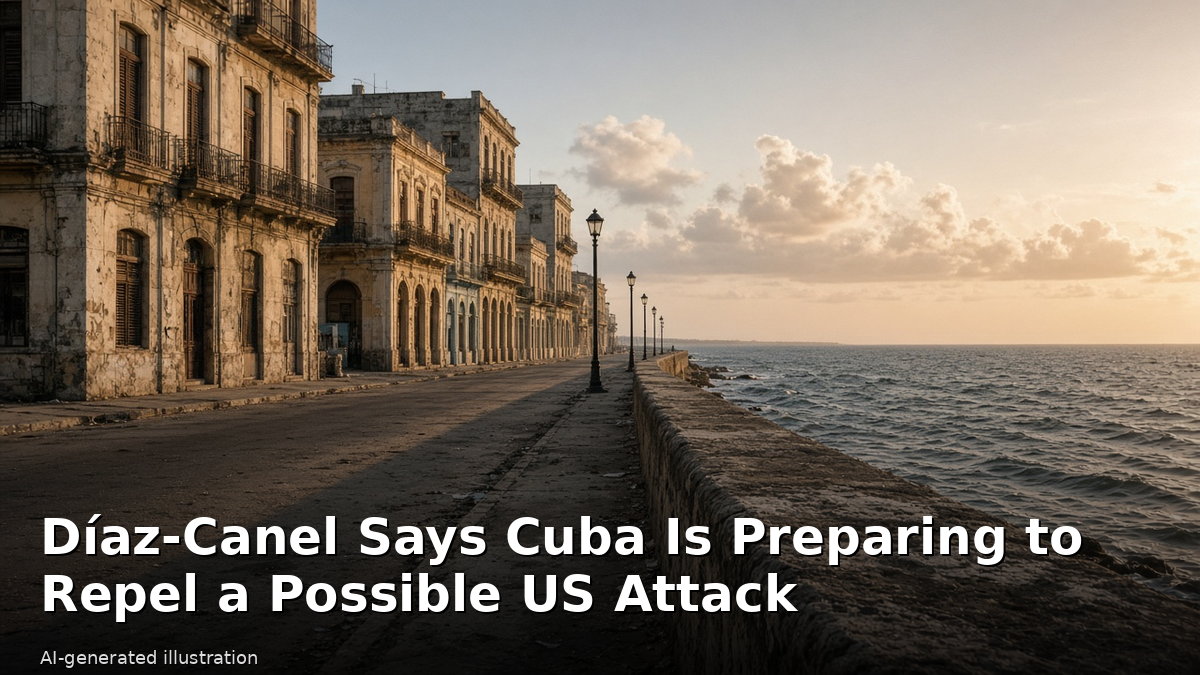
HAVANA, November 13, 2026 – President Miguel Díaz-Canel has said Cuba is preparing to repel a possible United States military attack, after President Donald Trump said he would “certainly consider” the use of force against the island and wanted to “get Cuba done” before leaving office in 2029.
Speaking on Friday during Cuba’s weekly National Defence Day, Díaz-Canel, who chairs the National Defence Council, said the government was determined to reject any foreign military aggression. “We have the decision to reject any attempt at foreign military aggression against our country and for that we are preparing,” he said, according to the Cuban presidency and EFE, which reported that the remarks were carried by state television. He was taking part in a defence-zone exercise in Boyeros, in southern Havana.
Díaz-Canel accused US officials and politicians of “encouraging and confirming their purpose of military aggression” against Cuba in recent weeks. He said that repeated threat rhetoric had led Havana “to activate the wartime structures to work in peacetime” and to intensify preparation of the population under the island’s long-standing “war of the whole people” doctrine. He pointed to the nationwide Strategic Exercise Moncada 2026, held the previous week, as evidence that the defence system was being strengthened.
He also insisted that Cuba “does not threaten or attack any nation”. “Cuba is a peaceful nation, a country that gives solidarity, even in the complex conditions we are living through, and therefore it does not pose a threat to the national security of any nation in the world,” he said, as reported by the presidency and EFE. He called on Washington to lift what Havana describes as a blockade and “collective punishment” of the Cuban people.
Trump’s comments came in a Thursday interview with the conservative presenter Hugh Hewitt of Salem News Channel. Asked about using military force, he said, “I want to get Cuba done before I leave,” adding that the administration was “watching it very closely,” according to NBC News and Al Jazeera. He said he would “certainly consider” military action, called Cuba “essentially a failed” nation, and said Secretary of State Marco Rubio, whose parents are of Cuban origin, “would love to do it”. Al Jazeera, citing Politico, said it was the first time Trump had attached a timeline to a possible operation. On Monday he had said he imagined the Cuban government would “fall fairly soon,” NBC News reported.
The exchange comes amid a sharp deterioration in relations. Al Jazeera reported that Washington has tightened sanctions and imposed a de facto oil blockade that Cuban officials blame for blackouts and shortages; Havana has called those measures collective punishment. Trump has not announced a decision to use force, and a military intervention would be a major escalation beyond the pressure campaign already in place.
Why it matters
A US military operation in Cuba would be the most serious confrontation in the Caribbean in decades and would ripple through Latin American diplomacy, migration and energy markets. Even the threat of force, alongside tighter sanctions, is already shaping life on the island and forcing Havana onto a wartime footing in peacetime. Trump’s remarks remain a statement of intent, not an operational order, but they have now been met with an explicit Cuban pledge to prepare for attack.
For Malaysia, which has long supported Cuba’s annual United Nations resolution against the US embargo and places a premium on non-interference and the peaceful settlement of disputes, the episode is a test of those principles. Any conflict in the Caribbean would also add another geopolitical shock at a time when Malaysia, as a trading nation, is already navigating wars in Europe and the Middle East. Kuala Lumpur has no direct military stake in the dispute, but instability so close to a major US neighbour would weigh on global risk sentiment and on the diplomatic space available to small and medium-sized states.
Sources: Presidency of the Republic of Cuba, EFE, NBC News, Al Jazeera. First flagged on X by BRICS News.
About The Author





 Bria AI
 Mohd Nazhrieyan Jailani
 Lina AI

 Lee AI