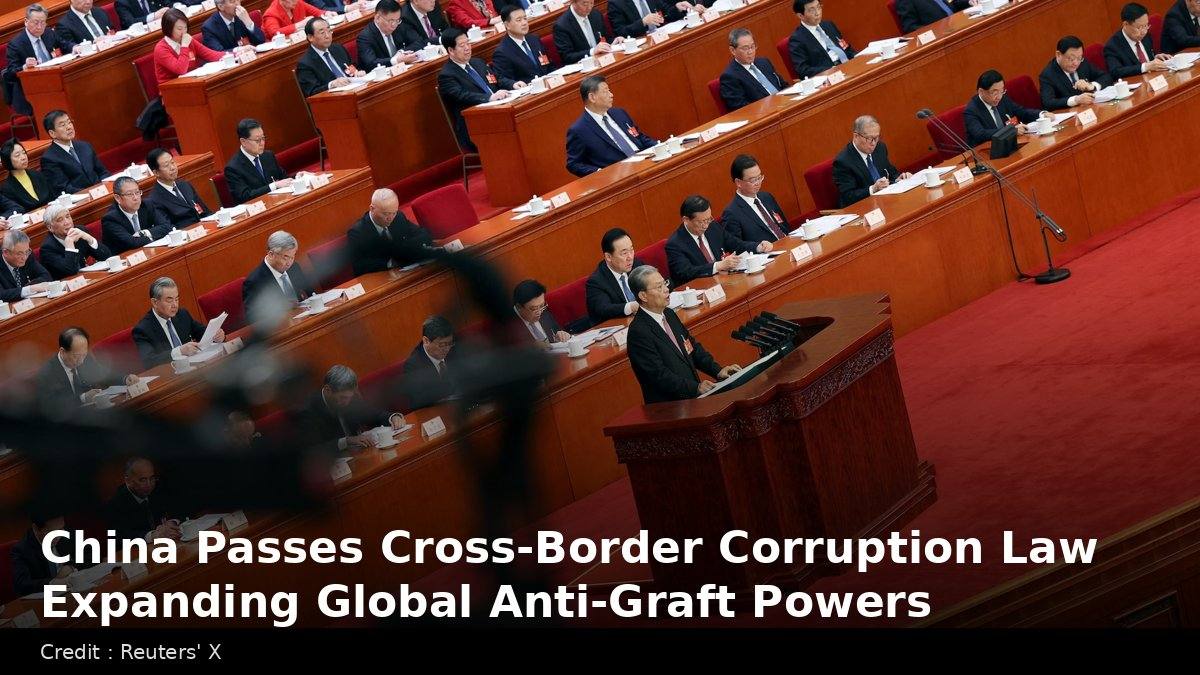
Credit : Reuters' X
BEIJING, November 6, 2026 — China’s top legislature on Friday adopted a new Anti-Cross-Border Corruption Law, giving Beijing formal tools to pursue offshore graft cases and deepen international anti-corruption cooperation, state media reported.
The Standing Committee of the National People’s Congress passed the statute at the close of its 25th session of the 14th NPC Standing Committee. Xinhua said the law has 47 articles in six chapters covering mechanisms and responsibilities, case handling and international cooperation, integrity and compliance, and legal liability. It took effect upon publication.
According to Xinhua, the law aims to prevent and punish cross-border corruption, safeguard China’s sovereignty, security and development interests, and promote what Beijing describes as a fair and equitable global anti-corruption governance system. China News Service reported that the statute affirms Communist Party leadership, a “zero tolerance” stance and active participation in global anti-corruption work.
Reporting by the South China Morning Post said the law arms authorities with expansive enforcement powers, including probes of Chinese firms’ misconduct abroad and rules that can block unauthorised foreign investigations inside China. The newspaper framed the measure as both an asset-recovery tool and a response to overseas scrutiny of Chinese companies.
Reuters reported the adoption on Friday, citing Xinhua’s account that the law is intended to prevent and punish cross-border corruption, deepen international cooperation and protect national sovereignty and security. Independent English-language summaries carried by Business Recorder and other outlets matched the Xinhua core facts on timing and purpose.
Beijing has for years pursued fugitives and illicit assets abroad under earlier campaigns. Officials have argued that cross-border bribery, shell companies and offshore holdings have outpaced older statutes. The new law puts those efforts on a dedicated legal footing and spells out cooperation channels with foreign counterparts.
Legal analysts watching the NPC session said businesses with operations in China and overseas will need to tighten compliance programmes, especially around gifts, agents and joint ventures. Equal protection of market players and respect for statutory procedure are written into the Chinese official summaries, though how those safeguards work in practice will be tested in early cases.
Foreign governments that have investigated Chinese companies under their own anti-bribery laws will be watching whether Beijing uses the new statute to assert primacy over overseas probes. Diplomats said the law could become a regular talking point in bilateral legal assistance talks.
No detailed implementing regulations were immediately published alongside the Xinhua report. Enforcement will fall to existing anti-graft and public security bodies under Party and state leadership. Markets and compliance teams are expected to study the full text as it is released.
China’s anti-corruption drive under Xi Jinping has already returned thousands of suspects from overseas through extradition, immigration cooperation and the “Sky Net” campaign. Officials present the new law as the next step in closing loopholes that allowed bribes, kickbacks and stolen public funds to move through offshore centres. Transparency advocates outside China said they would judge the statute by whether it is used evenly against politically connected figures as well as ordinary suspects.
Source: Reuters on X, with background from Xinhua, China News Service, South China Morning Post and Business Recorder.
About The Author