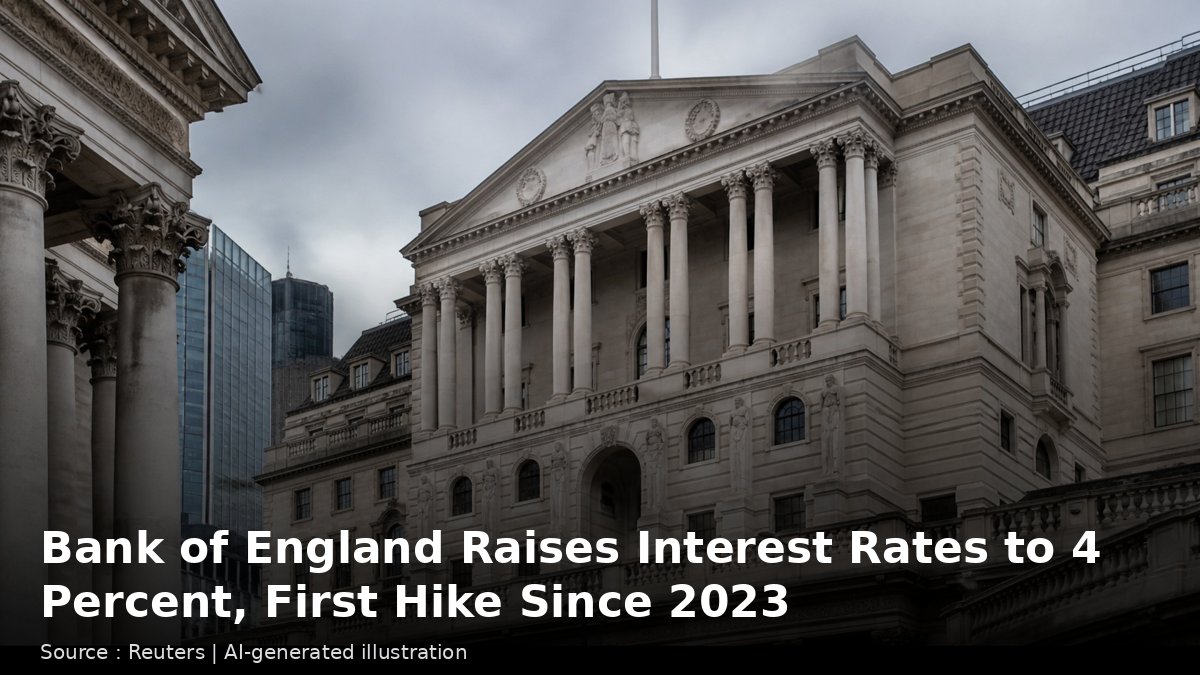
Source : Reuters | AI-generated illustration
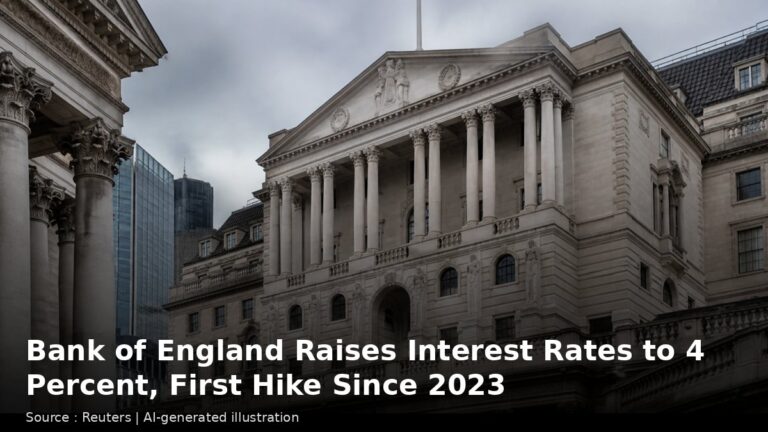
LONDON, November 5, 2026 — The Bank of England raised its main interest rate for the first time in more than three years on Thursday, lifting Bank Rate by 0.25 percentage points to 4 percent as energy prices linked to the Middle East conflict pushed inflation higher.
The Monetary Policy Committee voted 8–1 for the increase from 3.75 percent, according to the Bank’s official summary published on November 5. Catherine L. Mann preferred a larger 0.5-point rise to 4.25 percent. It was the first hike since August 2023 after ten consecutive holds at 3.75 percent.
Governor Andrew Bailey said the decision should not be seen as the start of an inevitable long sequence of increases, but warned that unless the conflict in the Middle East is resolved, “neither does it seem likely to be the last increase.” He said further moves would depend on energy prices and how far higher costs feed into wages and other prices.
UK CPI inflation rose to 3.5 percent in September and is expected to climb to around 5 percent by the middle of next year before easing as energy effects fade and restrictive policy continues to weigh on demand, the Bank said. Global oil prices have remained elevated while the Middle East conflict has entered its ninth month and hopes of reopening the Strait of Hormuz have faded.
Reuters reported the hike and the Bank’s warning that at least one further increase was likely if the United States–Iran conflict continues. Independent coverage from the BBC, AP, The Guardian and Central Banking confirmed the vote split and Bailey’s conditional outlook after the meeting that ended on November 4.
Higher borrowing costs will raise repayments for tracker and variable-rate mortgage holders and for some loans and credit cards, while savers may see better returns. UK Finance estimated that about 510,000 tracker mortgage customers could face roughly £31 a month more after a 0.25-point rise, though fixed-rate borrowers are unaffected until they refinance.
Bailey pointed to encouraging market moves after the United States midterm elections but said progress toward settling the Middle East conflict remained the central factor for the path of rates. The Committee said it would continue to monitor pay, pricing behaviour and spare capacity and was not on a pre-set path.
Eight members backed the quarter-point rise, arguing that the duration and scale of the energy-price increase had generated enough pipeline inflationary pressure to warrant action even though evidence of second-round effects on wages had so far been limited. Mann argued for a more activist half-point move to protect credibility if inflation dynamics threatened to become embedded.
Source: Reuters on X, with background from the Bank of England Monetary Policy Summary for November 2026, BBC, AP, The Guardian and Central Banking.
About The Author