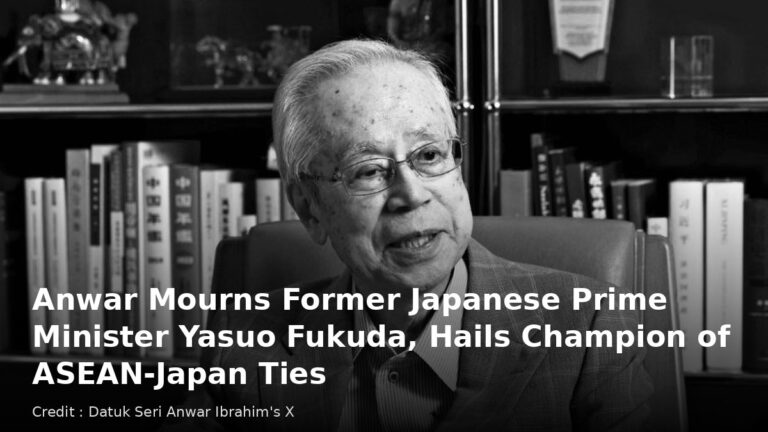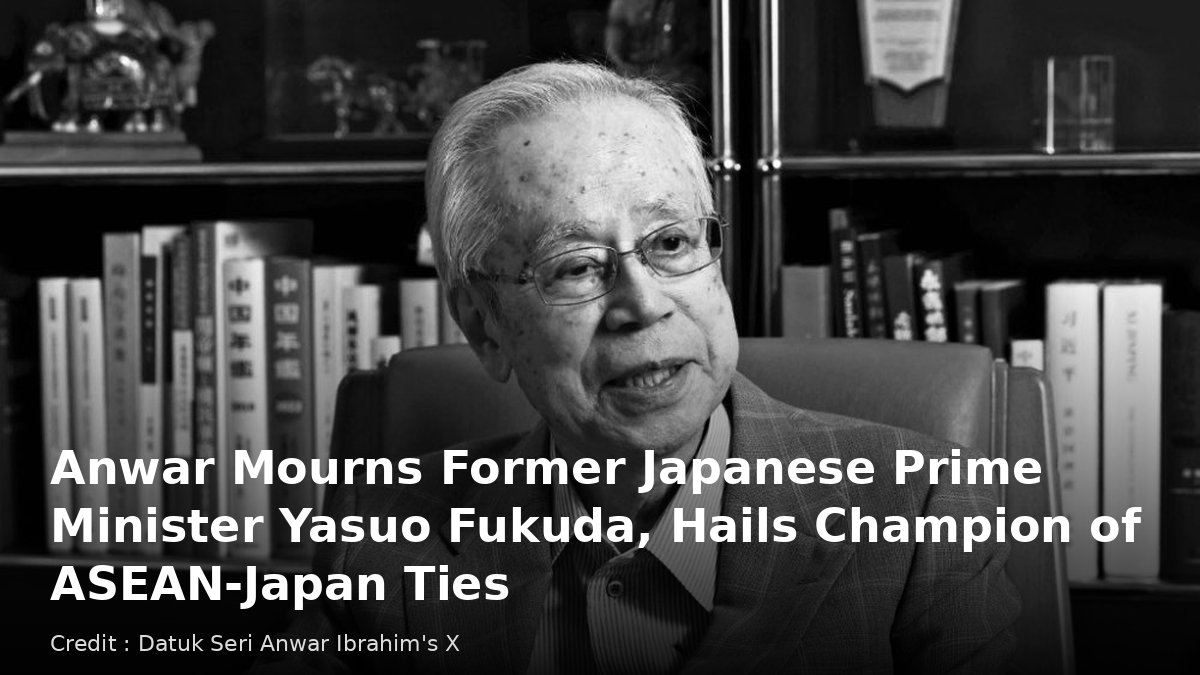
Credit : Datuk Seri Anwar Ibrahim's X
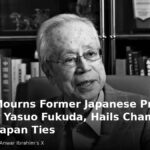
Prime Minister Datuk Seri Anwar Ibrahim has expressed his sorrow over the passing of former Japanese Prime Minister Yasuo Fukuda, describing him as a statesman who devoted much of his public life to advancing understanding, friendship and cooperation among the nations of Asia.
In a statement shared on his official X account on October 28, Anwar said Fukuda’s steadfast commitment to ASEAN-Japan relations was rooted in the conviction that lasting peace and shared prosperity must be founded upon mutual trust, respect and a common sense of purpose.
“In carrying forward the spirit of the Fukuda Doctrine, he upheld a vision of Asia where differences could be bridged through dialogue, and cooperation would prevail over confrontation,” Anwar wrote.
“On behalf of the Government and people of Malaysia, I extend my deepest condolences to his family and the people of Japan,” said the Prime Minister, who signed off the message in his own name.
Fukuda died in Tokyo on October 22 at the age of 90, according to Japan’s ruling Liberal Democratic Party, which announced his passing on Monday, October 26. Japanese media reported that he died of heart failure at a Tokyo hospital. Born in Tokyo in 1936, he led Japan from September 2007 to September 2008, taking office after the abrupt resignation of Shinzo Abe. He also served for many years as Chief Cabinet Secretary before becoming prime minister.
Fukuda was the son of former Japanese leader Takeo Fukuda, and the two became the country’s first father-and-son pair to serve as prime minister. During and after his brief tenure, the younger Fukuda was widely regarded as a proponent of steadier ties between Japan and its Asian neighbours, and he spent years afterwards working to build better relations with China.
The Fukuda Doctrine referred to by Anwar dates back to his father’s time in office. On August 18, 1977, at the end of a tour of Southeast Asia that followed a Japan-ASEAN summit in Kuala Lumpur that same month, Takeo Fukuda delivered a landmark speech in Manila setting out three principles for Japan’s relations with the region. Japan, he said, was committed to peace and rejected the role of a military power; it would build mutual confidence and trust with Southeast Asian nations based on “heart-to-heart” understanding; and it would be an equal partner of ASEAN and its member countries.
The doctrine has since been seen as a cornerstone of Japan’s post-war engagement with Southeast Asia, and Anwar’s tribute highlighted how the younger Fukuda carried that spirit forward in his own diplomacy.
In Tokyo, Japanese Prime Minister Sanae Takaichi said she had visited Fukuda’s bereaved family to pay her final respects and was deeply saddened by his passing. She noted that, as prime minister, he placed particular emphasis on consumer affairs to ensure the safety and peace of mind of the Japanese people, and that as chair of the G8 Hokkaido Toyako Summit in 2008 he significantly raised Japan’s profile on the world stage.
Malaysia and Japan have long enjoyed close ties, and Anwar’s message adds Malaysia’s voice to the tributes being paid across the region to a leader remembered for his belief that Asia’s future lay in dialogue, trust and cooperation.
Source: Datuk Seri Anwar Ibrahim on X
About The Author