Source : @fahmi_fadzil
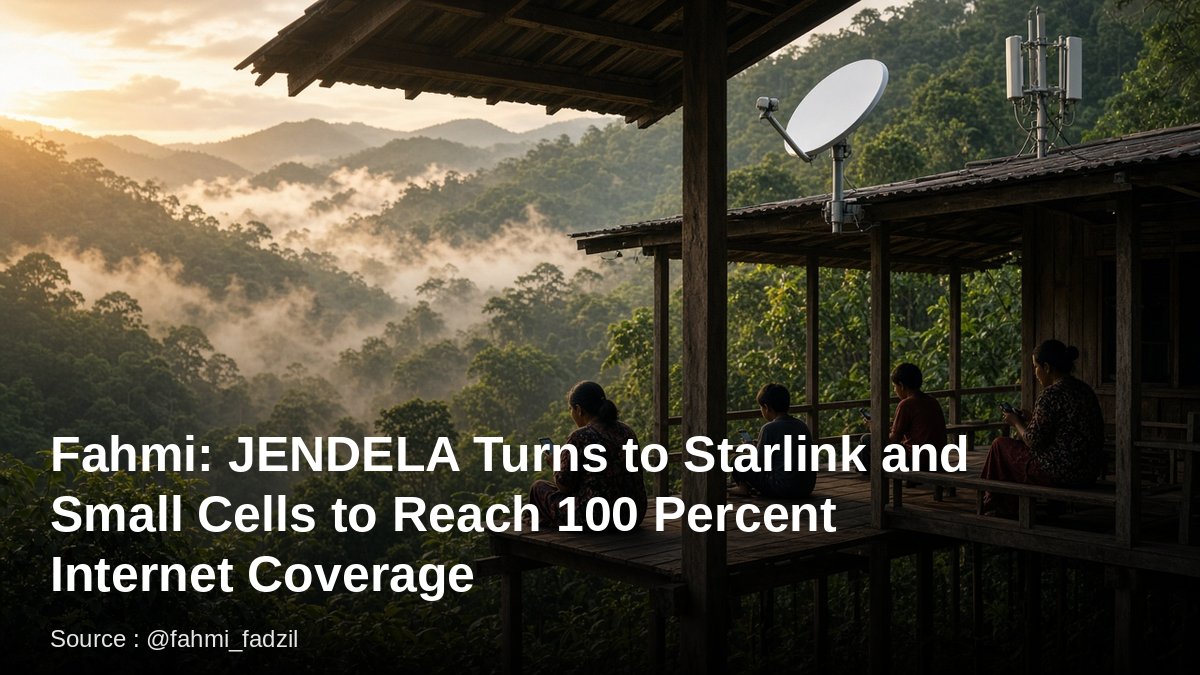
KUALA LUMPUR, October 27, 2026 – Malaysia’s National Digital Network initiative, JENDELA, is being reshaped to rely on Starlink satellite links and small cells so that every populated area in the country, including the most remote interior settlements, can finally get Internet coverage, Communications Minister Datuk Seri Fahmi Fadzil has said.
Fahmi highlighted the plan on his X account on October 27, quoting a post from the Information Department of Malaysia (Jabatan Penerangan Malaysia) with a Wi-Fi and Malaysian flag emoji. The department’s post, translated from Malay, said: “The JENDELA initiative is being improved through the use of Starlink technology and small cells, with an allocation to achieve the target of 100 percent Internet coverage in populated areas, including the interior.”
The minister first set out the approach on the evening of October 26, when he appeared as a guest on the Astro AWANI talk show Agenda AWANI, in an episode titled “Budget 2027: Closing the Digital Gap, Driving the Creative Economy.”
“We might not build telecommunication towers everywhere. In some places, we will install Starlink, in others, small cells sufficient for the 40 to 50 people living there. The goal is to ensure 100 percent coverage in populated areas, including the most remote locations,” Fahmi said, as reported by the national news agency Bernama.
“Building a tower is costly, so we will deploy solutions better suited to the community. As the community grows, we can upgrade the technology later,” he added.
Closing the final one percent
According to Fahmi, Internet coverage in populated areas has now reached 99 percent. The remaining one percent, he said, needs more practical solutions that fit the geography and the size of each community, rather than the conventional approach of putting up a tower in every location.
He also pointed to a gap that many Malaysians will recognise. “We also noticed another issue. In many Felda settlements, the coverage is good, but once you get onto the trunk roads connecting these settlements to towns, there is often no signal. This poses a danger, so JENDELA will focus on equipping such areas with coverage,” he said.
Felda settlements are the land development schemes run under the Federal Land Development Authority, home to many rural farming communities.
Broadcaster RTM reported that the revamp also shifts JENDELA’s focus from Coverage of Populated Areas (COPA) toward coverage of economic areas, so that connectivity directly supports local economic activity. Fahmi added that high-speed infrastructure has to go hand in hand with better digital literacy and online safety awareness to curb cybercrime and online scams, and that the government will continue to strengthen the 1,099 National Information Dissemination Centres (NADI) nationwide.
JENDELA 2 and the push into the interior
The latest comments build on what Fahmi said in Melaka on October 10, the day after Prime Minister Datuk Seri Anwar Ibrahim tabled Budget 2027. Speaking then about the second phase of the plan, known as JENDELA 2, Fahmi said it covers about 3,000 locations nationwide, each with populations ranging from 20 to 30 people up to 200 to 300 people.
He said the first phase, covering 1,000 sites, was split evenly between the peninsula, Sabah and Sarawak, while the remaining 2,000 sites in the second phase are largely in the interior of Sarawak and Sabah, with some locations in the peninsula. Only about a third of all JENDELA 2 sites are expected to involve building a telecommunications tower, with the rest using other solutions suited to local conditions. The Malaysian Communications and Multimedia Commission (MCMC) is handling vendor selection.
Fahmi said at the time that newer Starlink terminals, which are smaller, portable and use less power, make the satellite service a good fit for low-density areas with difficult terrain and thick vegetation, including Orang Asli villages. The Budget 2027 speech also pledged to extend 4G coverage to all Orang Asli villages next year.
JENDELA was launched in 2020 as the government’s national plan to improve broadband coverage and quality, and it has since been expanded in stages to reach rural and remote communities.
Source: Fahmi Fadzil on X, with additional reporting from Bernama, RTM and Malay Mail.
About The Author