Source : BRICS NEWS
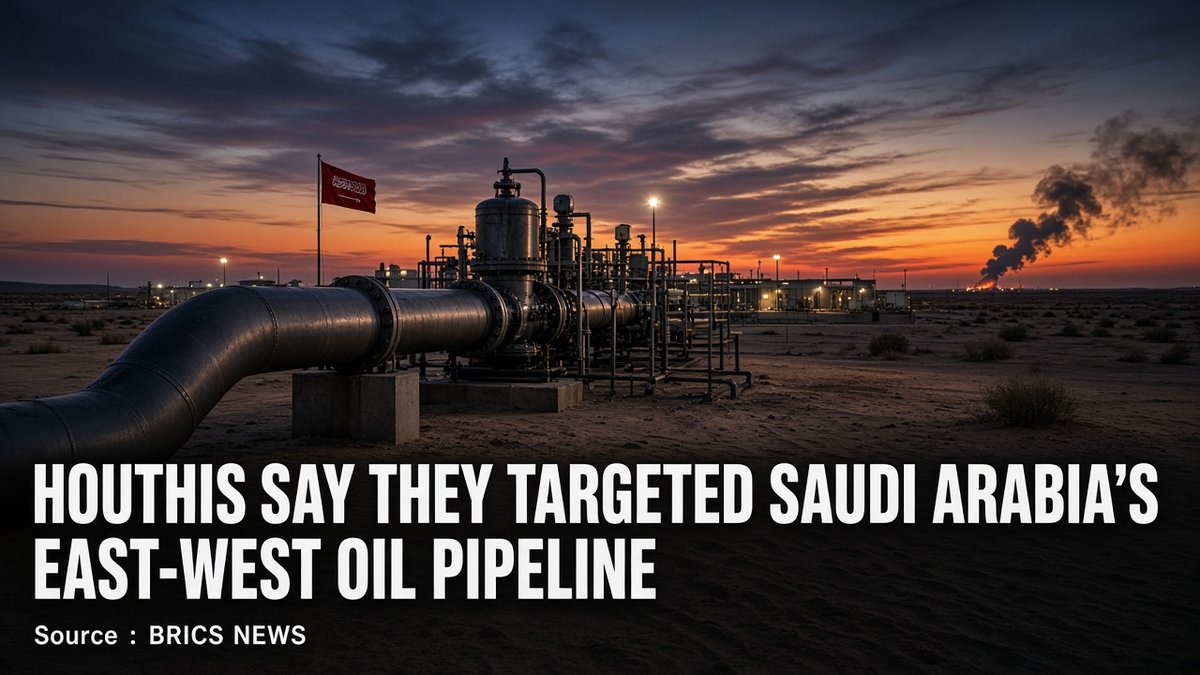
Yemen’s Houthi movement says it has targeted Saudi Arabia’s East-West oil pipeline, according to a report by BRICS News on October 26, 2026, marking the latest in a string of claimed attacks on the kingdom’s energy infrastructure.
“JUST IN: Yemen’s Houthis say they targeted Saudi Arabia’s East-West oil pipeline,” BRICS News posted on X on Monday morning. The post did not give details of the weapons used, the exact location along the pipeline that was hit, or whether any damage was caused. There was no immediate response from Saudi authorities to the latest claim at the time of writing.
The claim comes only two days after the Iran-allied group said it had struck a wide range of Saudi targets. On Saturday, October 24, Houthi military spokesman Yahya Saree said the group had targeted King Khalid International Airport in Riyadh, an Aramco facility in Yanbu, the Rabigh oil refinery, crude oil pumping stations and the East-West Pipeline, as well as King Fahd International Airport in Dammam, an airport in Najran and an air base in Khamis Mushait, Reuters and AFP reported.
The Saudi-led coalition said at the time that it had destroyed two ballistic missiles fired by the Houthis towards Yanbu and Taif. Saudi Civil Defense reported that debris from intercepted missiles had fallen in the Mecca and Medina regions, as well as in areas of Jeddah, Taif and Rabigh. The Houthis later denied attacking Mecca and Medina, saying their operations “target Saudi oil facilities and military bases”, according to Reuters.
The Saudi Press Agency has since reported that attacks on energy facilities reduced the kingdom’s oil production and flows through the East-West Pipeline, and Saudi Arabia’s energy minister said two pump stations on the line had been attacked, describing the sabotage as targeting global oil supply.
Why the pipeline matters
The East-West Pipeline, also known as Petroline, carries crude oil roughly 1,200 kilometres across Saudi territory from Abqaiq in the Eastern Province to the port of Yanbu on the Red Sea. It allows Saudi Aramco to export oil without sending tankers through the Strait of Hormuz, the narrow waterway at the mouth of the Gulf through which a large share of the world’s seaborne oil normally passes.
Built in the early 1980s during the Iran-Iraq war to protect exports from attacks on Gulf shipping, the line has taken on fresh importance this year as tensions linked to the conflict involving Iran have disrupted traffic through Hormuz. Yemeni outlet Daily Yemen reported that the pipeline’s operating capacity had been raised to about seven million barrels per day in 2026, and that it had been knocked out of service for around 10 days after a drone attack in early September, citing industry tracking data, and halted again after a further attack in early October.
Markets on edge
Oil markets have been highly sensitive to the attacks. Regional business outlet 60 Arabia reported on October 24 that Brent crude was trading above $116 per barrel as traders weighed Aramco’s ability to keep crude flowing around Hormuz. Any further disruption to the East-West route would add pressure on global supplies, analysts have warned.
A widening conflict
The fighting between the Houthis and Saudi Arabia has shattered a truce that had largely held since 2022. Alongside its strikes on the kingdom, the group has been clashing with Saudi-backed Yemeni government forces, and Yemen’s government said the Houthis fired three ballistic missiles at coast guard sites in the southern port city of Aden on Saturday, Reuters reported.
It was not immediately clear whether Monday’s claimed attack had hit its target or been intercepted. LNA will update this story as more information becomes available.
Source: BRICS News on X, with additional reporting from Reuters, AFP, the Saudi Press Agency, 60 Arabia and Daily Yemen.
About The Author