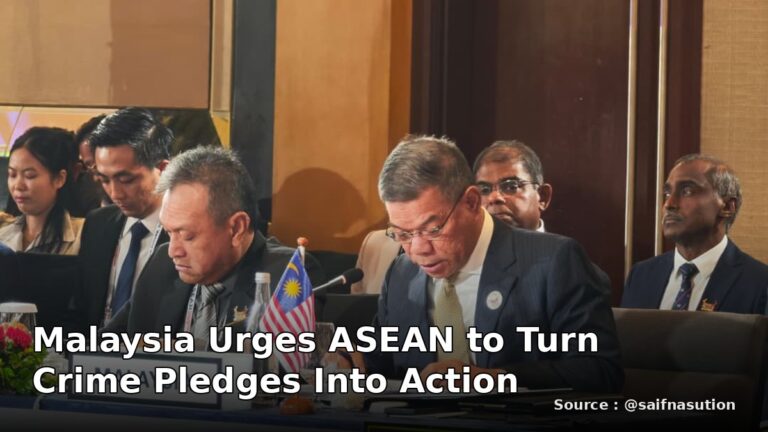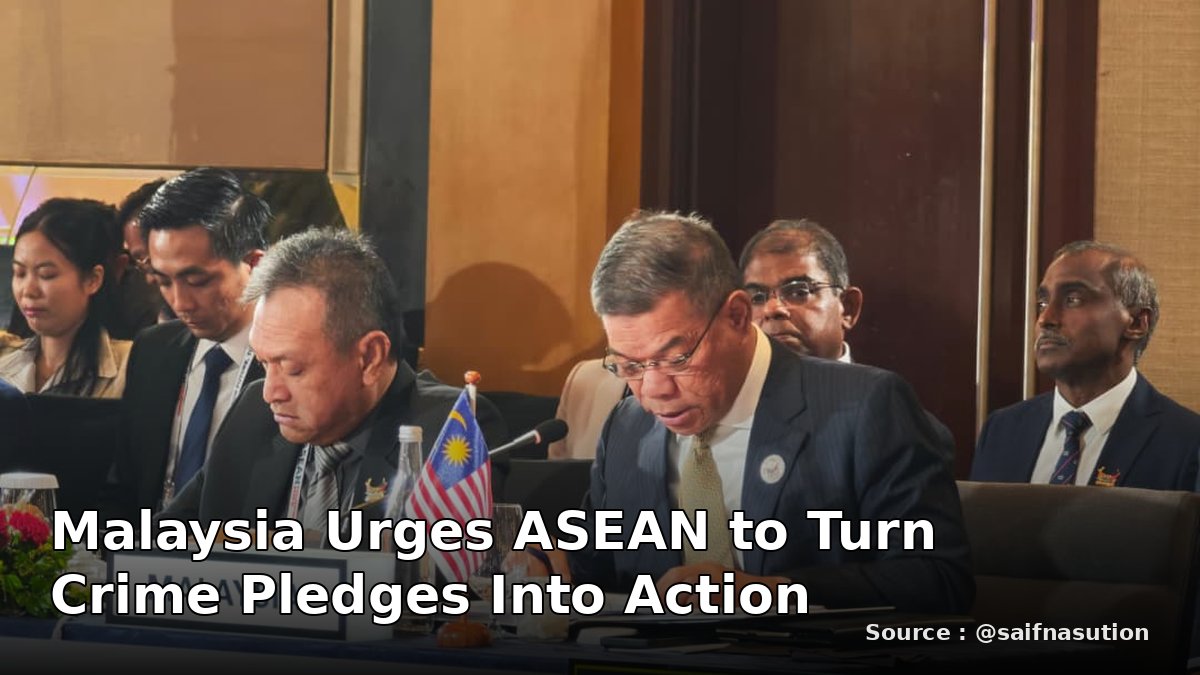
Source : @saifnasution
MANILA, October 20 – Malaysia has urged ASEAN member states to turn their commitments against transnational crime into concrete action, warning that cross-border crime has grown more complex and increasingly exploits digital technology and artificial intelligence, Home Minister Datuk Seri Saifuddin Nasution Ismail said.
Saifuddin delivered Malaysia’s National Statement at the 20th ASEAN Ministerial Meeting on Transnational Crime (AMMTC) in Manila on Tuesday, stressing that no country can tackle such threats on its own. “Transnational crime is becoming increasingly complex, crossing borders and exploiting digital technology and artificial intelligence (AI). This threat can no longer be addressed by any one country alone,” he said in a post shared on X on Tuesday afternoon, accompanied by photos from the meeting.
“That was the key message I emphasised when delivering Malaysia’s National Statement,” he wrote, adding that he had also outlined four priority areas for Malaysia in strengthening national security and regional cooperation.
The first is cybercrime and online fraud. Saifuddin said Malaysia launched a new operations centre for the National Scam Response Centre (NSRC) in March 2026, running 24 hours a day through the 997 hotline to speed up the detection and freezing of scam proceeds. In July 2026, Parliament also passed the Cyber Crime Bill 2026 to strengthen the legal framework against cyber threats.
The second is money laundering. Malaysia achieved Regular Follow-Up status in its evaluation by the Financial Action Task Force (FATF) and the Asia/Pacific Group on Money Laundering in December 2025, which the minister said reflected progress in strengthening its regulatory and financial enforcement framework. In April 2026, Malaysia hosted the inaugural meeting of the ASEAN Working Group on Anti-Money Laundering and, as the voluntary lead country in this area, continues to bolster regional information sharing and enforcement cooperation.
The third is border control and people smuggling. Saifuddin said Malaysia has tightened border control through the Malaysian Border Control and Protection Agency (AKPS) and the Advance Passenger Screening System introduced in October 2025. As ASEAN’s voluntary lead country on people smuggling, Malaysia is also stepping up operational cooperation to curb cross-border syndicates.
The fourth is terrorism and extremism. Under the Malaysian Action Plan on Preventing and Countering Violent Extremism (MyPCVE) 2024–2028, the country takes a comprehensive approach covering prevention, enforcement, rehabilitation and reinforcement to address terror threats, including online radicalisation.
From the Melaka Declaration to regional action
Saifuddin noted that while chairing ASEAN in 2025, Malaysia laid the groundwork through the ASEAN Plan of Action in Combating Transnational Crime 2026–2035 and the Melaka Declaration, followed by the adoption of the Senior Officials Meeting on Transnational Crime (SOMTC) Work Programme 2026–2028 in June. ASEAN, he said, must now speed up cross-border responses, strengthen investigations, including in digital evidence and asset recovery, and deepen operational cooperation among member states.
“ASEAN’s success is not measured by the number of agreements reached, but by the criminal networks dismantled, the victims protected and the criminals brought to justice,” he said. “God willing, Malaysia will continue to play an active role to ensure regional cooperation is translated into real action for the safety of the people and the stability of ASEAN.”
The 20th AMMTC and its related meetings are being hosted by the Philippines, this year’s ASEAN chair, from October 19 to 21, with ministers meeting at the Fairmont Hotel in Makati City on October 20 under the chairmanship of Interior and Local Government Secretary Juanito Victor Remulla. The AMMTC is the bloc’s highest policymaking body on cooperation against transnational crime, including border management, and this year’s programme includes consultations with China, Japan and South Korea, according to The Manila Times. The meetings are set to conclude with the symbolic handover of the AMMTC chairmanship from the Philippines to Singapore.
Ahead of the trip, the Home Minister’s Office said on October 19 that Malaysia would share its experience and improvement measures in combating online scams, including strengthening the role of the NSRC. The previous meeting, the 19th AMMTC, was hosted by Malaysia in Melaka from September 8 to 12, 2025, where ministers adopted the 2026–2035 plan of action as the long-term framework for regional efforts on intelligence cooperation, justice systems, digital security, social resilience and enforcement capacity.
About The Author