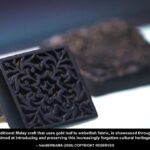
KUALA LUMPUR, Oct 19 (Bernama) – A traditional Malay art of embellishing fabric with gold leaf, known as telepuk, is gaining renewed attention through workshops and exhibitions aimed at preserving the nearly forgotten heritage craft.
Recently, pewter manufacturer and retailer Royal Selangor organised a telepuk workshop at the Royal Selangor Visitor Centre in Setapak, introducing participants to the intricate process behind the traditional art.
The workshop, conducted by cultural organisation Langkasuka Movement, brought together 20 participants, including the writer, to learn the techniques used to create gold-leaf motifs on fabric.
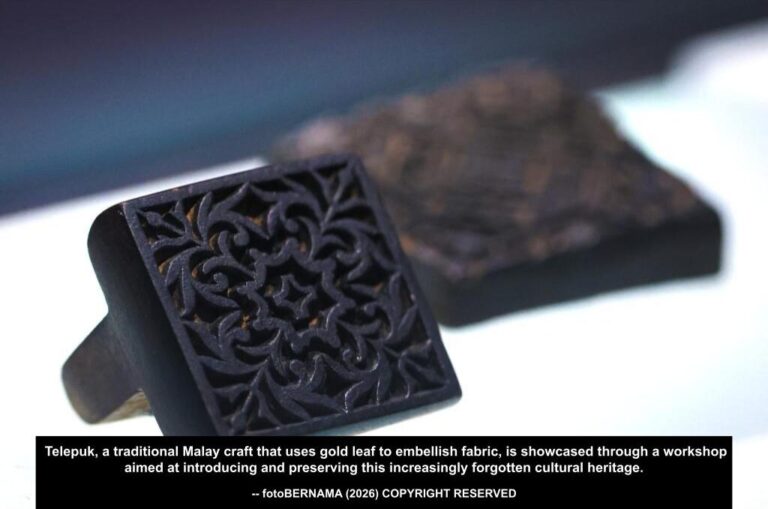
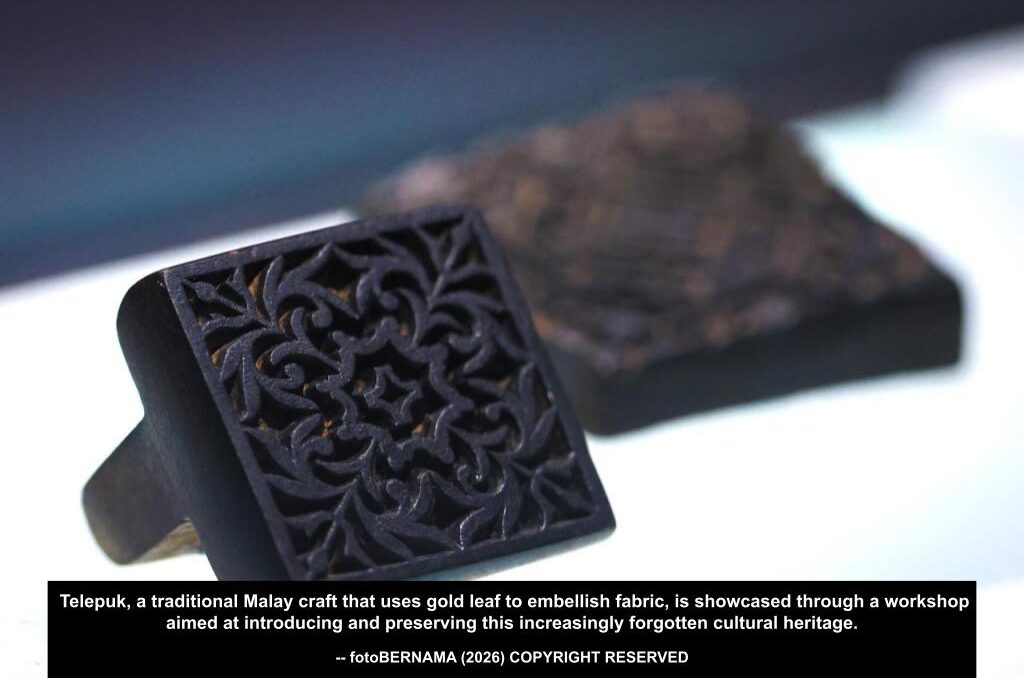
Participants were provided with fabric, carved wooden blocks and gold leaf. Guided by artisans, they applied natural acacia gum to their forearms before transferring the gum-coated motifs onto fabric using the carved blocks.
Gold leaf was then applied to the adhesive patterns, with excess material gently brushed away to reveal intricate floral designs.
The hands-on experience offered participants a closer understanding of the precision, patience and craftsmanship required to produce telepuk textiles, traditionally used for royal ceremonial attire.
Businessman Winston Tham, 50, from Ampang, said the workshop helped him discover an art form he had previously known little about.
“You cannot love what you don’t know. Previously, I had no idea what telepuk was. If it is not preserved, this art will disappear. Perhaps schools could organise workshops to allow students to try their hand at this craft,” he said.
Langkasuka Movement co-founder Intan Jailani said telepuk combines four key skills: weaving, wood carving, grinding and the application of gold leaf.
She said the craft had once fallen dormant for almost 90 years, making documentation and practical training essential to its revival.
Intan added that workshops introducing telepuk had received encouraging responses from participants of different backgrounds, helping raise awareness of the need to preserve traditional Malay craftsmanship.
She is also working on her third book on telepuk, focusing on its motif patterns, as part of efforts to document and pass down the knowledge to future generations.
The workshop was held in conjunction with the exhibition “Telepuk: The Imprint of Heritage”, officiated by the Sultan of Selangor, Sultan Sharafuddin Idris Shah.
Running from Aug 27 to Dec 31 at the Royal Selangor Visitor Centre, the exhibition showcases telepuk textiles, carved wooden printing blocks, tools and materials, alongside demonstrations of the traditional technique.
Among its key exhibits is a mid-19th-century royal attire set known as Baju Sikap, associated with Sultan Sir Abdul Samad and loaned by the Department of Museums Malaysia.
Visitors can also view 77 telepuk wooden blocks carved between 1920 and 1923, which belonged to Selangor’s Sultan Ala’eddin Suleiman Shah. The collection is held at the Victoria and Albert Museum in London and was previously displayed at the British Empire Exhibition in Wembley in 1924 and 1925.
The exhibition also explores the use of alternative materials in traditional embellishment.
Langkasuka Movement co-founder Abdul Razak Aziz said the idea of using tin foil emerged from discussions with Royal Selangor and historical records referring to tin, gold and silver in telepuk work.
He said the group worked with Royal Selangor to explore ways of producing thin tin sheets for use on fabric and traditional Malay headgear, or tanjak.
Although tin foil offers a different appearance from gold leaf, Abdul Razak said it was harder and less pliable, making it more challenging to work with.
He stressed that the use of tin foil remained experimental and was not yet available for commercial sale. The initiative aimed to explore new creative possibilities without compromising the authenticity and original purpose of telepuk.
Royal Selangor has also adapted six patterns from more than a century-old telepuk wooden blocks into pewter plaques for its “Telepuk Collector’s Set”. Two coaster designs featuring telepuk motifs have also been produced.
About The Author