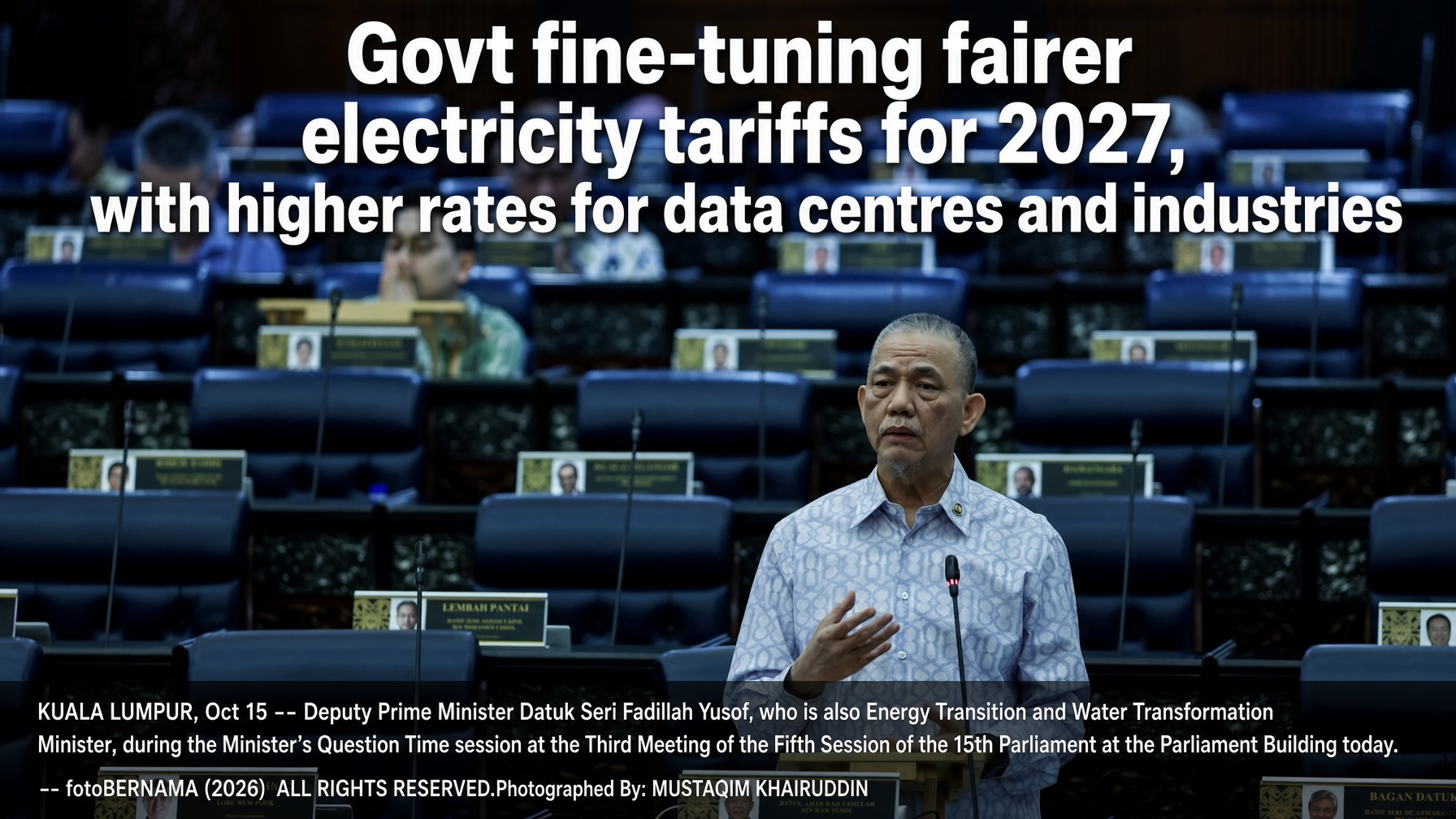
KUALA LUMPUR, Oct 15 2026 — The government is refining a new approach to make electricity tariffs fairer and more aligned with current conditions next year, Deputy Prime Minister Datuk Seri Fadillah Yusof said today.
Fadillah, who is also Energy Transition and Water Transformation Minister, said the Energy Commission (EC) has been directed to carry out a detailed study next year aimed at promoting more efficient energy use.
One option under consideration is a user-pay system, under which high-consumption users such as data centres and industries would be charged different rates from domestic consumers.
“This is to ensure fairer electricity tariffs, particularly to protect domestic consumers,” he told the Dewan Rakyat during Minister’s Question Time.
He was responding to a supplementary question from Azli Yusof (PH-Shah Alam) on the government’s plans to review the exemption for electricity charges for usage of up to 800 kilowatt-hours (kWh) after Dec 31, 2026.
Fadillah said that although electricity generation costs rose sharply following the West Asia crisis, the government had protected domestic consumers using less than 600 kWh from the higher costs. The threshold has since been raised to 800 kWh.
To encourage more efficient energy consumption, the government has introduced several measures, including the “time of use” scheme that offers lower rates during off-peak periods, as well as a RM40 electricity bill rebate for hardcore poor households, backed by a RM55 million allocation for 2026.
It has also set aside RM150 million for the SuRIA Home programme, which provides a rebate of RM600 per kilowatt of alternating current (kWac) for residential solar installations, capped at RM3,000 for systems of up to five kWac. The programme targets 45,000 to 50,000 households, mainly from the M40 group and some from the B40 group who can afford home solar systems.
In addition, the NUR MADANI programme offers a RM200 rebate to individuals who purchase energy-efficient air-conditioners and four- or five-star-rated refrigerators.
“We have implemented many approaches, but more importantly, we are fine-tuning a new approach next year to ensure electricity tariffs are more closely based on consumption, with different rates for domestic consumers and industries, and a different approach for those who consume more energy,” Fadillah said.
“We hope this will ensure a fairer system that is better suited to the circumstances we will face in the coming years.”
About The Author