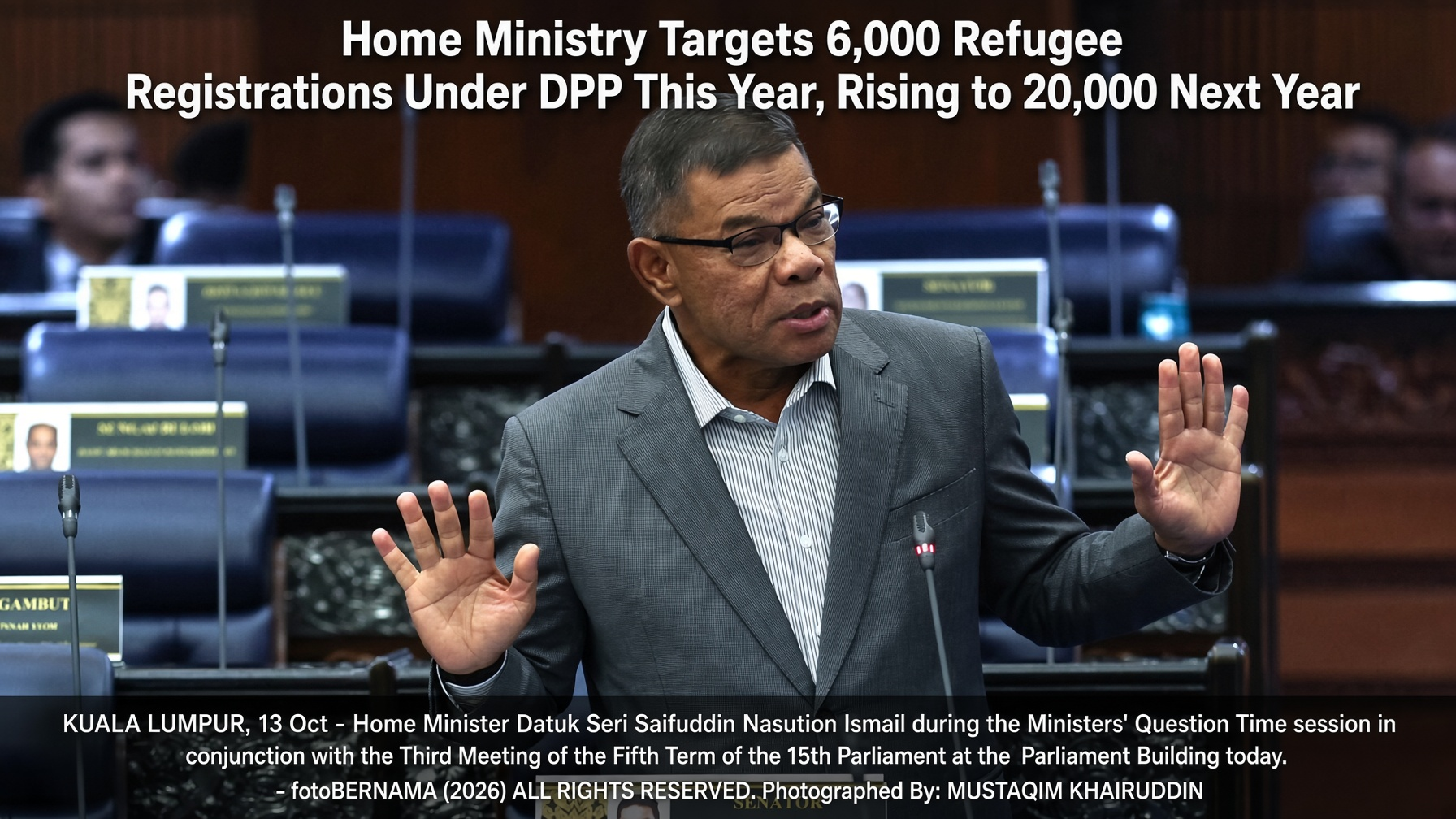
KUALA LUMPUR, 13 October 2026 – The government aims to register about 6,000 refugees under the Refugee Registration Document Programme (DPP) this year, with the projection rising to 20,000 next year, Home Minister Datuk Seri Saifuddin Nasution Ismail said.
Answering a question from Tebrau MP Tuan Jimmy Puah Wee Tse during Ministers’ Question Time (MQT) in the Dewan Rakyat today, Saifuddin stressed that the refugee issue is a long-standing legacy problem spanning decades that must be resolved thoroughly and sustainably to avoid financial, social, economic, political and security burdens on the country.
He noted that UNHCR has stated there are 225,000 refugees in Malaysia, but the data is raw because the government lacks detailed information such as names, locations, ages, genders and their security screening status.
“The government has decided that we need to conduct our own data collection. DPP is a data-gathering process. We collect data — their names, ages, then their locations. There is police screening and immigration screening. We are creating a biometric system so that we have credible data,” he said.
Phase One Targets
For the first phase of DPP, which began in January this year, the government is targeting roughly 4,000 to 4,010 people already held in immigration detention depots, plus another 2,000 outside the depots, bringing the total to around 6,000 this year. Next year the projection will be raised to 20,000 once the process becomes more proficient.
Saifuddin explained that priority is being given to “low-hanging fruit” — those already in depots — before expanding to those outside. The data collected will serve as a security instrument to formulate public policy and more effective law-enforcement mechanisms.
He also outlined three pathways for refugees: resettlement in third countries such as Australia, New Zealand and Canada; voluntary repatriation (recently about 1,400 people were sent back); and deportation if they break the law.
Possibility of Working in Specific Sectors
Responding to a supplementary question on whether refugees registered under DPP might be allowed to work, Saifuddin said the idea has not yet been implemented. He referred to labour needs in five sectors under the 13th Malaysia Plan (RMK-13) — manufacturing, plantations, agriculture, construction and services — with the foreign-worker ceiling capped at 10 per cent of the 17-million workforce, or 1.7 million people.
“Our intention is that labour needs do not necessarily have to be met by bringing people in from abroad. Let me give an example: suppose Pasir Gudang has oil-palm estates that need 100 workers. There are two options — bring them from Bangladesh and pay all the costs, or check against our refugee registration data that we already have,” he said, adding that he does not rule out the possibility of moving in that direction to meet genuine labour needs.
Talks with Myanmar and Warning Against Independent Action
On bilateral discussions with Myanmar leaders, Saifuddin said the issue of the Rohingya and Myanmar nationals was raised in two meetings — a one-on-one between the Prime Minister and the Myanmar President, and discussions involving ministers. The Myanmar government has agreed to accept the return of its nationals of all ethnicities at their own expense, and to cooperate in a screening process to identify its citizens in Malaysia through the ASEAN mechanism.
He also advised the public not to take independent action against refugees who cause unease, but instead to report matters to the authorities such as the police. Activists’ efforts are appreciated as a reflection of public concern, but all actions must follow the rule of law.
To prevent DPP from becoming a pull factor, the government has set a cut-off date of January 2023. Refugees who entered after that date will not be considered under the programme. Saifuddin added that the data-collection process is not new; the government has inherited data on about 30,000 people from an earlier phase, which is now being expanded to ensure the data is more credible and measurable for public-policy formulation.
About The Author