WASHINGTON D.C Sept 4, 2026 – President Donald Trump said Friday that several oil pipelines now under construction across the Middle East offer growing alternatives to the Strait of Hormuz, arguing the waterway is “not what it used to be.”
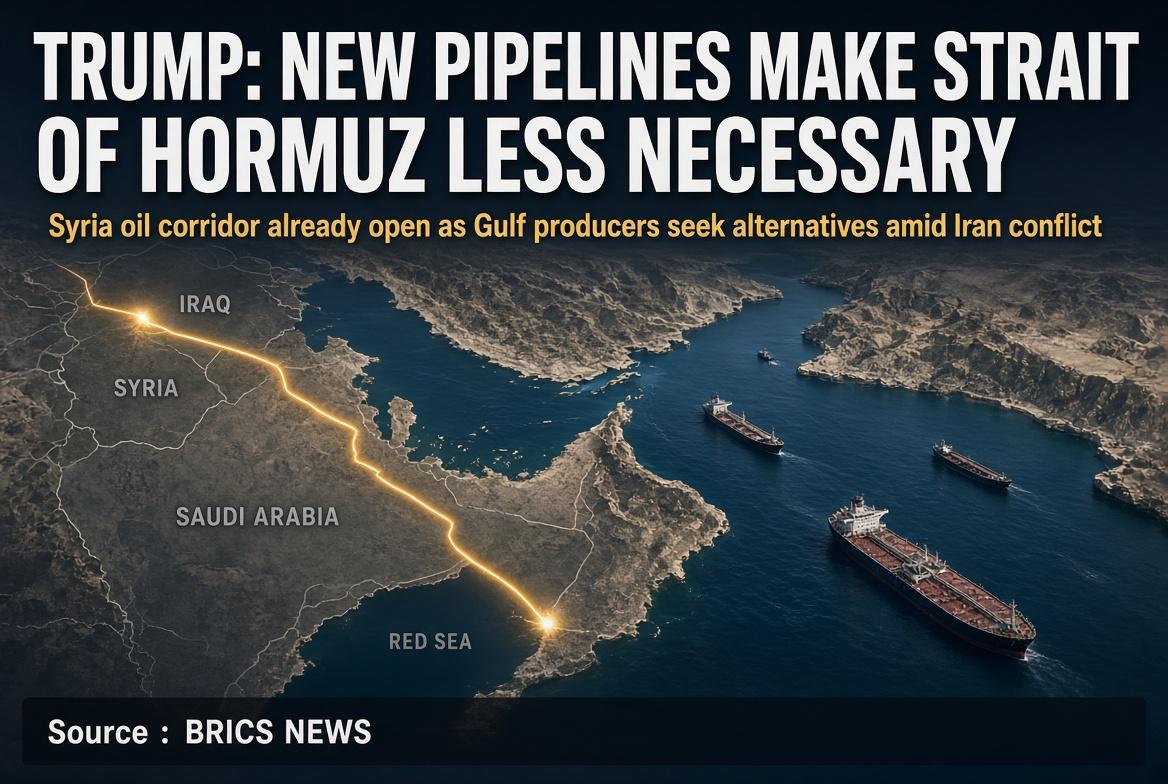
“Pipelines are being built right now,” Trump told reporters. He pointed to a route through Syria that he described as already open, with “massive trucks with oil” using it. “A lot of alternatives are being made to the Hormuz Strait,” he added. “Iran is going to end up with a Hormuz Strait that’s not very necessary anymore.”
The comments come more than six months into a U.S.-Iran conflict that has sharply reduced tanker traffic through the narrow passage linking the Persian Gulf to the Indian Ocean. The strait normally carries about one-fifth of the world’s seaborne oil, or roughly 20 million barrels per day. Shipping volumes have fallen well below those levels for much of 2026.
Trump had earlier praised Syria’s bid to position itself as a land-based energy corridor. On Thursday he shared a report on the plan and wrote, “This is GREAT!” Syria has been promoting its Mediterranean port of Baniyas as an outlet for Iraqi crude, with thousands of oil trucks already moving between southern Iraq and the Syrian coast.
A more ambitious project would replace much of that trucking with a roughly 1,000-mile pipeline from Basra in Iraq to Baniyas. The Trump administration has backed the effort, which involves Chevron and is estimated to cost about $5.7 billion. Officials say it could eventually carry up to 2 million barrels per day, though construction is expected to take at least two and a half years.
Other bypass projects are also advancing. The United Arab Emirates is expanding its Habshan-Fujairah pipeline to double export capacity to the Gulf of Oman by 2027. Saudi Arabia has already increased flows through its East-West pipeline to the Red Sea port of Yanbu. Additional routes through Iraq, Turkey, and Syria are in various stages of planning.
U.S. Treasury Secretary Scott Bessent struck a similar note earlier this week, saying pipelines would render the strait “a worthless piece of water” within two years. He estimated that up to 70 percent of the energy that once moved through Hormuz could eventually travel overland.
Energy analysts note that existing and planned pipelines still fall short of fully replacing the strait’s capacity. Many projects face security, financing, and construction hurdles. Even so, Gulf producers have already shifted a significant share of exports to alternative routes since the conflict began.
The push for overland options reflects a broader effort by the United States and regional partners to reduce the leverage Iran has long held over a critical global energy chokepoint. Whether the new infrastructure can meaningfully lessen that dependence will depend on how quickly the pipelines are completed and how long disruptions in the strait persist.
About The Author