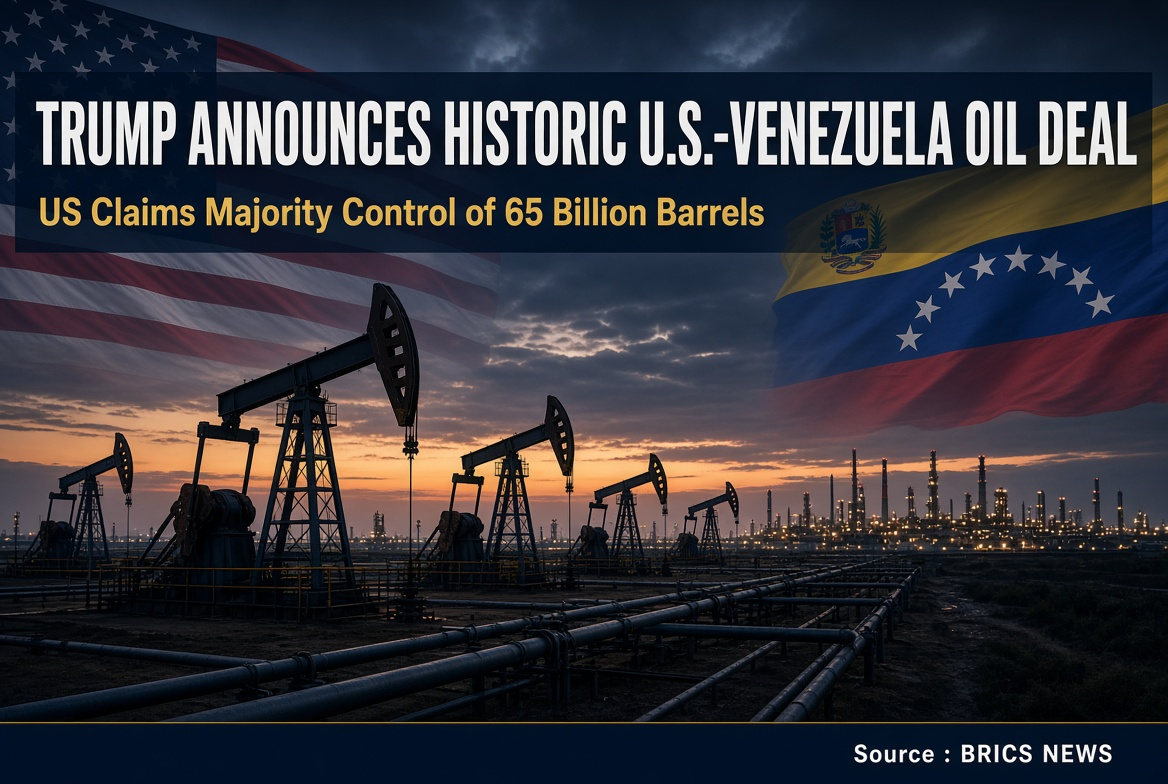
WASHINGTON D.C Aug 29, 2026 – President Donald Trump announced Friday that the United States has reached an agreement with Venezuela granting majority American control over more than 65 billion barrels of the South American nation’s proven oil reserves.
In a Truth Social post, Trump called it “THE BIGGEST OIL DEAL IN WORLD HISTORY.” He said Secretary of State Marco Rubio and Defense Secretary Pete Hegseth negotiated the arrangement with Venezuela’s interim President Delcy Rodríguez and private-sector partners “at no cost to the American Taxpayer.”
Trump stated the deal would more than double U.S. oil reserves, increase domestic supply, and substantially lower gasoline prices over the long term while supporting Venezuela’s economic recovery. A White House official told CNN the structure involves a new private joint venture in which the United States would hold 55% effective output. Rodríguez granted 100-year concessions on the fields, according to the official. The U.S. government would receive more than half the value through a combination of equity ownership and guaranteed at-cost offtake, with supplies intended for the Strategic Petroleum Reserve and U.S. military needs.
The announcement comes nearly eight months after U.S. forces captured former President Nicolás Maduro in January 2026 and brought him to the United States to face charges. Rodríguez, previously vice president, has served as interim president since then. Washington has spent the intervening months easing sanctions, encouraging U.S. company re-entry, and seeking stable Venezuelan crude for American refineries.
Venezuela holds the world’s largest proven crude reserves, estimated at about 303 billion barrels. Years of underinvestment, mismanagement, and sanctions have left production at roughly 1.25 million barrels per day—far below historical peaks—and much of the infrastructure in poor condition. A significant portion of the targeted reserves lies in the extra-heavy Orinoco Belt crude, which is expensive to extract, upgrade, and refine.
Secretary Rubio described the agreement as a “huge win” for both countries, saying it would bring nearly $100 billion in private investment, create thousands of jobs, and aid Venezuela’s reconstruction. Details of the participating companies, exact field list, and legal structure have not been publicly released. Earlier reporting indicated talks involved a group of fields containing tens of billions of barrels, potentially using a lease or concession model that could face constitutional questions inside Venezuela.
U.S. proved crude oil reserves stood near 46 billion barrels in the most recent comprehensive data. The Strategic Petroleum Reserve has fallen to about 290 million barrels, a four-decade low, after drawdowns tied to supply disruptions from the war with Iran. National average gasoline prices have remained elevated heading into midterm elections.
Analysts note that turning paper reserves into flowing barrels will require years and tens of billions of dollars in new investment. Venezuelan opposition figures have criticized the talks as overly favorable to Washington and insufficiently focused on a full political transition. Full contract terms and timelines for increased production have not yet been disclosed.
About The Author