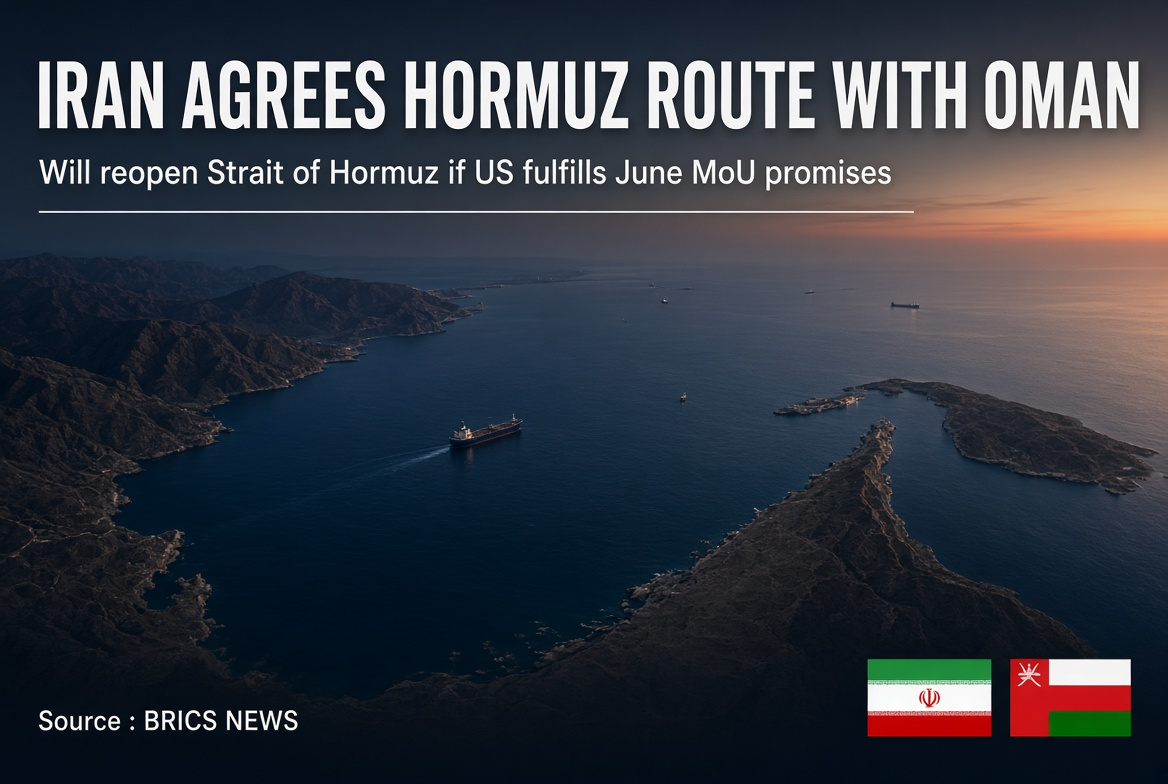
TEHRAN Aug 28, 2026 – Iranian President Masoud Pezeshkian announced Friday that Tehran has agreed with Oman on a shipping route through the Strait of Hormuz and is prepared to reopen the vital waterway — but only if Washington fulfills commitments made in a June memorandum of understanding.
“We agreed with Oman on the passage route through Hormuz, and if the US fulfills its commitments under the memorandum of understanding, we will open the strait,” Pezeshkian said, according to Iran’s official IRNA news agency. He added that the route had been communicated to Iran’s supreme leader and that the Supreme National Security Council approved the arrangement with a 12-to-1 vote.
The president listed Iran’s conditions: lifting sanctions and the naval blockade, releasing frozen assets, starting investment, and ending the conflict in Lebanon. He said the United States had initially begun easing some restrictions after the June deal, but “because they did not comply, the memorandum of understanding collapsed.”
The announcement follows weeks of talks between Iranian and Omani officials. The two countries have discussed a temporary joint navigational corridor, reported at about 7 miles (11 km) wide, with inbound traffic using a route that begins in Iranian territorial waters and part of the outbound route also passing through Iranian waters. They have also discussed a joint mine-clearing project. Iranian officials have additionally claimed agreement on sharing waters and revenues from the strait; Oman has not publicly confirmed the revenue details.
The Islamabad MoU, signed in June 2026 and mediated by Pakistan, had called for an immediate ceasefire, a 60-day window to negotiate a final deal, a phased end to the U.S. naval blockade, and Iranian efforts to restore safe commercial passage through the strait free of charge for 60 days while talking with Oman on future administration. That framework later unraveled amid renewed strikes and accusations of non-compliance on both sides.
The Strait of Hormuz, which sits between Iran and Oman at the mouth of the Persian Gulf, normally carries roughly one-fifth of the world’s seaborne oil. Traffic has fallen sharply from pre-conflict levels of around 130 ships a day to well under 20 on many days, with mines, blockades, and competing routes creating what shipping analysts have described as chaotic conditions.
Iranian officials have stressed that the Oman agreement covers only a temporary route and does not by itself mean the strait is open. They say vessels would still require Iranian permission and that full reopening remains tied to U.S. action on sanctions, assets, and the blockade. Washington has not publicly accepted those conditions as a package.
About The Author