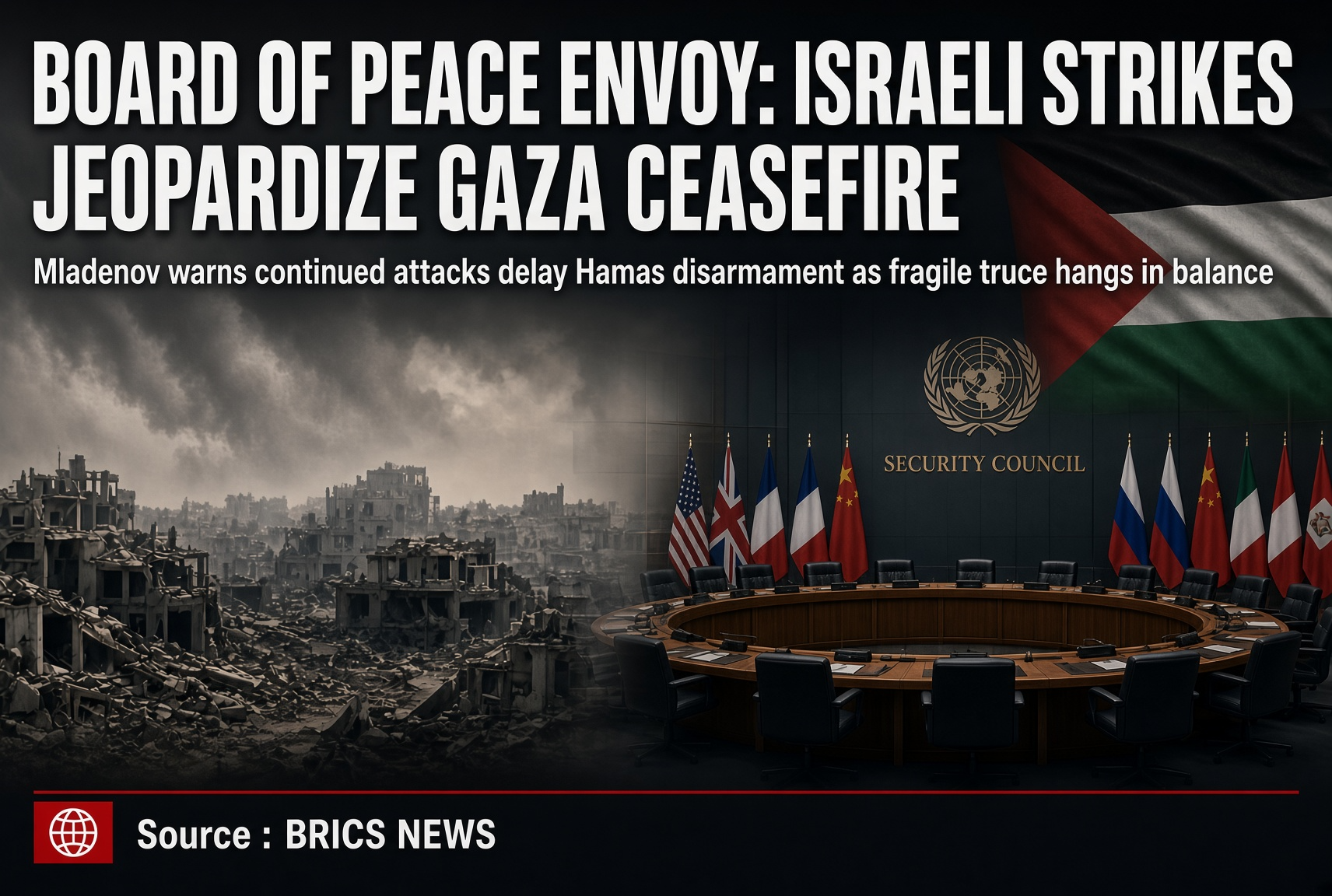
NEW YORK August 26, 2026 – Nickolay Mladenov, high representative for Gaza on President Donald Trump’s Board of Peace, told the UN Security Council on Wednesday that continued Israeli strikes in Gaza are undermining the October 2025 ceasefire and delaying the demilitarization of Hamas.
“Will another strike on a munitions depot stop Hamas from rearming or tightening its grip on Gaza? It will not,” Mladenov said. “It only delays the demilitarization that would happen, and it obstructs the civilian transition that should take place.”
He argued that such operations do not alter the status quo that existed before the October 7, 2023 Hamas attacks and instead perpetuate Hamas’s hold over parts of the territory. “These strikes do not change the status quo that produced 7 October 2023,” he said in related remarks.
Mladenov, a former Bulgarian foreign minister and UN Middle East envoy, leads day-to-day implementation of the U.S.-backed plan endorsed by UN Security Council Resolution 2803 in November 2025. The Board of Peace, chaired by Trump, is a transitional body tasked with overseeing reconstruction, an International Stabilization Force, and a Palestinian technocratic administration—the National Committee for the Administration of Gaza (NCAG)—until the Palestinian Authority can assume control after reforms.
On July 30, Hamas and other Palestinian factions accepted a 15-point Board of Peace roadmap calling for full disarmament of all weapons categories, handover of civilian and security authority to the NCAG, and performance-based sequencing rather than fixed calendars. Mladenov called the agreement a “historic breakthrough” but stressed that “an agreed document on disarmament does not immediately mean a disarmed Gaza.” Implementation, he said, must follow the principle of “trust nothing and verify everything.”
He also criticized Hamas. The group “has committed to cease all military activities. That commitment is still to be met in full,” Mladenov said. “Every weapon carried, every tunnel still worked on, and every convoy still obstructed sets the process back and hands an argument to those who want to resume war.” Palestinian civilians, he added, would bear the consequences.
Mladenov warned that Gaza “does not have another catastrophe left in it.” A full collapse of the ceasefire “would not be a setback” but “a point of no return for everyone,” leaving no roadmap to return to and nothing left to rebuild. Humanitarian conditions have improved since famine was declared a year earlier, but the gains are “very easily reversible” amid funding shortfalls and restrictions on shelter materials, which he called “not acceptable.”
Israeli Prime Minister Benjamin Netanyahu has publicly rejected key elements of the latest roadmap, insisting Israeli forces will not withdraw from current positions until Hamas is fully disarmed. Israel’s deputy UN ambassador, Noa Furman, told the Council that Israel remains committed to Trump’s plan but that it cannot succeed while Hamas remains armed. Israel says its strikes target Hamas operatives and respond to immediate threats.
Mladenov said he recently met Netanyahu and Trump adviser Jared Kushner and that they had narrowed remaining technical disagreements. He asked the Security Council to reaffirm that complete decommissioning of weapons is the only path to Israeli withdrawal, reconstruction, and a credible political horizon for Palestinians. The alternative, he said, is either Israeli reoccupation or a return to managing an armed Hamas—both of which he described as postponement that ends in the same place: another war.
“Ceasefires that deliver nothing visible are not sustained by patience; they are only exhausted by it,” Mladenov concluded.
About The Author