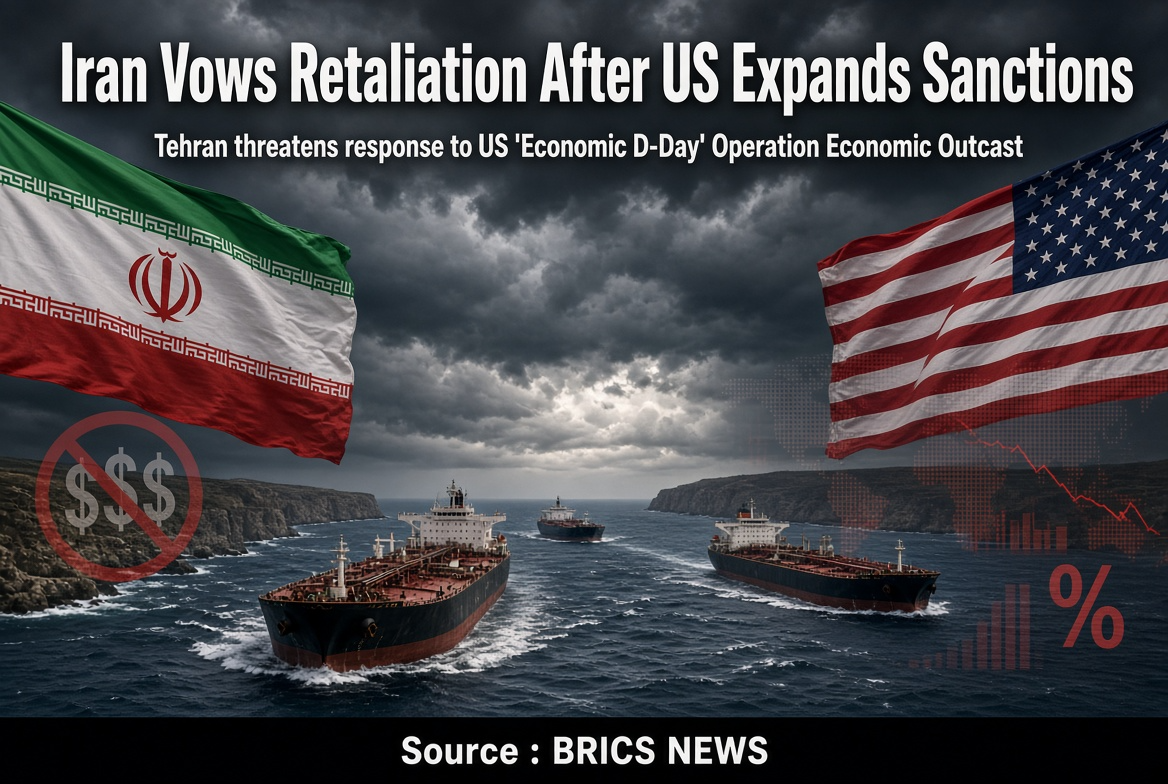
TEHRAN August 25, 2026 – Iran has pledged to retaliate against a major expansion of U.S. sanctions announced Monday, with Iranian officials warning of potential strikes on energy chokepoints and expressing confidence that key trading partners will resist American pressure.
U.S. Treasury Secretary Scott Bessent unveiled “Operation Economic Outcast” on August 24, describing it as an “economic D-Day” and the start of an unprecedented campaign to sever Iran’s remaining financial lifelines. The measures expand secondary sanctions risks for entities dealing with Iran in five key sectors: digital assets, technology, gold, aviation, and shipping. The Treasury’s Office of Foreign Assets Control also sanctioned nearly 60 individuals, entities, and vessels linked to oil revenue generation, nuclear and missile procurement, and cyber operations.
“Our objective is to sever every economic lifeline that sustains this tyrannical regime until Tehran stands alone,” Bessent said. He framed the campaign as forcing Iran to choose between complete global isolation or a path toward reintegration with the world economy, while warning that no country or entity stands above the reach of U.S. sanctions. President Trump has reportedly contacted world leaders urging them to cut specific business ties with Iran.
Iranian Economy Minister Ali Madanizadeh responded defiantly on state television, stating that Iran is “fully prepared for the U.S. sanctions.”
“Naturally, the enemies intend to launch an economic terrorist attack on us, but we also have our own tools and know how to play the game. Our defense is no longer so defensive; the enemies should wait for an attack,” he said. Madanizadeh added that neither China nor Russia had accepted the U.S. measures and predicted other countries would similarly resist.
Brigadier General Hossein Mohebbi, a spokesperson for Iran’s Islamic Revolutionary Guard Corps (IRGC), warned of “heavy blows to U.S. vital interests and energy chokepoints” if Iran’s infrastructure is threatened.
The announcement comes nearly six months after the start of a U.S.-Israeli military campaign against Iran that has significantly degraded Tehran’s conventional forces, killed former Supreme Leader Ayatollah Ali Khamenei, and disrupted oil flows through the Strait of Hormuz. Shipping traffic in the strait has fallen sharply, contributing to elevated global energy prices. An earlier interim deal brokered in Islamabad collapsed, leaving the conflict in a “no war, no deal” stalemate.
China, Iran’s largest oil buyer in recent years, has criticized the sanctions approach, stating that pressure tactics do not resolve the issue and affirming it will protect its interests. Analysts note Washington has so far avoided directly targeting major Chinese financial institutions, citing risks to the global financial system.
The new U.S. measures build on existing sanctions and a naval blockade of Iranian ports. Bessent emphasized a “zero-leakage” strategy to block revenue funding the IRGC and the Iranian regime, while giving third countries time to wind down Iran-related activities before potential unilateral enforcement.
As of Tuesday, oil prices had steadied after earlier declines, and Pakistani mediators reported ongoing talks with Tehran aimed at de-escalation and reopening the Strait of Hormuz. Both sides continue to signal that further military or economic moves remain possible.
About The Author