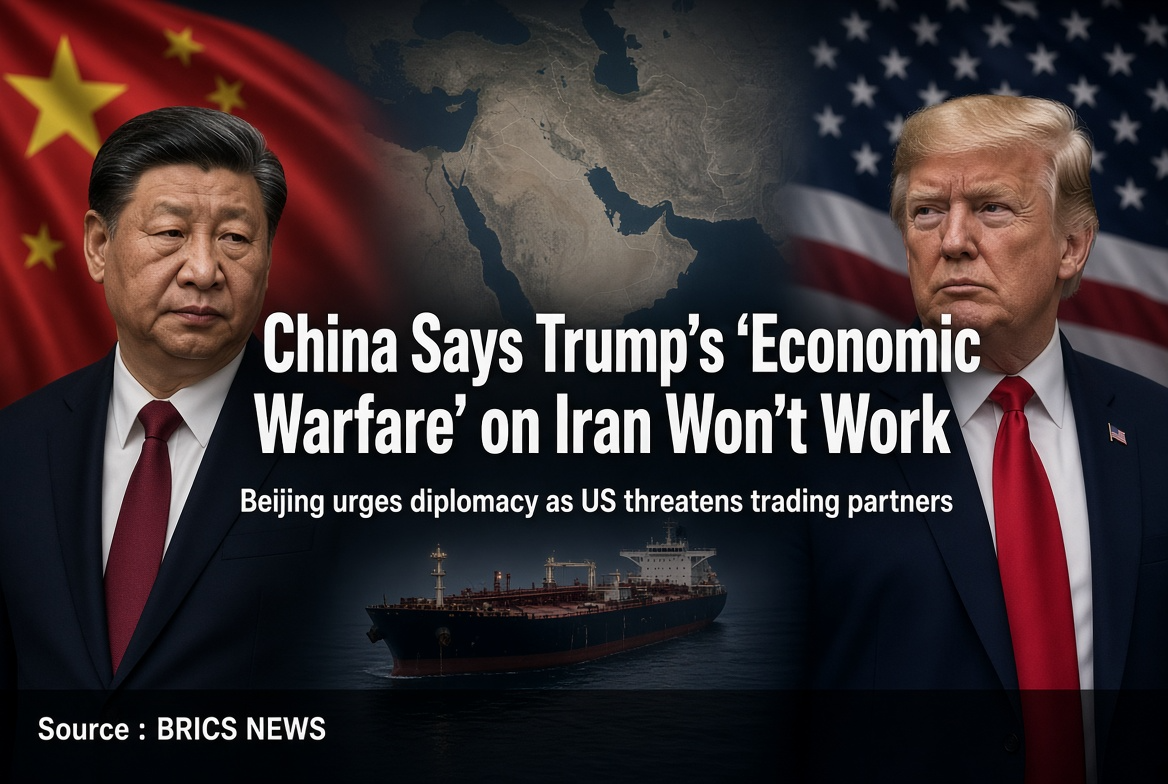
BEIJING August 20, 2026 – China on Thursday rejected U.S. President Donald Trump’s threat to wage “economic warfare” on Iran and any countries providing it a lifeline, saying sanctions and pressure would not resolve the ongoing crisis.
Chinese Foreign Ministry spokesman Lin Jian told a regular briefing in Beijing: “Sanctions and pressure will not help resolve the issue. China calls on relevant parties to take responsible measures and seek to solve the issue through diplomatic and political means.”
The comments came in direct response to Trump’s Truth Social post on Wednesday, in which he declared “the MOST CRUSHING ECONOMIC OPERATION EVER TAKEN AGAINST ANY COUNTRY!” and announced “Economic Warfare and Isolation on an unprecedented scale.” Trump warned that “ANY country that allows its financial institutions, businesses, airports, or government entities to provide any type of lifeline to Iran will itself face TREMENDOUS Economic Consequences,” labeling the move an “ECONOMIC D-DAY.” He specifically called for an immediate end to oil smuggling, swap lines, cash transfers, exchange houses, ship registries, and front companies.
Trump did not name specific countries. However, China—which purchases more than 90 percent of Iran’s oil exports—is widely seen as the primary target of any secondary measures. China was Iran’s second-largest overall trading partner in 2025, behind the United Arab Emirates, which this week severed all economic ties with Tehran after accusing it of firing ballistic missiles at UAE territory.
The Chinese response underscores Beijing’s longstanding position that it does not recognize unilateral U.S. sanctions. While Chinese state-owned entities and major banks have historically avoided direct exposure to blacklisted Iranian oil to protect access to the U.S. dollar system, independent “teapot” refineries have continued importing discounted Iranian crude. The latest exchange risks adding fresh strain to U.S.-China relations ahead of a planned meeting between Trump and Chinese President Xi Jinping next month.
Iran’s Foreign Minister Abbas Araghchi separately dismissed Trump’s plan as a diversion from America’s domestic economic problems, calling it “economic terrorism” that threatens the global economy and national sovereignty.
The announcement comes nearly six months into a conflict involving U.S. and Israeli military actions against Iran, with the Strait of Hormuz remaining partially restricted and diplomatic efforts stalled. U.S. Treasury Secretary Scott Bessent reinforced the message on Thursday, stating the campaign aims to “collapse this regime” and warning both allies and rivals—including China—to “get with the program.”
The development was widely circulated on social media, including by the account @BRICSinfo, which highlighted China’s statement that the threatened economic measures “won’t work.”
About The Author