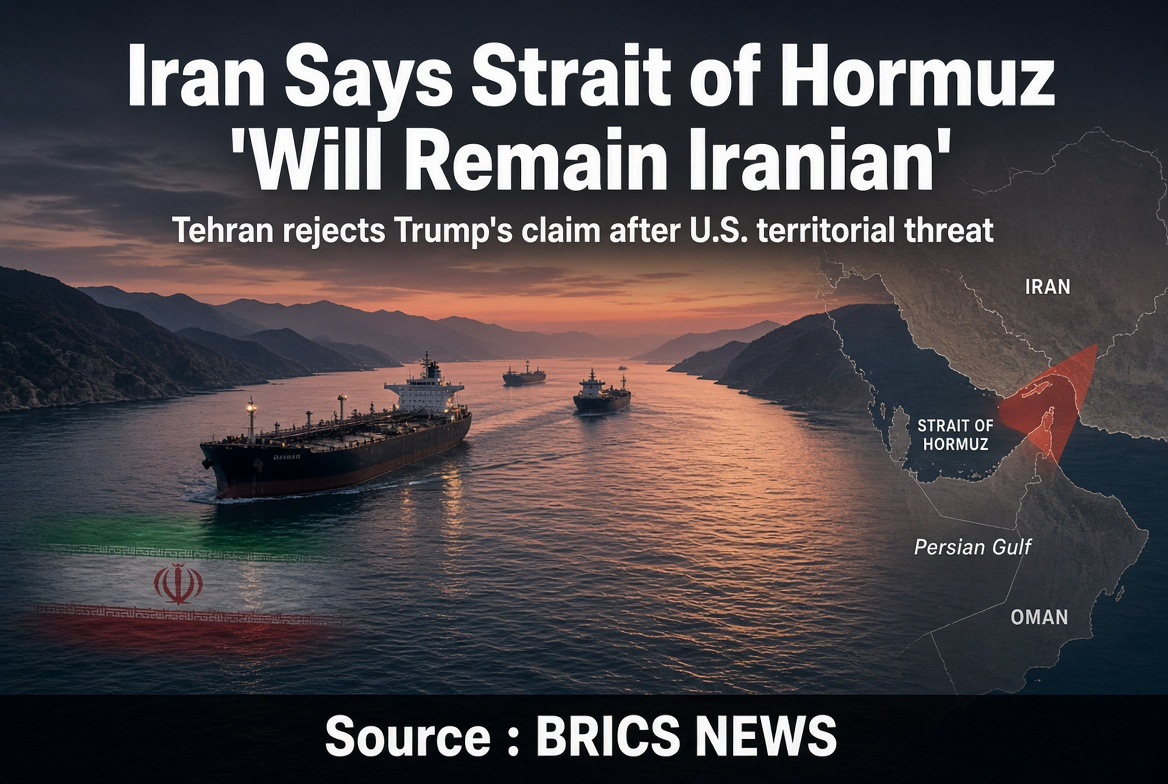
TEHRAN Aug 14, 2026 — Iranian Deputy Foreign Minister for Legal and International Affairs Kazem Gharibabadi on Friday firmly rejected U.S. President Donald Trump’s recent remarks suggesting the Strait of Hormuz could be declared American territory, declaring that the vital waterway “has been Iranian, is Iranian, and will remain Iranian.”
In a strongly worded statement posted on X, Gharibabadi responded directly to Trump’s comments that, following what the U.S. president described as Iran’s defeat, he would claim the strait as U.S. territory.
“The Strait of Hormuz cannot be seized by tweet, nor by aircraft carrier, nor by issuing an order, nor by an election speech,” Gharibabadi wrote. “Iran neither fears threats nor cowers before displays of power.”
He added: “Once and for all, accept the reality: up to this point, you have suffered strategic and heavy defeats; the Strait of Hormuz has been Iranian, is Iranian, and will remain Iranian; this strait will only be closed and opened under Iran’s command.”
The remarks come amid continued Iranian restrictions on shipping through the Strait of Hormuz, a critical chokepoint through which roughly one-fifth of the world’s oil supplies pass. Iran has maintained control measures and a partial blockade of the waterway since the early months of 2026 following military exchanges with the United States and Israel.
Iranian officials have repeatedly stated that the strait will not return to its pre-conflict status and that transit will remain subject to Tehran’s conditions, including an end to what they describe as U.S. military pressure, the release of frozen Iranian assets, and broader regional ceasefires.
Gharibabadi’s statement underscores Tehran’s position that sovereignty over the strait is non-negotiable and that any reopening will occur only under Iranian terms. Iranian Foreign Minister Abbas Araghchi has separately indicated that no decision has yet been made on restarting direct negotiations with Washington.
The exchange highlights persistent tensions over one of the world’s most strategically sensitive maritime routes more than five months after the peak of hostilities between Iran and the U.S.-Israeli alliance.
About The Author