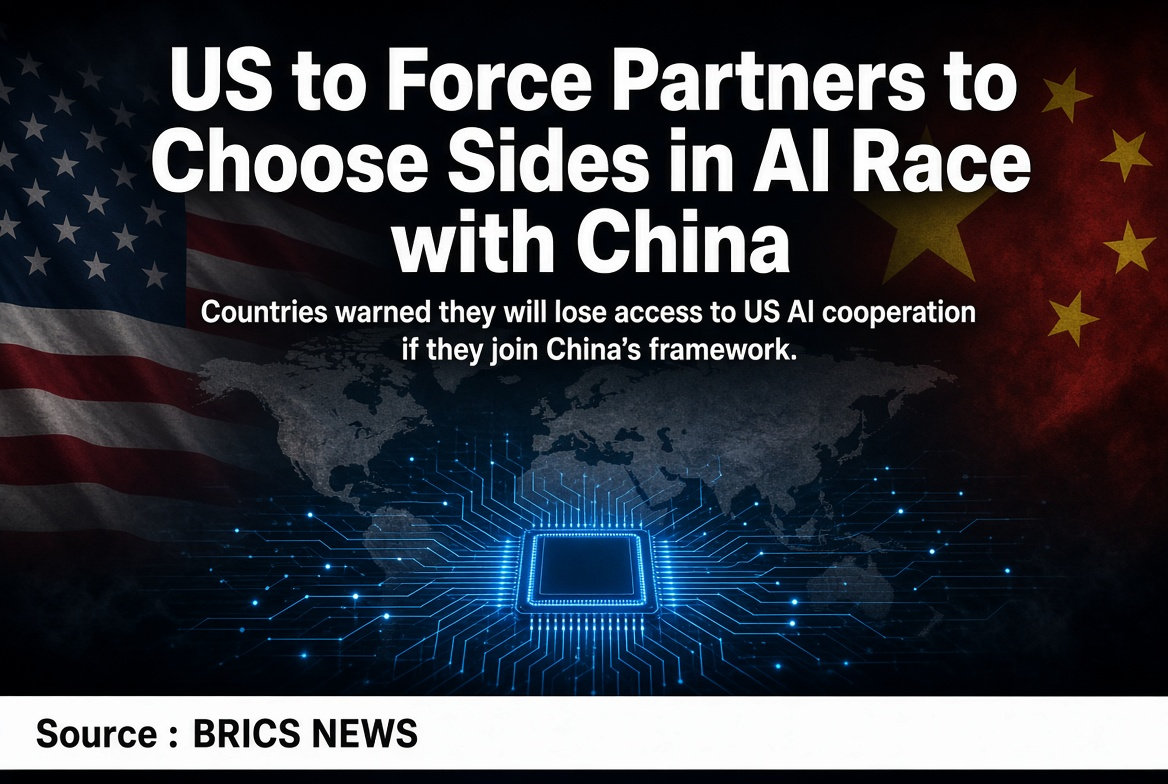
WASHINGTON D.C Aug 14, 2026 — The United States is preparing to demand that dozens of partner nations pick sides in the intensifying artificial intelligence competition with China, warning that dual participation in competing frameworks will result in exclusion from a U.S.-led AI coalition.
According to a U.S. official and an internal draft letter reviewed by Reuters, the State Department plans to send formal notices to the 35 countries that signed the AI Opportunity Statement in June 2026. The letter states that membership in the U.S. Pax Silica initiative “is not merely a membership subscription, but a commitment” and “cannot be held alongside membership in duplicative initiatives whose expectations conflict with our own.”
“To be part of everything is to be part of nothing,” the draft letter reads, urging recipients to “choose deliberately” on artificial intelligence.
The move comes amid China’s launch in July 2026 of the World Artificial Intelligence Cooperation Organization (WAICO), a Shanghai-based intergovernmental body signed by 29 countries and promoted by President Xi Jinping as a platform for open-weight AI technology and Global South cooperation.
Kazakhstan is the only country known so far to have joined both the U.S. and Chinese initiatives, raising particular concern in Washington because of its significant reserves of critical minerals essential for AI hardware and semiconductors.
Pax Silica, launched by the State Department in late 2025, aims to build secure supply chains for AI models, advanced chips, and critical minerals among trusted partners. Signatories include close U.S. allies such as Japan, Australia, South Korea, and the United Kingdom, along with India, the UAE, and others.
A U.S. official told Reuters: “You can’t have it both ways. It’s difficult to see how a country can credibly position themselves as trusted partners in one technology ecosystem while simultaneously signing up for an initiative designed by China to advance a competing vision for AI.”
The policy reflects growing U.S. efforts to limit China’s access to global resources and talent as Chinese open-weight AI models continue closing the performance gap with leading American systems from companies such as OpenAI and Anthropic. Washington hopes the exclusivity requirement will help secure technological leadership with potential military and economic implications.
The State Department declined to comment on the draft letter, describing it as a “purportedly leaked internal document.” Chinese and Kazakh officials have not yet issued formal responses.
About The Author