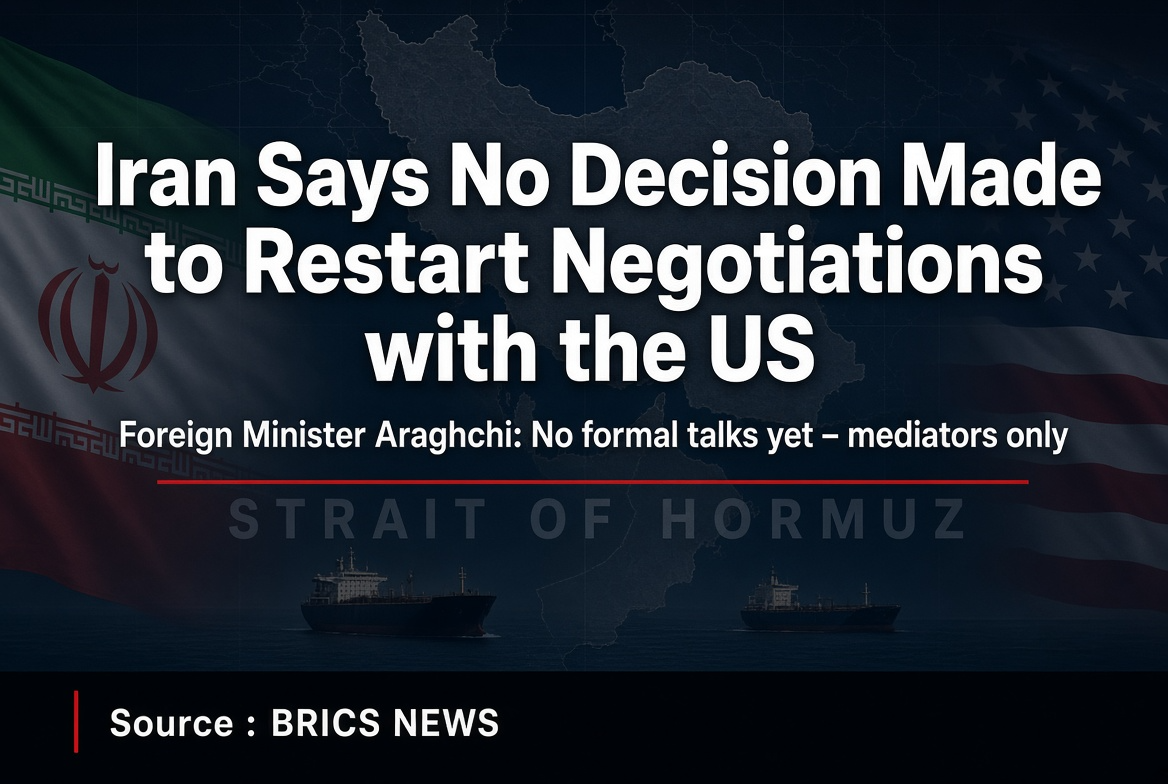
TEHRAN Aug 14 2026 – Iranian Foreign Minister Abbas Araghchi stated on Friday that Tehran has not yet decided whether to resume negotiations with the United States, emphasizing that ongoing contacts through mediators do not amount to formal talks.
“Both Qatar and Pakistan continue to exchange messages and remain in contact with us, but that does not mean negotiations,” Araghchi told Iran’s ISNA news agency. “No decision has yet been made to resume talks with the United States.”
He added that previous communication channels are no longer effective and that efforts are underway to establish a temporary new channel that could later become permanent. Separate technical discussions with Oman on establishing new shipping lanes through the Strait of Hormuz are continuing and could conclude soon, but these are unrelated to any U.S. contacts, Araghchi said.
The comments come amid a nearly six-month conflict that began with U.S. and Israeli strikes on Iran in late February 2026. An interim memorandum of understanding signed in June, which called for an immediate end to military operations, quickly unraveled. U.S. President Donald Trump declared the deal “over” in early July, while Iran accused Washington of violating its terms within days and suspended its own commitments.
Iran has repeatedly insisted it will not return to direct talks until the United States fully implements the interim agreement’s provisions, including lifting a naval blockade, addressing sanctions, and other conditions related to the Strait of Hormuz and regional hostilities. Messages continue to be exchanged via intermediaries, but Iranian officials stress these do not constitute negotiations.
On the same day as Araghchi’s remarks, Trump escalated rhetoric over the strategic waterway. Speaking in Garden City, New York, the president said that “after we finish defeating Iran, which is being very badly defeated, pretty soon I’ll be declaring the Hormuz Strait a territory of the United States.” He noted the U.S. blockade means “no ships get through unless we want them to.”
The Strait of Hormuz, a critical chokepoint through which roughly 20% of global oil typically passes, has been effectively closed or heavily restricted by Iran since the early stages of the war. Both sides claim degrees of control, and the standoff has contributed to elevated oil prices and ongoing disruption to international shipping. Iranian officials have rejected Trump’s territorial claim, asserting that the strait will open or close only under Tehran’s authority.
Diplomacy remains stalled as the original 60-day window under the June interim deal has passed without a permanent resolution. Iranian sources have dismissed reports of any extension, arguing that from Tehran’s perspective the agreement never properly took effect due to U.S. violations. Mediators, including Qatar and Pakistan, continue efforts behind the scenes, but formal talks have not restarted.
The latest statements underscore the deep mistrust between the two sides nearly six months into the conflict, with no clear path yet to a lasting ceasefire or comprehensive agreement.
About The Author