TEHRAN, July 15, 2026 — Iran has warned it will close or disrupt other regional oil and gas export routes that serve the interests of the United States and its allies, according to Iranian state media reports circulating on Wednesday.
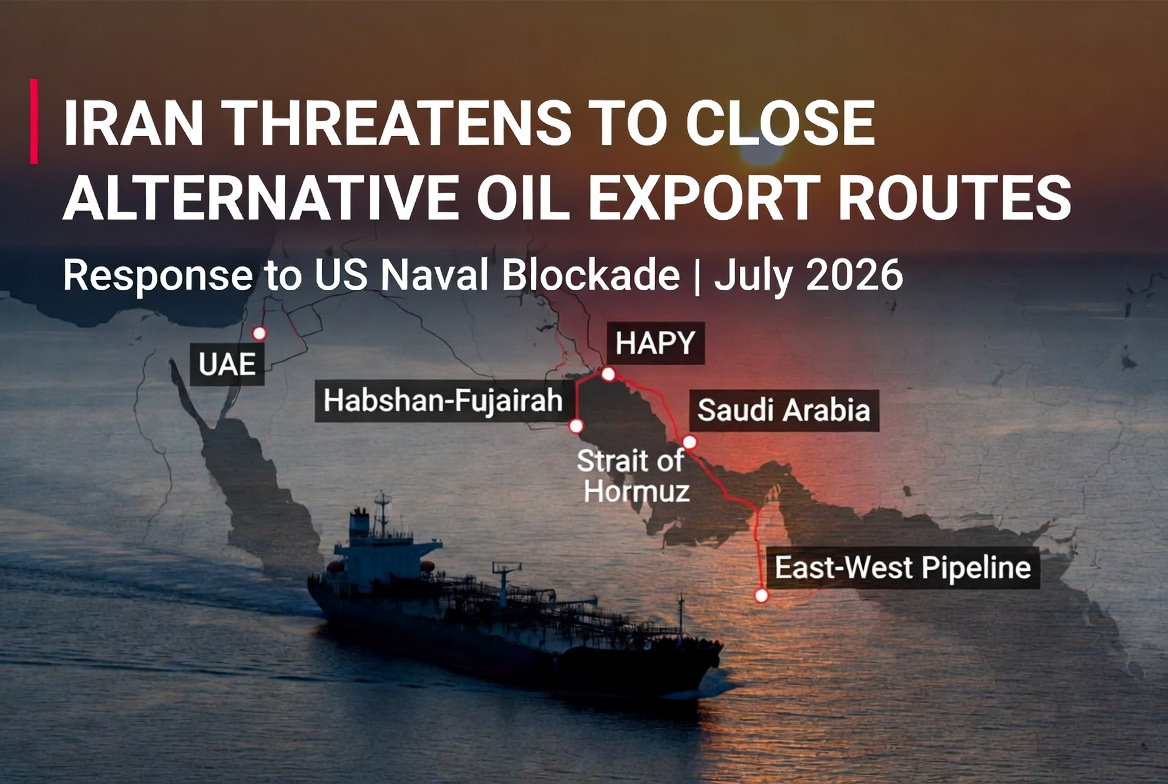
The threat, attributed to Iranian officials and reported via Tasnim News Agency, comes in direct response to the US naval blockade on Iranian energy exports. It specifically references infrastructure such as the UAE’s Fujairah pipeline (Habshan-Fujairah crude oil pipeline) and Saudi Arabia’s East-West pipeline (Abqaiq-Yanbu).
Iranian messaging stressed the principle of equal access to energy exports, with a reported statement declaring that “oil and gas exports from the region: either for everyone or for no one.”
These pipelines are critical bypass options that allow Gulf producers to export oil without routing through the narrow Strait of Hormuz, a chokepoint for roughly 20% of global seaborne oil trade.
The US imposed a naval blockade on Iranian ports in April 2026 amid the broader 2026 Iran conflict. The measure has severely impacted Iranian crude exports, with multiple independent analyses reporting drops of 80% or more in certain months compared to pre-blockade levels. Iran has faced billions in lost revenue, leading to attempts to use smaller vessels, alternative terminals (such as Jask), and other workarounds.
A brief easing occurred in June following a memorandum, but tensions appear to have resurfaced, with the blockade or related restrictions remaining a major point of friction.
Any move against the Fujairah or East-West pipelines would represent a significant escalation, potentially affecting exports from key US allies Saudi Arabia and the UAE. These routes have historically provided redundancy against disruptions in the Strait of Hormuz.
Global oil markets are already sensitive to developments in the region. Further disruptions could lead to renewed price volatility, though the full impact would depend on whether threats translate into concrete actions.
Iran has previously signaled willingness to use asymmetric measures, including support for allied actions in chokepoints like the Bab el-Mandeb Strait. US officials have maintained that the blockade aims to pressure Tehran amid stalled diplomatic efforts.
No immediate official responses from Washington, Riyadh, or Abu Dhabi were available at the time of reporting, but energy analysts and governments are closely monitoring the situation for any signs of implementation.
This latest warning underscores the high-stakes energy dimension of the ongoing US-Iran standoff and the vulnerability of global oil supply chains to Gulf instability.
About The Author