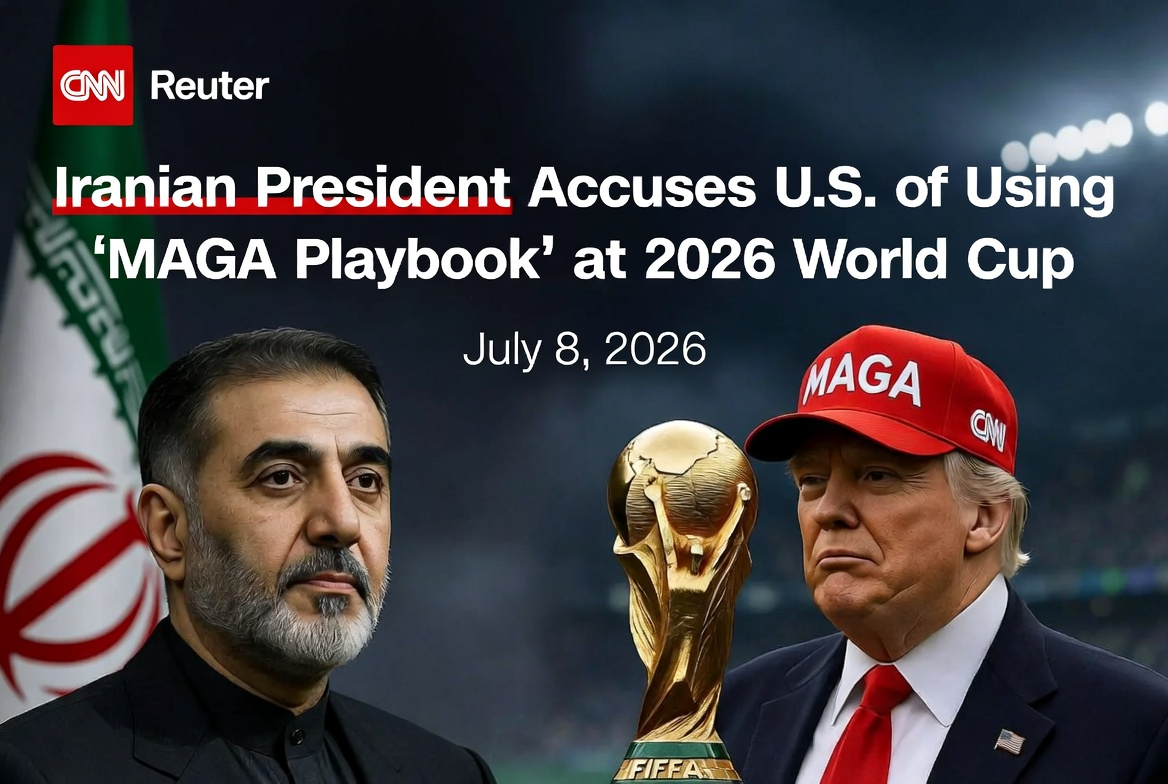
TEHRAN, July 8, 2026 — Iranian President Masoud Pezeshkian has sharply criticized the United States for its conduct as co-host of the ongoing FIFA World Cup 2026, accusing Washington of mirroring its foreign policy by “bending rules, bullying rivals, creating obstacles, and cheating.”
In a statement released today, Pezeshkian said: “The U.S. government’s conduct as World Cup host follows its familiar foreign policy: bending rules, bullying rivals, creating obstacles, and cheating. This is their MAGA playbook. Iran rejects such games. We stand firmly for our rights.”
The remarks come shortly after Iran’s national team was eliminated from the tournament, amid a series of complaints from Iranian officials, players, and the football federation about alleged unfair treatment by the host nation.
Iranian authorities have repeatedly raised concerns throughout the tournament, including:
- Visa denials or delays for team staff and officials (some reportedly linked to security concerns over alleged ties to Iran’s Islamic Revolutionary Guard Corps).
- Disruptions to training schedules and travel arrangements.
- Restrictions affecting Iranian fans’ ability to attend matches.
- Perceived controversial referee decisions and unequal treatment.
Iranian players and coaching staff had previously described the atmosphere as tense and politicized, with some calling the handling of their participation a “disaster.”
The criticism reflects long-standing geopolitical tensions between Iran and the United States, which have spilled over into the sporting arena. The 2026 World Cup, co-hosted by the United States, Canada, and Mexico, is the largest edition in history with 48 participating teams.
Iranian officials, including the national team captain and coach, had voiced similar frustrations in recent weeks, accusing the U.S. of failing to separate politics from sport and questioning America’s suitability as a host.
No immediate official response from the U.S. government to President Pezeshkian’s latest statement was available at the time of reporting.
The comments have sparked widespread discussion online, with supporters of Iran viewing them as a justified stand against perceived double standards, while critics have dismissed them as sour grapes following Iran’s group-stage exit.
About The Author