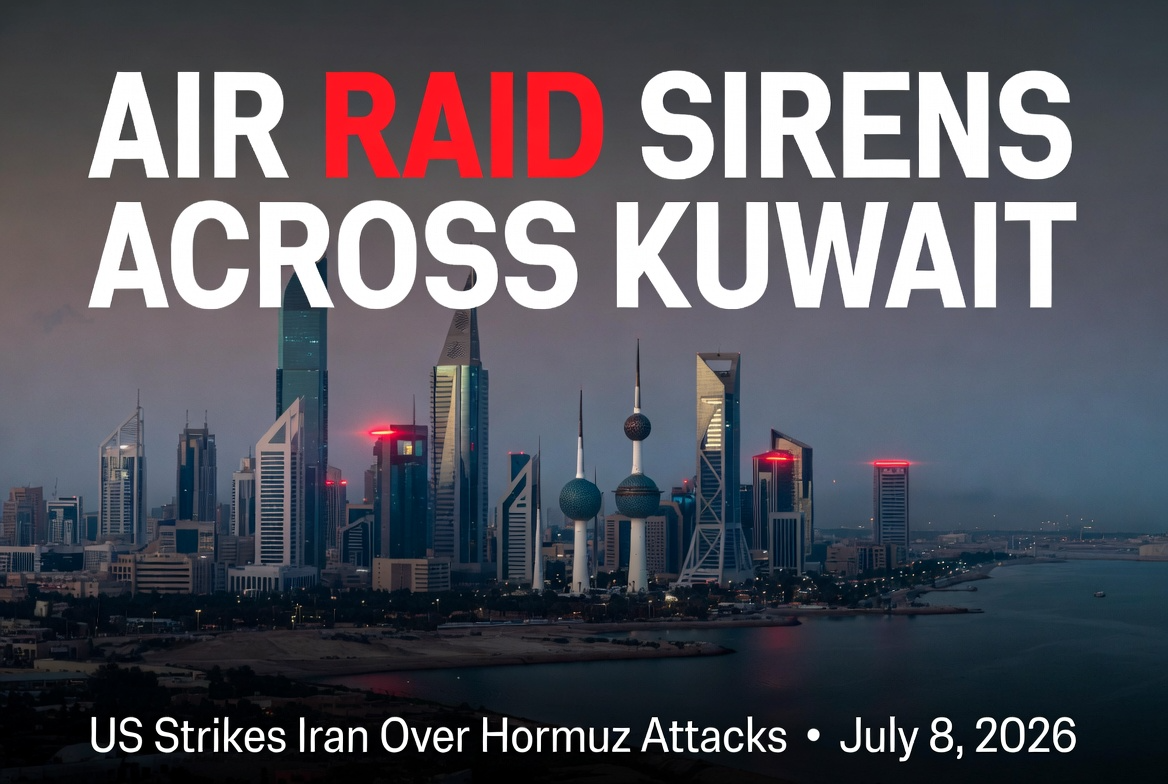
KUWAIT CITY July 8, 2026 — Air raid sirens blared across Kuwait early Wednesday morning as the country’s military intercepted what officials described as hostile missile and drone attacks, marking the latest escalation in the ongoing Iran-US conflict centered on the Strait of Hormuz.
Kuwaiti army statements confirmed that air defense systems engaged incoming aerial threats, with explosions heard resulting from successful interceptions. Similar air raid sirens were also activated in neighboring Bahrain, where authorities urged residents to seek shelter.
The alerts come hours after the United States Central Command (CENTCOM) carried out a series of strikes on Iranian military sites in southern Iran. US forces targeted more than 80 locations, including air defense systems, command and control centers, coastal radar sites, anti-ship missile capabilities, and over 60 Islamic Revolutionary Guard Corps (IRGC) small boats near the Strait of Hormuz. Key areas hit included the port city of Sirik, Qeshm Island, and Bandar Abbas.
According to CENTCOM, the operation was launched in direct response to Iranian attacks on three commercial vessels transiting the Strait of Hormuz on July 7 — including tankers flagged by Qatar, Saudi Arabia, and others. The strikes aim to degrade Iran’s ability to threaten international shipping.
Iranian officials strongly condemned the US action. The Khatam-al-Anbiya Central Headquarters called the strikes a “blatant act of aggression” and vowed a “crushing response.” Iranian state media reported explosions across southern Iran and claimed several civilians were wounded by shrapnel in Sirik, with some hospitalized in nearby Minab. Iran’s Deputy Foreign Minister described the move — including the revocation of an oil export waiver — as a violation of previous agreements.
The incident occurs against the backdrop of a fragile ceasefire framework between the US and Iran. Tensions have repeatedly flared over control of the vital Strait of Hormuz, through which roughly 20% of global oil trade passes. Oil prices rose sharply following the news of the strikes and renewed shipping threats.
Kuwait, which hosts significant US military facilities, has faced multiple waves of aerial threats during the broader 2026 conflict, prompting repeated activation of its air defense systems.
Authorities in Kuwait and Bahrain have not yet reported casualties from the latest alerts, and both countries continue to monitor the situation closely.
Further developments are expected as Iran signals it will respond and regional actors call for de-escalation to prevent wider conflict.
About The Author