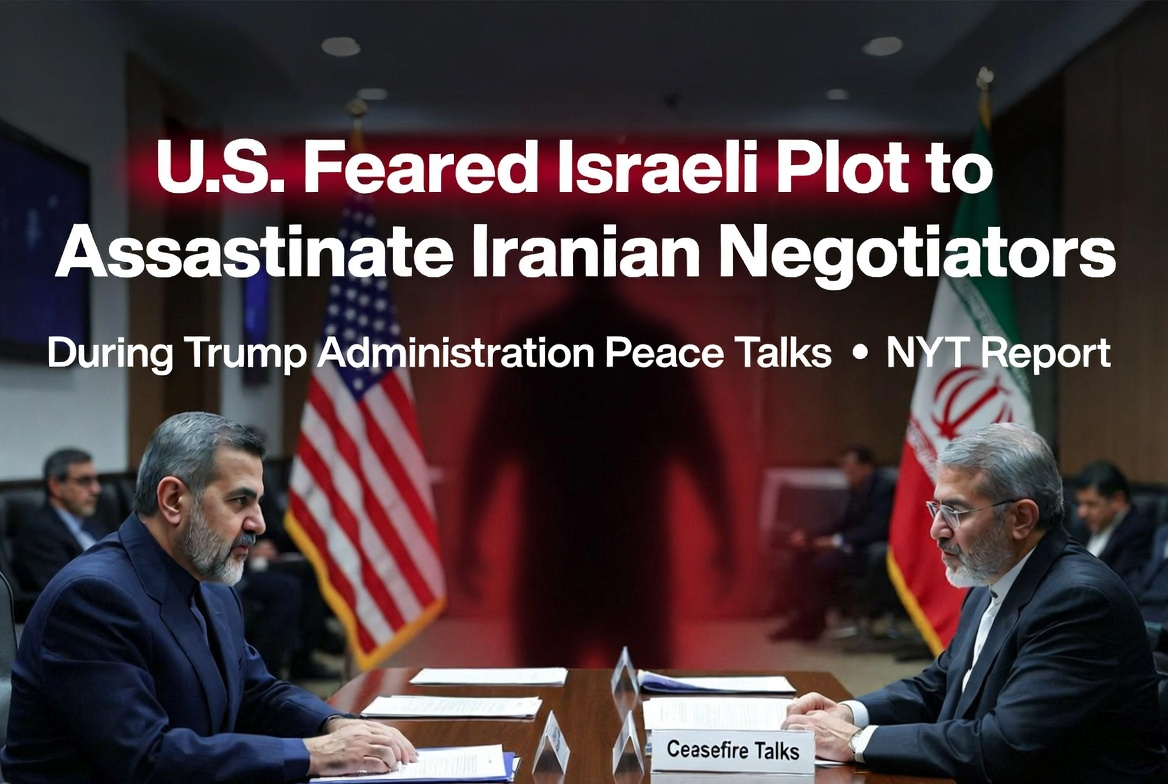
NEW YORK July 2, 2026 — U.S. officials believed Israel was actively plotting to assassinate Iran’s Foreign Minister Abbas Araghchi and Parliament Speaker Mohammad Bagher Ghalibaf while the Trump administration was engaged in delicate ceasefire negotiations with Tehran this spring, according to a detailed report by The New York Times.
The revelation highlights growing tensions between Washington’s push for a diplomatic resolution and Israel’s broader strategy of targeting senior Iranian leadership during the ongoing conflict.
According to current and former U.S. officials cited by the Times, American concerns intensified after cease-fire talks began in earnest in April 2026. While Israel had long included the elimination of senior Iranian officials as part of its war strategy — aimed at weakening or toppling Iran’s hard-line government — U.S. officials feared that killing Araghchi or Ghalibaf at that stage would immediately derail the fragile diplomatic process.
To protect the talks, U.S. officials took the unusual step of asking regional countries to warn Iran about the potential Israeli threat. The warnings were conveyed through intermediaries so that Iranian negotiators could take extra security precautions.
One notable incident occurred in April 2026 ahead of a planned meeting in Islamabad. Ghalibaf’s delegation was traveling when Iranian security forces received intelligence suggesting Israel planned to attack their aircraft. Pakistani fighter jets provided escort on the outbound journey. On the return leg, reports of Israeli fighter jets entering Iranian airspace near Iraq prompted an emergency landing in Mashhad, after which the delegation traveled by land to Tehran.
Iranian negotiators reportedly sought explicit U.S. guarantees — through Pakistani and Qatari channels — that Israel would not target the delegation during the talks.
The negotiations followed an initial two-week ceasefire in April 2026 and aimed at reaching an interim peace framework. This included reopening the Strait of Hormuz and setting the stage for further discussions on Iran’s nuclear program. U.S. Vice President JD Vance met with Iranian officials in Switzerland in June, alongside other Trump administration envoys.
U.S. and Israeli objectives had diverged significantly during the conflict that began in late February 2026. While the United States focused on military targets such as Iran’s navy and missile forces, Israel prioritized leadership decapitation strikes and sought deeper objectives including regime change elements and damage to Iran’s proxy networks and missile capabilities.
A framework agreement was reached in June 2026, though it drew criticism in Israel for falling short of its strategic goals.
Iranian lawmakers have described the negotiators’ willingness to continue talks despite the risks as a “real sacrifice.” Both Araghchi and Ghalibaf have faced previous assassination attempts or close calls during the conflict.
Israeli officials declined to comment on the specific allegations in the Times report.
The story underscores the complex and often tense dynamics between the U.S. and its close ally Israel as both navigate efforts to de-escalate one of the region’s most dangerous confrontations in recent history.
About The Author