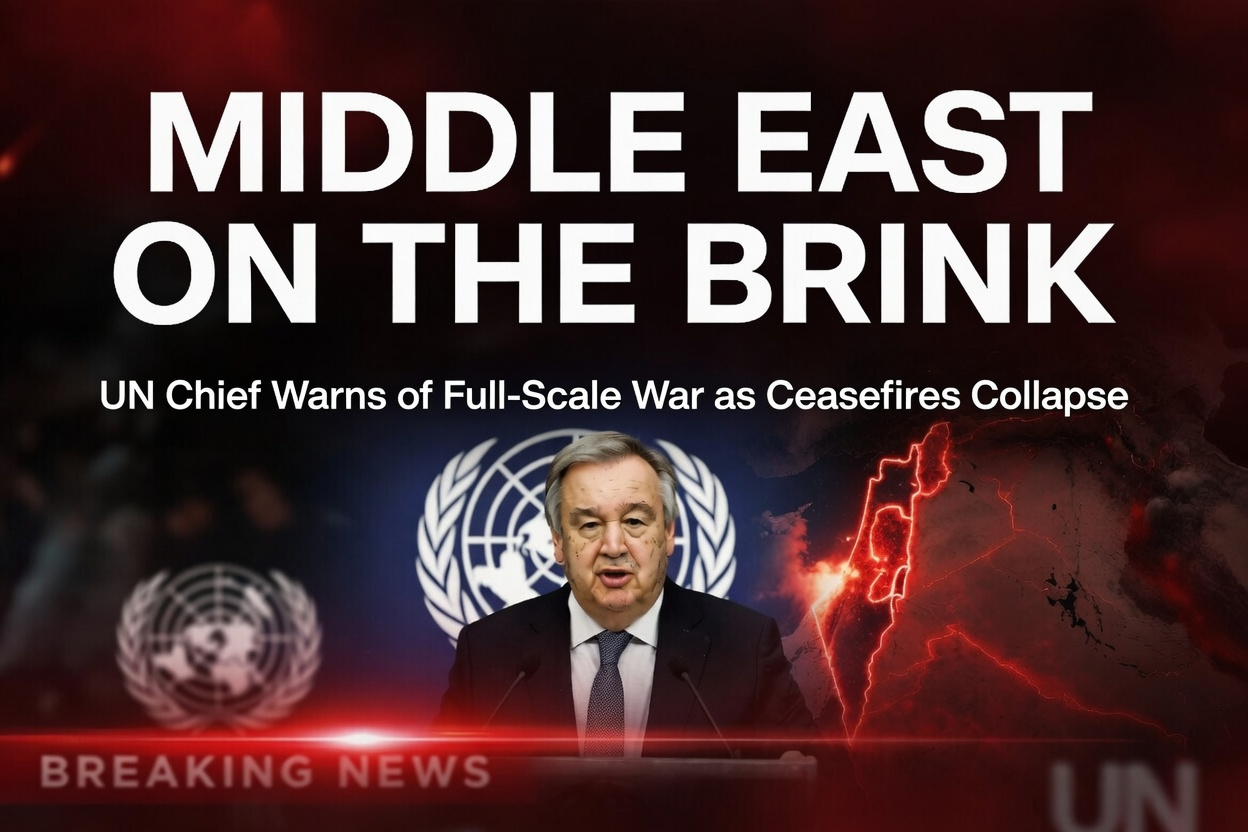
NEW YORK June 10, 2026 — United Nations Secretary-General António Guterres issued a stark warning Wednesday that the Middle East is being “pulled deeper into crisis,” with recent wider attacks and fragile ceasefires threatening to ignite a full resumption of conflict that could have devastating global consequences.
In remarks to the UN Security Council, Guterres highlighted a week of escalating violence and deterioration across multiple fronts, describing ceasefires in places like the Gulf region as “more like a lesser-fire.”
“We should not minimize the risks of lesser fire becoming full fire,” he said. “No more attacks. No more excuses.”
Guterres pointed to serious escalation in Lebanon since March, including intensified Israeli operations, Hezbollah rocket fire, civilian deaths, mass displacement of over a million people, and the killing of seven UN peacekeepers. He called for full respect of Security Council resolution 1701, a comprehensive ceasefire, and continued UN presence in the area.
In Gaza and the occupied West Bank, he described a rapidly deteriorating situation despite an eight-month-old ceasefire. Daily civilian casualties, constrained humanitarian aid, and Israeli declarations of intent to control much of the Strip have raised alarms. Guterres urged implementation of a U.S.-Qatar-Egypt-Türkiye facilitated plan, reopening of border crossings, and progress toward a two-state solution based on pre-1967 lines.
He condemned settler violence in the West Bank, home demolitions, land confiscation, and settlement expansion, warning that such actions risk making a two-state solution impossible.
In the Gulf, Guterres expressed profound concern over attacks and rhetoric in the past 48 hours, stressing threats to sovereignty, civilian infrastructure, and navigational freedoms in the Strait of Hormuz. These disruptions, he said, are driving up energy prices, disrupting supply chains, increasing food costs, and exacerbating hunger and inflation worldwide — with developing countries hit hardest.
He praised mediation efforts by Pakistan, Egypt, Oman, Qatar, Saudi Arabia, and Türkiye, and called for honoring ceasefires, restoring navigation rights, and negotiating a peaceful resolution to Iran’s nuclear program alongside a new Gulf security architecture.
Guterres also addressed spillover risks to Syria and Yemen, while emphasizing that military solutions offer no path forward. “Dialogue is our best and only hope for peace,” he said, urging the Security Council to back the two-state solution as the key to lasting regional stability.
The Secretary-General’s remarks come amid ongoing U.S.-Israel-Iran hostilities and related strikes that have strained ceasefires agreed earlier in 2026. He stressed that escalation reverberates globally through displacement, insecurity, markets, and humanitarian needs.
Guterres concluded by offering the UN’s good offices and tools for peaceful dispute resolution, warning that there is “no alternative” to diplomacy and “no time to waste.”
About The Author