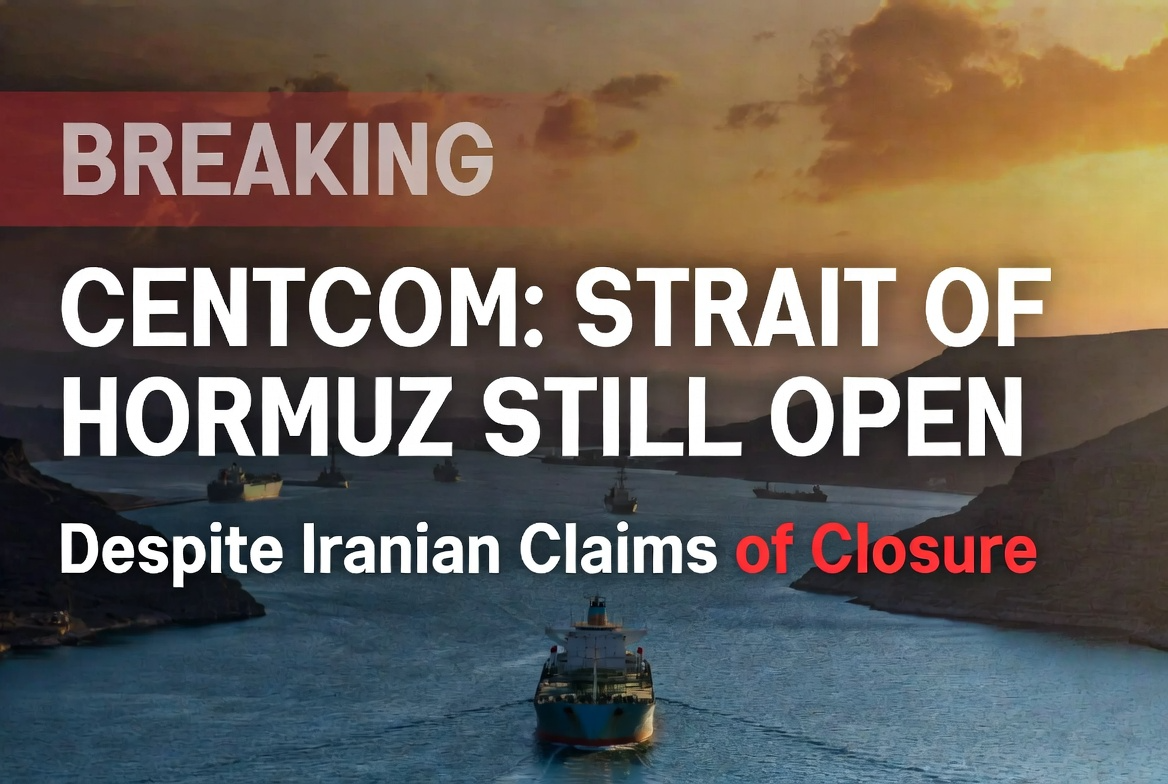
WASHINGTON, D.C. June 10, 2026 — U.S. Central Command (CENTCOM) directly countered assertions by Iran’s Islamic Revolutionary Guard Corps (IRGC) that the Strait of Hormuz has been closed, stating that commercial vessels continue to transit the critical waterway as of Tuesday night.
In a “FACT CHECK” graphic posted on X, CENTCOM declared:
“🚫 CLAIM: Iran’s Islamic Revolutionary Guard Corps claims that the Strait of Hormuz is closed.
✅ TRUTH: Commercial ships are continuing to transit in and out of the Strait of Hormuz tonight.”
The post comes amid heightened tensions in the Persian Gulf, where U.S. forces have enforced a naval blockade on Iranian ports since mid-April 2026 while maintaining that freedom of navigation for non-Iranian traffic remains open. Iran has repeatedly claimed control over the strait and coordinated limited passages, often in response to U.S. actions.
The Strait of Hormuz, through which roughly 20% of global oil and liquefied natural gas typically passes, has seen dramatically reduced traffic since early March 2026. Live maritime tracking data as of June 10 shows the strait effectively in a “closed” status for normal operations, with only about 2 transits in the last 24 hours — roughly 3% of pre-crisis daily averages — and daily throughput at just 1.5% of normal levels.
U.S. officials have described operations such as “Project Freedom” as efforts to guide commercial shipping safely while targeting vessels attempting to violate the Iran-specific blockade. CENTCOM has disabled several ships in recent weeks for ignoring warnings.
Iran, for its part, has asserted that any transits occur only with IRGC coordination and permission, framing the waterway as under its effective control despite the U.S. presence.
The exchange reflects months of tit-for-tat actions:
- U.S. imposition of a blockade on Iranian ports in April.
- Multiple reported incidents involving mines, drones, and vessel interdictions.
- U.S. strikes on Iranian targets in response to perceived threats.
Global energy markets remain sensitive to developments in the region, with oil prices fluctuating on news of disruptions.
CENTCOM’s statement appears aimed at reassuring international shipping interests and countering Iranian narratives that could further deter commercial traffic. However, independent tracking data indicates transits remain severely limited compared to pre-conflict norms, with many vessels loitering or diverting due to security risks.
No immediate response from Iranian officials was available at the time of publication. The situation in the Gulf remains fluid, with both sides continuing military operations in the vicinity of the strait.
About The Author